A complete guide to starting a yoga practice — styles, poses, breathwork, what to expect in class, and how to build a practice that actually sticks.
Yoga is one of the most misrepresented hobbies a beginner can walk into. It is not primarily about flexibility, and it is not reserved for people who already have it. It is a practice of attention — learning to move deliberately, breathe consciously, and develop a relationship with your own body that most people never build. The physical benefits follow from that, not the other way around.
What Yoga Actually Is
Yoga is a practice originating in ancient India that combines physical postures, controlled breathing, and directed attention to cultivate both physical and mental wellbeing. The word itself means union — a joining of body, breath, and mind that distinguishes yoga from ordinary exercise. In contemporary Western practice, the physical component dominates, but understanding the role of breath and attention is what separates people who practice yoga from people who simply do yoga-shaped stretching.
The physical practice — called asana — is one of eight traditional limbs of yoga, and experienced teachers will tell you it is not the most important one. Pranayama, or breath control, is another. So is dharana, the practice of sustained concentration. Most beginners experience these dimensions only incidentally at first, but they become increasingly central as the practice deepens. The person who has been practicing for five years is not just more flexible than the person who started last month. They are paying attention in a fundamentally different way.
What makes yoga genuinely different from other fitness pursuits is that it is non-competitive by design. There is no performance metric, no weight to lift, no distance to cover. The practice is with yourself, not against a standard. That quality makes it accessible at any age or fitness level and sustainable over decades in a way that most physical activities are not.
Styles of Yoga to Explore
The word yoga covers a wide range of practices with very different physical demands and intentions. Choosing the right style at the start matters more than most beginners realise. Here is a practical overview of the styles a new practitioner is most likely to encounter:
Styles of Yoga to Explore
The word yoga covers a wide range of practices with very different physical demands and intentions. Choosing the right style at the start matters more than most beginners realise. Here is a practical overview of the styles a new practitioner is most likely to encounter:
| Style | Pace | Physical Demand | Best For |
|---|---|---|---|
| Hatha | Slow | Low to moderate | Absolute beginners, learning alignment and breath |
| Vinyasa | Moderate to fast | Moderate to high | People who want movement and flow linked to breath |
| Yin | Very slow | Low (but intense) | Flexibility, joint health, stress relief, meditation entry |
| Ashtanga | Fast, structured | High | Disciplined practitioners wanting a fixed sequence |
| Iyengar | Slow, precise | Low to moderate | Alignment focus, injury recovery, detail-oriented people |
| Restorative | Extremely slow | Very low | Recovery, nervous system regulation, stress and burnout |
| Bikram / Hot Yoga | Moderate | Moderate (heat adds demand) | People who want a physical challenge and sweat heavily |
Start with Hatha or a class explicitly labelled beginner or foundations. Both prioritise alignment and hold poses long enough to understand what you are doing in them. Vinyasa is appealing because it feels energetic, but moving through sequences quickly before the basic poses are understood is one of the most reliable ways to develop bad habits or get hurt early on.
What You Will Need
Yoga requires less equipment than almost any other physical practice. Here is what actually matters and what is genuinely optional:
The non-negotiables — you need these before your first session. No upsell here, just what actually matters to get started safely.

Yoga Block


Worth it once you're committed. These items meaningfully improve your experience and are often bought within the first few months.


A mat, two blocks, and a strap cover everything a beginner needs for the first year of practice. The mat matters more than most people realise — a cheap mat that bunches, slides, or leaves marks on your knees makes balancing poses frustrating and discourages practice. Brands consistently recommended at the entry level include Liforme, Jade, and Manduka PRO Lite. A used Manduka or Lululemon mat bought second-hand is better value than a new budget mat.
Clothing should allow full range of motion without riding up during inversions or forward folds. Barefoot is standard — shoes are never worn. Layers are useful for classes that end in extended Savasana, when body temperature drops noticeably after physical activity.
Interactive Buyer's Guide
Compare all tiers, track what you own, see your full budget.
How to Get Started Step by Step
Choose class over home practice first
A teacher watching you in person catches alignment problems that a YouTube video cannot. One month of in-person beginner classes builds a foundation that makes home practice significantly safer and more effective. Self-taught beginners frequently ingrain compensations that take longer to correct than to prevent.
Tell the teacher you are new before class starts
A good teacher adjusts cueing and offers modifications for new students throughout the class. They can also flag poses that commonly cause problems for beginners. This single habit produces a meaningfully better first experience and prevents the most common early injuries.
Focus on breath before worrying about depth
In every pose, consistent breathing is more important than how deep the posture looks. Holding your breath to force deeper range of motion is the most common beginner mistake and the one most associated with strain and injury. If you cannot breathe smoothly in a pose, you have gone too far.
Use props without embarrassment
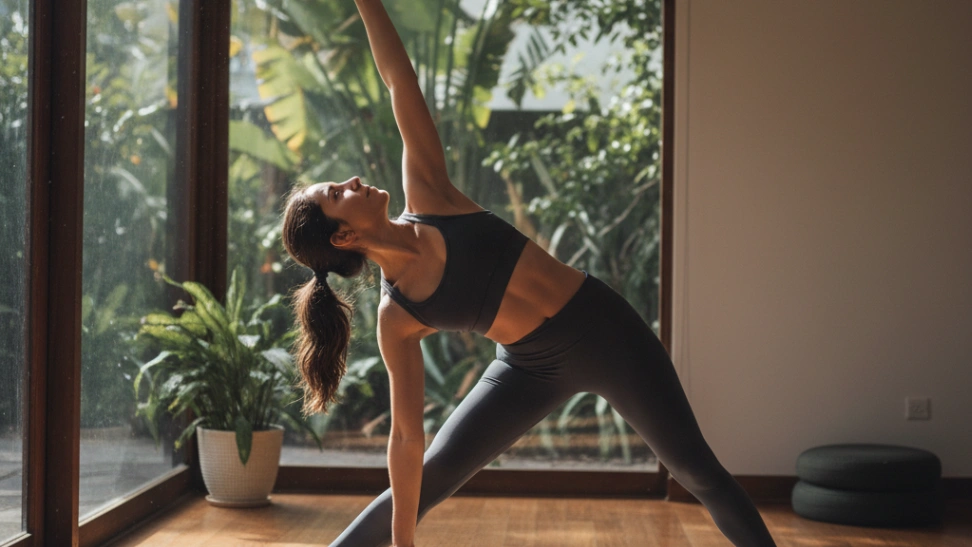
Blocks, straps, and bolsters exist to make poses accessible at every level of flexibility and strength, not to mark beginners as inadequate. Experienced practitioners use them throughout their careers. A block under your hand in Triangle Pose does not diminish the pose — it makes it possible to do it correctly.
Practice at least three times per week
Once a week builds familiarity slowly. Three times a week is where physical adaptation — improved flexibility, core strength, body awareness — becomes noticeable within the first month. The frequency matters more than session length at the beginning. Three 30-minute sessions outperform one 90-minute session.
Stay for Savasana
The final resting pose at the end of every class is not optional recovery time. It is the period where the nervous system integrates the work of the session. Leaving early because it feels unproductive is one of the most consistent mistakes beginners make. Five minutes of genuine stillness at the end of practice is worth more than an extra vinyasa.
What to Expect in Your First Sessions
Here's what typically happens when you start — and why it's useful information, not failure.
You will not be able to do many of the poses fully. This is entirely normal and expected by every teacher in every beginner class. Yoga poses are destinations that some people take years to reach. The work of getting there — the attempt, the wobble, the modification — is the practice. There is no performance standard to meet in your first class.
Your mind will wander constantly. The instruction to focus on breath and sensation will produce about three seconds of attention followed by thoughts about what you need to do later. This is not failure. It is what the practice is training. The moment you notice the mind has wandered and return attention to the breath is a repetition, exactly like a bicep curl. More of those repetitions is the entire point.
Some poses will feel surprisingly difficult. Chair Pose, Plank, and Warrior sequences are physically demanding. Beginners who expect yoga to be gentle are often surprised by how much strength the practice requires. The flip side is that strength develops quickly — poses that are exhausting in week one become sustainable within a few weeks of consistent practice.
You may feel emotional. Hip openers in particular — Pigeon Pose, Lizard, seated forward folds — occasionally produce unexpected emotional responses. This is documented widely enough in yoga culture that teachers are trained to expect it. It is not a sign that something is wrong. The body holds tension in ways the mind does not always register, and releasing it physically can have emotional dimensions.
Savasana will feel strange. Lying completely still on the floor while someone talks softly is unfamiliar territory for most people. The discomfort of stillness is itself the point. It becomes easier quickly, and what once felt like wasted time often becomes the part of practice people value most.
Beginner Tips That Actually Help
Pain and discomfort are not the same thing
Yoga should produce sensation — stretch, effort, mild intensity in muscles and connective tissue. It should not produce sharp, shooting, or joint-focused pain. Learning to distinguish between productive discomfort and signals to back off is the most important physical skill in yoga and the one most responsible for keeping practitioners injury-free over years of practice. When in doubt, do less. The pose will still be there next week.
Build a home practice from the beginning
A 10 to 15 minute home practice on the days between studio classes compounds the benefits of each session. It does not need to be ambitious — five minutes of hip openers and five minutes of breathwork is sufficient. The habit of returning to the mat regularly, regardless of how much time is available, is what builds a practice that lasts rather than one that starts and stops with studio attendance.
Learn the Sanskrit names gradually
Many teachers cue poses by their Sanskrit names — Tadasana, Adho Mukha Svanasana, Trikonasana. This is not gatekeeping. Sanskrit names are precise in a way that English translations often are not, and learning them eventually makes classes easier to follow regardless of which teacher or tradition you are practicing with. A small amount of deliberate study — five poses a week — covers the foundational vocabulary within a month.
Your flexibility is not the measure of your practice
Hypermobility — the ability to move joints through a very wide range — is not the same as good yoga. Some of the most skilled practitioners are not particularly flexible. Flexibility without strength and stability is a liability in yoga, not an asset. The goal in every pose is not maximum range of motion but conscious, supported range of motion. That distinction changes how you approach every session.
Find a teacher whose approach resonates with you
Yoga is taught with widely varying emphasis — some teachers prioritise the physical, others the meditative, others the spiritual or philosophical. A teacher whose priorities match yours is one you will want to practice with consistently, and consistency is what produces results. Trying several teachers at the beginning, rather than committing to the first one you encounter, is time well spent.
Read beyond the mat if the practice engages you
The physical postures are an entry point into a much larger body of thought. Practitioners who find themselves genuinely drawn to yoga often benefit from reading more widely. Accessible books to start with include B.K.S. Iyengar's Light on Yoga for the definitive asana reference, Donna Farhi's The Breathing Book for pranayama, and Patanjali's Yoga Sutras in any readable translation for the philosophical foundation the entire practice rests on.
Common Questions Answered
- Do you need to be flexible to start yoga?
No, and this misconception keeps more people away from yoga than any other. Flexibility is a result of yoga practice, not a prerequisite for it. The people who benefit most from yoga are often the least flexible when they start. Every pose has modifications that make it accessible regardless of current range of motion, and a good teacher will offer those without being asked.
- Is yoga a sufficient workout on its own?
It depends entirely on the style and intensity. A vigorous Vinyasa or Ashtanga practice provides genuine cardiovascular and strength training that qualifies as a complete workout for many people. Yin and Restorative yoga are not designed to be physically demanding and are better understood as complementary practices rather than primary fitness activities. Most practitioners find that yoga integrates naturally alongside other physical activities rather than replacing them entirely.
- Is yoga religious?
Yoga has roots in Hindu, Buddhist, and Jain philosophical traditions, and those roots are present in the language, symbolism, and ethics of classical yoga. Contemporary Western yoga practice largely separates the physical and wellness dimensions from the religious ones. Whether to engage with the spiritual dimension is entirely personal. Most studio classes in the West make no assumption about religious belief and can be practiced as a purely physical and mindfulness discipline without conflict.
- Is yoga suitable for people with injuries or chronic pain?
Yes, with appropriate guidance. Yoga is widely used in physical rehabilitation, chronic pain management, and post-surgical recovery. The key is transparency with your teacher about your condition before class and the willingness to modify or skip poses that aggravate it. Iyengar yoga in particular is known for its therapeutic application because of its precision alignment focus and extensive use of props. Anyone with a significant injury or health condition should consult a physician and seek a teacher with relevant therapeutic experience rather than attending a standard group class without context.
- How long before you feel a real difference?
Most beginners notice improved sleep, reduced tension, and better body awareness within two to three weeks of practicing three times per week. Visible flexibility gains typically appear within four to six weeks. The subtler benefits — improved stress response, greater equanimity, a changed relationship with discomfort — develop more slowly and tend to be noticed retrospectively rather than in the moment. The practitioners who describe yoga as transformative have almost universally been practicing for more than a year.
- Studio classes or online practice — which is better for a beginner?
In-person studio classes with a live teacher are significantly better for beginners for one reason: real-time alignment correction. Poor alignment in foundational poses practiced repeatedly without correction causes the kind of overuse injuries that drive people away from yoga. Online practice becomes highly effective once a solid foundation of alignment has been established, typically after two to three months of regular in-person practice. Yoga with Adriene on YouTube is the most widely recommended free resource for transitioning to home practice.