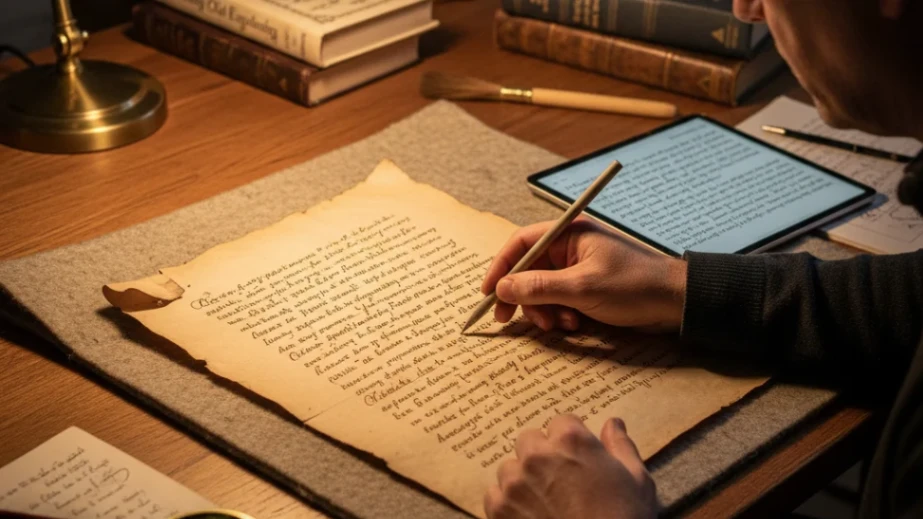
For the curious mind fascinated by history and the art of deciphering ancient texts.
Every hobby is defined by a set of core characteristics. Understanding these traits, from the energy it requires to the environment it thrives in, helps you find an activity that truly resonates with your personal style.
A deeply personal and solitary activity, perfect for quiet time and introspection.
A calm, low-key pursuit that helps you unwind and de-stress.
Best enjoyed in the comfort of your own home or a dedicated indoor space.
Creativity plays a role, but the focus is on mastering technical skills and structured problem-solving.
A mentally stimulating activity that challenges your mind, strategy, and focus.
Offers both tangible, useful outcomes and a great deal of personal enjoyment.
Based on 13 community votes.
Your journey starts here. Follow these steps to get started with Epigraphy.
Begin by studying inscriptions in scripts you already know, such as Latin or Greek, to build foundational understanding. Focus on common phrases and formulas found in these older texts.
Familiarize yourself with the visual variations of letters (ligatures, abbreviations, different hands) found in ancient scripts. This skill is crucial for accurately transcribing inscriptions.
Utilize online resources like the Epigraphik Online or the Thesaurus Linguae Graecae to view and study a wide range of inscriptions. These databases often provide transcriptions and translations.
Consult introductory books on epigraphy or classical archaeology that cover the fundamentals of reading and interpreting inscriptions. These resources will provide essential context and methodologies.
Ancient inscriptions often use connected letters (ligatures) or shortened words (abbreviations) that can easily be misread without proper training, leading to incorrect transcriptions.
Focusing solely on the text without considering the inscription's find spot, material, or associated imagery can lead to incomplete or flawed interpretations.
While helpful, facsimiles or rubbings may not capture all the nuances of an inscription. Direct examination, when possible, is always preferable for accurate analysis.
Not sure about Epigraphy? Your next passion might be just a click away.
Expand your knowledge with related articles from our community blog.
We haven't published any articles specifically for Epigraphy yet. Why not write the first one?
Dive deeper with these community-recommended websites, guides, and forums.
A comprehensive portal for epigraphic studies, offering databases, bibliographies, and research tools.
A digital library of ancient Greek literature and inscriptions, essential for Greek epigraphy.
A professional organization that fosters the study of Greek and Latin inscriptions, offering resources and connections.
A text carved or written onto a durable surface, such as stone, metal, or pottery.
The study of ancient handwriting and scripts, focusing on their form, evolution, and decipherment.
The study of inscriptions, including their decipherment, interpretation, and historical context.
Two or more letters joined together into a single symbol.
A shortened form of a word or phrase, common in ancient inscriptions.