Best Magnifying Glass for Documents (2026): Light Matters More Than Power
Reading faded handwriting on old paper is a lighting problem at least as much as a magnification one. Higher power sounds like the answer and quietly makes things worse — the field of view shrinks, the working distance drops, and you end up examining letters one at a time with your nose on the document. Most people want less magnification and more light than they think.
HobbyStack may earn a commission from links on this page at no extra cost to you. Our picks are chosen on merit; the commission helps fund the research.
- 2x to 3x is right for reading. Higher power shrinks the field so far that words stop being readable as words.
- Higher magnification also means a shorter working distance — you have to hold it closer to the page.
- A built-in light does more for faded ink than extra magnification does.
- Raking light from the side reveals impressions and faded strokes that flat light hides.
- A high-power spot lens on a low-power main lens gives you both without owning two.
 Our pickCarson SureGrip 2x with 10x spotReading plus detail$12Check price
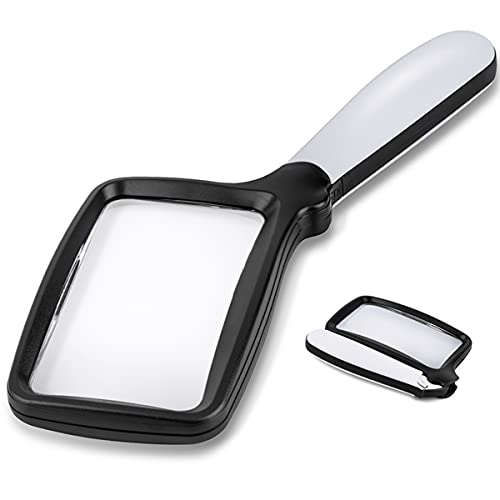 Folding Handheld with Light 5xFaded ink$14Check price
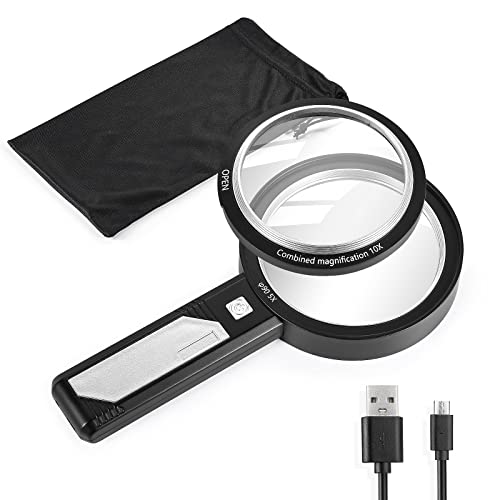 Handheld Loupe 5/10/15xClose examination$22Check price
Why more magnification is usually worse
Three things move together in a magnifier, and only one of them is the number on the box.
Field of view shrinks as magnification rises. At 2x you see a phrase; at 10x you see two or three letters. Reading requires seeing enough words together to use context, which is most of how anyone deciphers bad handwriting.
Working distance shrinks too. A 2x lens sits comfortably above the page; a 10x lens has to be almost touching it, which means your head follows it down and your own shadow lands on the thing you are reading.
Depth of field narrows, so the lens must be held at exactly the right height or nothing is sharp.
So: 2x to 3x for reading, and a high-power lens only for examining a specific mark — a watermark, a seal, a single ambiguous letter. Buying 10x as a general reading magnifier is the most common mistake.
Light does the work magnification cannot
Faded iron gall ink on aged paper is a contrast problem. Making it bigger does not make it darker; making it brighter, or lighting it differently, often does.
More light is the first move, and a lens with an integrated LED puts it exactly where you are looking rather than casting your own shadow across the page.
Raking light is the technique nobody mentions. Hold a lamp low and off to one side so the light skims across the surface rather than hitting it flat. Impressions from a pen that has scored the paper, and strokes where the ink has vanished but the surface is disturbed, jump into visibility.
Angle the page rather than the lamp if the lamp will not move — the effect is identical and often easier.
Between a brighter lamp and a raking angle, most faded text becomes legible without any additional magnification at all.
 Best all-rounder
Carson® SureGrip 2x Soft-Grip Glass Magnifier
A 2x lens with a small 10x spot lens set into it, which is exactly the right combination for document work and the reason this is the pick. The 2x main lens gives a wide enough field to read a phrase at a comfortable working distance, and when you hit an ambiguous letter or want to look at a watermark you slide the 10x inset over it without picking up a second tool. Glass rather than acrylic, so it stays clear and does not scratch as readily. The grip is genuinely comfortable for long sessions. There is no light, so pair it with a good lamp — and it is not the tool for examining something at high power across a large area.
What's good
- 2x for reading and 10x for detail in one tool
- Glass main lens — clear and scratch resistant
- Comfortable grip for long sessions
- Padded zip pouch included
What's not
- No integrated light
- The 10x spot lens is acrylic, not glass
- Small spot covers a tiny area
- Not for prolonged high-power work
 Best for faded ink
Folding Handheld Magnifying Glass
A lit magnifier, and the light is the reason to choose it over a cheaper plain lens — on faded ink, illumination does more than magnification, and having it built into the lens means the light arrives where you are looking instead of being blocked by your own head. The rectangular lens is about four and a half inches across, which suits lines of text far better than a circle does: you read along a line rather than through a disc. Two brightness settings matter more than they sound, because full brightness on glossy or heavily foxed paper produces glare that hides exactly what you were trying to see. The handle folds, so it travels to an archive without a case. It takes three AAA batteries and does not come with them.
What's good
- Integrated light — the real upgrade for faded ink
- Wide rectangular lens follows a line of text
- Two brightness levels — dim it to kill glare
- Handle folds for travel to archives
What's not
- 5x is narrow for continuous reading
- Three AAA batteries, not included
- Acrylic rather than glass
- Hinge is a wear point
 Best for close examination
5 10 15X Handheld Magnifier Loupe Magnifying Glass Coins
Two lenses that work separately at 5x and 10x or fold together for 15x, which suits the examination end of research rather than the reading end — checking a seal, a watermark, an engraver's mark, or whether two signatures were made by the same hand. Being able to step through powers matters because the right magnification for a given mark is rarely the one you guessed. It charges over USB rather than eating AAAs, which is the right call for a tool that lives in a bag. It also has a UV mode, sold as a banknote checker and quietly useful in archives: modern paper is treated with optical brighteners that glow under UV and pre-twentieth-century paper is not, so a sheet that lights up is not as old as it claims. It is not a reading magnifier — at 5x and above the field is too narrow.
What's good
- 5x, 10x, or both together for 15x
- Rechargeable over USB — no AAAs to buy
- UV mode flags modern paper by its brighteners
- Good for seals, watermarks and hands
What's not
- Too narrow a field to read with
- Really a second tool, not a first
- Must be charged before you go
- Short working distance at 15x
Hold a lamp low and to one side so light skims across the paper rather than hitting it flat. Pen impressions and strokes where the ink has faded but the surface is disturbed become visible immediately. It costs nothing, works on documents no amount of magnification helps, and is the first thing to try on anything you cannot read.
Handling old documents
A magnifier gets you close to things that are fragile, so a few conventions are worth knowing.
Clean dry hands, usually no gloves. Cotton gloves reduce your grip and sense of touch, which makes tearing more likely — most archives now prefer clean bare hands for paper. Gloves are for photographs and metal.
Support the whole sheet. Lift with a board or another sheet underneath rather than by a corner, which is where old paper tears.
Nothing on top. No pens over documents, no drinks in the room, and use pencil for notes.
Photograph rather than linger. A phone photo taken with the flash off, at a raking angle, lets you study the image at length without handling the original repeatedly — and you can zoom further than any hand lens.
Before you buy
2x to 3x for reading. High power is for examining single marks.
A light does more for faded ink than more magnification.
Rectangular lenses suit lines of text better than round ones.
Glass stays clearer than acrylic and resists scratching.
Try raking light before you buy anything at all.
Magnifier questions
What magnification do I need to read old documents?
Do I need a magnifier with a light?
What is raking light?
Should I wear gloves handling old documents?
Buy less magnification and more light than instinct suggests. The Carson SureGrip is the right first tool — 2x for reading at a comfortable distance with a 10x spot for the ambiguous letter, in glass, for very little. Add the lit folding magnifier if faded ink is your usual problem, and the multi-power loupe only for examining seals and watermarks. Before any of it, try a lamp held low and to one side.
Ready to actually do it?
The first local history research quest takes an evening, and it tells you whether the gear was worth it better than any review can.
Start Local History ResearchThe HobbyStack editorial team researches each guide against manufacturer specifications, published resources and practitioner sources. Every product is checked for availability and described against its current listing before publication, and prices are re-checked when guides are updated.
About our editorial process →More gear guides
All guides
Best Flashcards for Language Learning (2026): The Leitner Box Still Wins
Flashcards work, but only if you stop reviewing the ones you already know. That single idea — spacing the easy cards further apart and the hard ones closer together — is what turns a stack of cards from a chore into the most efficient vocabulary tool there is. It was worked out on paper in the 1970s, and a shoebox with dividers still implements it perfectly.

Best Pottery Tool Set (2026): Six of the Twelve Do Nearly Everything
Open a twelve-piece pottery set and six tools will do nearly all your work: the wire cutter, a wooden rib, a metal rib, a loop trimming tool, a sponge and a needle tool. The rest get picked up once, found to duplicate something, and left in the canister for years.

Long Blade Freediving Fins (2026): Stiffness Is Matched to Your Legs, Not Your Ambition
Long blades are not about speed. A long blade moves a large volume of water per kick, so you cover distance at a slow, unhurried cadence instead of a fast one, and on a breath-hold the thing you are conserving is oxygen. A stiff blade you cannot load properly burns more of it than a soft blade you can.
Best Millinery Wire (2026): Gauge Decides Whether the Brim Holds Its Line
Wire gauge runs backwards, so an 18 gauge wire is thicker than a 20. That catches people out in exactly the wrong direction: they buy a high number expecting something substantial, wire a brim with it, and watch the brim sag the first time the hat is picked up.

Best Go Books (2026): Beginners Want Joseki and Need Life and Death
Every beginner reaches for a book of joseki, the memorised corner sequences, because they look like the secret. They are not. Strength at Go comes from reading life and death and recognising good shape, and a player who has memorised openings without those will play twenty moves of professional theory and then lose the group.

Best Pen Turning Chisels (2026): You Will Use Four of the Eight
An eight-piece lathe chisel set is sold as a starter kit, and a pen turner will use about four of them. Pens are small-diameter spindle work, so the roughing gouge, the spindle gouge, the skew and the parting tool do nearly everything, and the bowl gouge stays in the box.