A complete guide to getting started: earning your first certification, mastering buoyancy, understanding the underwater environment, and finding the dives and dive community that will keep you coming back.
Scuba diving does not require proximity to the ocean to be rewarding. The skills, the physics, and the mindset are learned in pools and quarries long before you ever reach a coral reef. At its core, the hobby is about developing the kind of calm, deliberate attention that makes the underwater world permanently more legible — and permanently more addictive.
What Scuba Diving Actually Involves
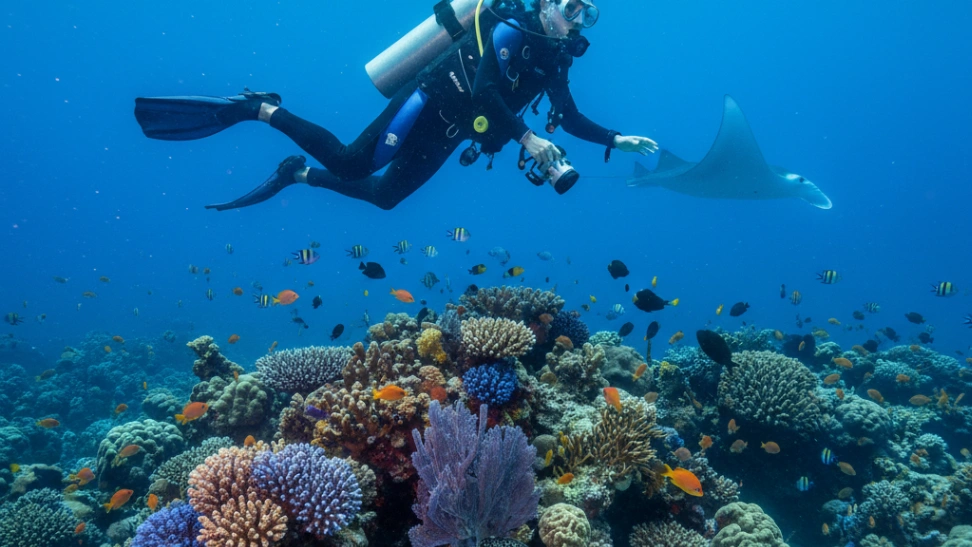
Scuba diving is the practice of exploring underwater environments while breathing from a self-contained compressed air supply. The acronym stands for Self-Contained Underwater Breathing Apparatus — though most divers quickly forget the acronym and focus on the experience it enables: swimming through kelp forests, hovering above coral walls, drifting alongside mantas, and observing marine life that behaves as though you are not there.
The core discipline being developed is not swimming strength. It is buoyancy control — the ability to hover motionlessly at any depth, move without disturbing the environment, and manage air consumption efficiently. Experienced divers are not strong swimmers; they are economical ones. Every unnecessary movement burns air and disturbs wildlife. The diver who finishes a dive with the most air remaining is usually the one who moved least and observed most.
Scuba exists on a spectrum from resort-based fun dives (supervised single dives in warm, clear water for uncertified tourists) to technical diving involving mixed gases, rebreathers, and depths beyond 100 metres. Most recreational divers sit comfortably between those poles — certified to 18–30 metres, diving warm-water sites on holiday and local sites year-round, building a log of accumulated experience across different environments.
The Certification Ladder
Scuba certification is structured around formal agencies — primarily PADI, SSI, BSAC, and NAUI. These stages describe how most divers' knowledge and logged experience actually develops. The dive counts are honest benchmarks, not targets; some divers progress faster, many stay happily at Open Water for years.
Discover Scuba / Try Dive
A single supervised experience — typically in a pool or shallow confined water — that introduces breathing underwater, clearing a flooded mask, and basic buoyancy. No certification awarded. Offered by nearly every dive centre worldwide and widely available on liveaboards and resort dive operations. The right first step for anyone who is unsure whether diving is for them.
Open Water Diver (OWD)
The entry-level certification recognised worldwide. Involves theory (dive physics, equipment, safety protocols), confined water skills (mask clearing, regulator recovery, controlled emergency ascents), and a minimum of four open water dives. Certifies you to dive to 18 metres with a buddy. Most courses take 3–5 days and can be started with eLearning theory before your trip. The single most important step in the hobby.
Advanced Open Water Diver (AOWD)
Five adventure dives across speciality disciplines — deep dive and navigation are mandatory; the remaining three are chosen from a broad menu including night diving, drift diving, wreck diving, and underwater photography. No written exam. Certifies you to 30 metres and builds the situational awareness that makes Open Water diving feel routine rather than demanding. Usually completed in 2–3 days.
Rescue Diver, Divemaster, and Specialties
Rescue Diver is widely considered the most personally transformative certification — it moves your attention from your own experience to the wellbeing of divers around you. Divemaster is the first professional certification, enabling you to guide certified divers. Beyond this lie specialty certifications (wreck, cave, rebreather, mixed gas) and the technical diving path, which involves depths and procedures outside recreational limits.
Core Skills to Develop
Neutral buoyancy control
<p>The ability to hover motionlessly at any depth without fin kicks or BCD adjustments. Developed by weighting correctly, breathing shallowly and deliberately, and making micro-adjustments by lung volume rather than BCD inflation. The single skill that separates inexperienced from competent divers. Takes 20–50 dives to develop naturally; a Peak Performance Buoyancy course accelerates it significantly.</p>
Monitoring and conserving gas supply
<p>Checking your SPG every 5 minutes, communicating your remaining air to your buddy, and planning the dive to surface at the agreed reserve (typically 50 bar). Air consumption decreases with experience as anxiety reduces and movement becomes more economical. Anxious divers consume twice the air of calm ones. Breathing slowly and deeply rather than rapidly and shallowly is a learnable skill.</p>
Underwater compass and natural navigation
<p>Using a compass to maintain a heading, execute a square pattern, and return to a fixed point. Natural navigation uses landmarks, reef features, depth, sand ripple direction, and sunlight angle as orientation cues. Being able to navigate confidently transforms diving from guided tours to self-directed exploration. The PADI Underwater Navigator specialty is worthwhile here.</p>
Efficient kick technique
<p>The flutter kick is learned first but is not always appropriate. The frog kick generates forward movement with minimal sediment disturbance and is preferable in most environments. The back kick enables precise manoeuvring without turning. Helicopter turns using asymmetric fin pressure allow rotation on a fixed axis. Learning to modify your kick technique for different environments is part of developing diver awareness.</p>
Species and environment recognition
<p>Understanding what you are looking at underwater transforms the experience from sightseeing to naturalism. Reef zonation (rubble, coral slope, wall, sand flat), fish family recognition, invertebrate identification, and understanding predator-prey behaviour context all accumulate with dive time. Carrying a slate and sketching unknowns for post-dive identification accelerates learning faster than field guides alone.</p>
Effective buddy communication and protocols
<p>The buddy system is only as strong as the quality of communication within it. Pre-dive briefing should cover signals, air turn-around pressure, maximum depth, and lost buddy procedure — not just a handshake and descent. Practising out-of-air scenarios, maintaining contact distance on navigation dives, and monitoring your buddy's air and behaviour continuously are habits that make the buddy system genuinely functional rather than nominal.</p>
Never dive beyond your certification limits, always dive with a buddy, and conduct a SEEDS (Site conditions, Entry and exit, Environment, Dive plan, Special considerations) briefing before every dive. Decompression sickness is real and preventable — follow your computer or tables and ascend slowly with a 3-minute safety stop at 5 metres on every dive. When in doubt, do not dive. The ocean will be there tomorrow.
Seasonal and Conditions Guide
| Season | Conditions | Best for | Key considerations |
|---|---|---|---|
| Spring | Water temperatures rising. Plankton blooms can reduce visibility in temperate waters but attract feeding fish and megafauna. Wrecks in temperate seas often at their clearest before summer algae build. | Wreck diving in temperate regions, manta and whale shark aggregations at tropical sites, nudibranch and invertebrate activity | Thermoclines can be sharp. A wetsuit upgrade may be needed even in nominally warm destinations. Check current patterns before booking. |
| Summer | Peak diving season in temperate regions. Warmer water, longer daylight for shore dives, maximum species diversity in Northern Hemisphere. Tropical sites may have afternoon thunderstorms reducing afternoon diveability. | Temperate sea diving, shark encounters at aggregation sites, liveaboard expeditions, learning and certification courses | Dive sites are at their most crowded. Book liveaboards well in advance. Heat on the surface is real — hydrate constantly between dives. |
| Autumn | Water temperatures still warm from summer but crowds thinning. Visibility often excellent at tropical sites as currents shift. Temperate seas can be stormy, reducing diveability from surface. | Tropical reef diving in shoulder season (best value), pelagic encounters at aggregation sites, mola mola in the Indo-Pacific | Weather windows in temperate regions become shorter. Flexibility in planning is essential. Some sites close to boat diving; shore diving continues later into autumn. |
| Winter | Cold water in temperate regions rewards dry suit investment. Tropical diving at its most accessible with clear visibility and calm seas in many regions. Whale migration routes pass many classic Caribbean and Pacific sites. | Dry suit diving development, tropical reef diving (Red Sea, Maldives, Caribbean), humpback whale encounters, cave diving in Mexico's cenotes | Dry suit certification is a prerequisite for comfortable winter diving in temperate waters. Do not attempt dry suit diving without training — the failure modes are serious. |
Where to Dive
Local quarry or inland dive site
Flooded quarries, lakes, and reservoirs are where most non-tropical divers develop their skills. Controlled, predictable conditions — no current, known depth profile, easy entry and exit — allow you to practise buoyancy, navigation, and equipment without environmental variables. UK divers particularly rely on sites like Stoney Cove and Capernwray. Visibility is often poor but competence built here transfers directly to ocean diving.
Year-round · Skill development · All cert levels
Warm, shallow coral reef
The Red Sea, Thailand, Philippines, Caribbean, and Maldives all offer reef diving at 5–15 metres where warm, clear water and high species density make the Open Water experience immediately compelling. These sites are where most divers fall permanently in love with the hobby. Sharm el Sheikh, Koh Tao, and Roatan are particularly established as learning destinations with dense dive infrastructure.
High visibility · Species rich · Crowded in season
Wreck diving
Deliberately sunken ships, accidental wrecks, and aircraft provide artificial reef structure that concentrates marine life and offers distinctive diving experiences unavailable on natural reef. The SS Thistlegorm in the Red Sea and the SS Yongala off Australia are among the most famous. Penetration wreck diving requires specialty certification — unguided penetration without training accounts for a significant proportion of diving fatalities.
AOWD minimum · Unique experience · Worldwide
Drift diving and blue water
Diving in current — from gentle drift dives on coral channels to powerful channel dives that require controlled descent and ascent protocols — demands confident buoyancy and situational awareness before it becomes enjoyable rather than stressful. Blue water diving (open ocean, often for pelagic encounters) requires additional safety protocols including surface marker buoys and SMB deployment skills. Highly rewarding once the foundational skills are automatic.
50+ dives recommended · Pelagic encounters · Conditions-dependent
Cave and cavern diving
Mexico's Yucatán Peninsula contains the world's longest known underwater cave systems. Cenote diving (flooded sinkholes with access to cavern zones) is accessible to Open Water divers under guide supervision. True cave diving — beyond the light zone, requiring guidelines and stage cylinders — is one of the most technically demanding disciplines in diving and has its own certification pathway through NACD and NSS-CDS. Do not proceed without formal cave training.
Cavern: all levels · Cave: specialist cert required · Mexico / Yucatán
Temperate and polar diving
Norwegian fjords, Iceland, the British Isles, and Patagonia offer world-class diving for divers willing to invest in dry suit training. Temperate seas have lower species density than tropical reefs but exceptional visibility and encounters with large marine mammals — grey seals in the UK, orca in Norway, leopard seals in Antarctica — that are not available in warm water. Cold water diving is genuinely excellent; the barrier is equipment cost, not experience.
Dry suit required · Large marine life · Exceptional visibility
The Certification Culture
Scuba diving's certification system provides measurable progression milestones that sustain engagement across years. Unlike most outdoor hobbies, each certification unlocks genuinely new experiences — new depth ranges, new environments, and new capabilities. Most serious divers pursue certifications not for the card, but because the training that earns the card expands what they are able to do underwater.
Professional Association of Diving Instructors
The world's largest certifying agency. PADI cards are accepted at virtually every dive centre globally, making them the pragmatic first choice for most divers. The eLearning format for theory work is genuinely well-produced. Some experienced divers feel PADI's recreational focus limits technical development — the advanced pathway is addressed through its TecRec division.
Scuba Schools International
PADI's primary commercial competitor. Digital certification delivery and a flexible course structure. Widely accepted, particularly in Europe and Asia. Many divers have certifications from both agencies as different dive centres favour different training organisations. SSI and PADI certifications are mutually recognised for entry level recreational diving.
British Sub-Aqua Club
The UK's dominant diving organisation, operating through a club structure rather than commercial dive centres. BSAC training is often considered more comprehensive than PADI equivalent levels and includes a strong emphasis on rescue skills from entry level. Club membership provides access to equipment, organised dives, and mentorship from experienced divers — a genuine advantage for divers who cannot afford constant commercial diving.
Sidemount configuration
Carrying tanks at your sides rather than on your back reduces back strain, improves streamlining, and provides redundant gas supply. Originally a cave diving configuration now popular in recreational diving. Sidemount changes your hydrodynamic profile significantly and requires dedicated training to use safely. Increasingly common among divers who dive regularly.
Underwater photography
The hobby within the hobby. Underwater photography demands exceptional buoyancy control — any buoyancy lapse directly damages the reef or ruins the shot. It slows you down and focuses your attention on small subjects, which often produces better wildlife encounters than standard recreational diving. Entry-level with a compact camera and housing is accessible; full SLR rig photography is a significant investment in both money and skill.
Night and low-visibility diving
Nocturnal species — octopus, mandarin fish, Spanish dancer nudibranchs, bioluminescent plankton — are unavailable during day dives. Night diving on a familiar reef site reveals a completely different ecosystem using torch light. Navigation is by compass rather than landmarks, making this a genuine skill builder as well as a dramatically different experience. Open Water certified divers can pursue this specialty.
On choosing an instructor The quality of your Open Water instructor has a larger impact on your long-term diving development than the certification agency they teach for. A good instructor who teaches proper buoyancy, emphasises the physics behind the protocols, and creates a genuinely relaxed learning environment will produce better divers than a rushed agency-brand course with a disengaged instructor. Ask to meet the instructor before booking a course, not just the dive centre.
Gear and Apps
Scuba gear has a clear hierarchy of what to own versus what to rent. The items in contact with your face and your air supply (mask, regulator, dive computer) are worth owning early because fit and familiarity matter. Large equipment (BCD, tank, wetsuit) can be rented indefinitely without significant compromise, though regular divers eventually own everything.
The non-negotiables — you need these before your first session. No upsell here, just what actually matters to get started safely.


Buoyancy Control Device (BCD)


Scuba Dive Computer


Worth it once you're committed. These items meaningfully improve your experience and are often bought within the first few months.

Apps & Resources
| App / Resource | Cost | Best for |
|---|---|---|
| Dive+ | Free | Dive log management, buddy finder, and site discovery. Syncs with many dive computers. Clean interface and growing community. Strong on trip planning for established dive destinations. |
| Subsurface | Free | Open-source dive log software for serious divers. Imports from virtually all dive computers, generates detailed gas consumption analysis and dive profile graphs. More powerful than commercial apps; less polished interface. |
| PADI App | Free | Digital certification card storage, eLearning access, and dive shop finder. Essential for PADI-certified divers as digital card replacement and for initiating specialty course eLearning before travel. |
| Reef Life Survey | Free | Citizen science platform for submitting marine species sightings to global reef health databases. Your fish counts and invertebrate observations contribute to conservation research. Makes every dive contribute to something larger. |
| iDive (or regional equivalents) | Paid | Offline-capable dive site database with depth profiles, current information, and diver reviews. Particularly useful when diving in regions with unreliable mobile data. Worth the cost for any planned dive trip to an unfamiliar destination. |
Interactive Buyer's Guide
Compare all tiers, track what you own, see your full budget.
Common Questions Answered
- Do I need to be a strong swimmer to learn to dive?
No, but you need to be comfortable in water. PADI Open Water requires a 200-metre swim (any stroke, no time limit) and a 10-minute float or treading water. This is a comfort assessment, not a performance test. Strong swimmers are not necessarily better divers — buoyancy and composure underwater matter far more than swimming fitness. If you are uncomfortable in the water generally, address that with swimming lessons before pursuing a diving course.
- How do I choose between PADI, SSI, and BSAC?
If you plan to dive internationally and want maximum card recognition worldwide, PADI or SSI are the pragmatic choices — the cards are accepted everywhere. If you are based in the UK and intend to dive British waters regularly, BSAC's club structure provides significant long-term advantages: access to equipment, organised dives, and a community of divers who know local sites. If you are doing a resort course on holiday, take whatever the available dive centre teaches and worry about agency preference when you return home and pursue further training.
- Is scuba diving dangerous?
Recreational diving within certification limits has a risk profile similar to other outdoor adventure sports — meaningful but manageable with proper training, equipment, and judgment. The most common diving incidents involve ascent rate violations, out-of-air emergencies, and getting separated from a buddy — all of which are preventable with proper protocols. Technical diving (beyond 40 metres, with decompression obligations or overhead environments) carries substantially higher risk and requires commensurately more training. The certification system exists precisely to ensure divers understand the risk profile of what they are undertaking at each level.
- How long does Open Water certification take?
The standard intensive course is 3–5 days including theory, confined water skills, and four open water dives. Many divers complete the eLearning theory (approximately 10–15 hours) before their trip, allowing the in-water portion to be condensed to 2–3 days. A referral course splits theory and pool work at home with open water dives completed on location — useful if you want to complete certification in a tropical destination rather than locally. The certification is valid for life, though divers who have not dived in more than a year are strongly encouraged to complete a Scuba Review or ReActivate session before their next dive.
- What medical conditions prevent diving?
Conditions that affect gas exchange in the lungs, any untreated cardiac condition, poorly controlled epilepsy, and certain psychological conditions that affect judgment under stress may be disqualifying. The standard form is PADI's Medical Statement, which lists conditions requiring physician sign-off before diving. If you have a respiratory condition, a history of cardiac events, or are on regular medication, consult a dive medicine physician — not your GP — before beginning training. Recreational diving is accessible to most healthy adults, including many people who might assume their medical history disqualifies them.
- How do I maintain my skills between dives?
Pool sessions at your local dive centre are the most direct option — practicing mask clearing, buoyancy, and emergency procedures in a controlled environment costs a fraction of open water diving and maintains both skill and comfort. Many dive clubs organise regular quarry or local dive sessions specifically for this purpose. Reviewing your dive computer profiles, keeping a detailed dive log, and reading about marine life at sites you plan to visit all contribute to readiness between dive trips. Skills that are not practised deteriorate — the six-month gap between dives is where confidence is most at risk.