Best Archery Finger Tab or Glove (2026): The Release Is the Shot
Everything you do before the release can be perfect and the arrow will still go wide if the string rolls off your fingertips rather than leaving cleanly. Finger protection is not mainly about comfort. It is about giving the string one consistent surface to leave from, every single time.
HobbyStack may earn a commission from links on this page at no extra cost to you. Our picks are chosen on merit; the commission helps fund the research.
- A tab gives one flat surface for the string. A glove keeps your fingertips independent.
- Tabs are the default for target and Olympic recurve. Gloves suit traditional and hunting.
- Never shoot without something. Bare fingers blister fast and teach you to flinch.
- Leather stretches and moulds. Buy snug, not loose.
- Cordovan is the premium material because it is dense and hardly compresses.
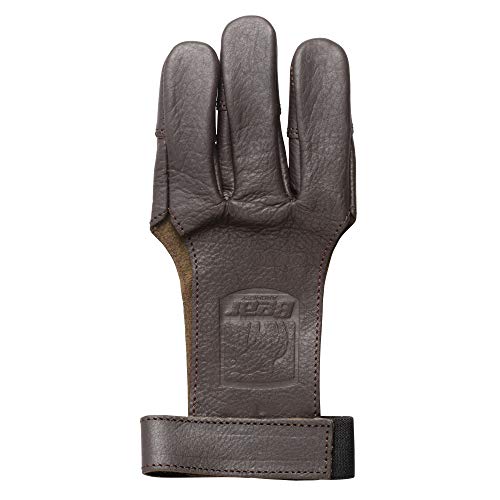 Bear 3-finger gloveTraditional shooting$16Check price
 Our pickLeather finger tabMost archers$19Check price
 BICASTER cordovan tabSerious target work$38Check price
Tab or glove, and what each does to the release
Both protect three fingers. They do it differently, and the difference changes the shot.
A finger tab is a single flat piece of leather that hangs from a finger loop and sits between the string and your fingers. The string rolls off one continuous surface, so the release is smoother and more repeatable, and there is nothing between your fingers to interrupt it. Tabs usually add a ledge or a shelf that sits against your jaw for a consistent anchor, and often a finger spacer that stops you pinching the arrow nock.
This is why tabs are near universal in target and Olympic recurve.
A shooting glove puts a leather stall over each of the three fingers. Each finger works independently, which keeps a lot of feel for the string and suits instinctive shooting. It stays on your hand between shots, which matters when you are moving in the field, and it does not interfere with anything else you are doing.
The trade is that the string leaves three separate surfaces instead of one, with the small seams and edges between them, so the release is marginally less consistent.
The rough rule: target and precision shooting wants a tab; traditional, instinctive and hunting shooting usually wants a glove. Neither is wrong for the other, and plenty of people cross over.
And do not shoot bare-fingered. Even a light bow will blister you within a session, and a sore hand teaches a flinch that takes far longer to unlearn than the blister takes to heal.
Material, fit and the ledge
Leather thickness is a trade. Thick leather protects more and dulls feel for the string. Thin leather gives feedback and wears out. Most tabs sit in the middle, and many use a double layer with a softer face against the fingers.
Cordovan is the premium material and it is genuinely different, not just dearer. It is a dense layer from horsehide that barely compresses, so the surface stays consistent shot after shot where ordinary leather gradually develops grooves where the string sits. Those grooves change the release, which is exactly what you are trying to keep stable.
Buy snug. Leather stretches and moulds to your hand with use. A tab that fits loosely when new will be sloppy in a month.
Check the hand. Tabs are handed. A right-handed archer holds the bow in the left hand and draws with the right, and needs a right-handed tab. Getting this wrong is a common and irritating first order.
The ledge or shelf on better tabs sits against your jaw or under your chin. It gives a physical anchor point you can feel identically every time, which does more for consistency than almost anything else on the tab.
A finger spacer keeps your index and middle fingers off the arrow nock. Pinching the nock lifts the arrow off the rest and sends it wide, and it is one of the commonest faults in new archers.
Aluminium backing plates, as on the premium tab here, spread the load across the fingers rather than concentrating it, which matters as draw weight climbs.
 Best for traditional shooting
Bear Archery Leather 3 Finger Traditional Archery Shooting
A three-finger leather glove from a name that has been making traditional archery gear for decades. Each fingertip gets its own leather stall, so you keep a lot of feel for the string, which is what instinctive and traditional shooters want. It stays on your hand between shots rather than dangling, which suits moving around in the field. The string leaves three surfaces rather than one, so the release is slightly less repeatable.
What's good
- Keeps real feel for the string
- Stays on the hand while you move
- Suits instinctive and traditional shooting
- Long-established traditional archery brand
What's not
- String leaves three surfaces, not one
- Less repeatable release than a tab
- No ledge for a consistent anchor
- Sizing is unforgiving as leather stretches
 Best for most archers
LAMCLTH Archery Finger Tab
A leather tab, which is the right default for anyone shooting at a target rather than at game. One continuous surface means the string rolls off the same way every shot, and that repeatability is worth more than the feel a glove preserves. It sits on a finger loop so it swings out of the way between ends, and it costs little enough to be an easy first purchase. Check you order the correct hand.
What's good
- One flat surface gives a repeatable release
- The standard for target and recurve shooting
- Swings out of the way between shots
- Cheap enough to be an obvious first buy
What's not
- Handed, so easy to order incorrectly
- Less string feel than a glove
- Plain leather develops grooves over time
- Dangles on the string when not held
 Best for serious target work
BICASTER Archery Finger Tabs Horween Cordovan Leather +
Horween cordovan, which is a genuinely different material rather than a dearer leather: it is dense enough that it barely compresses, so the face stays smooth instead of developing the string grooves that gradually change how ordinary leather releases. Aluminium finger guards spread the load across the fingers rather than concentrating it, which matters as draw weight climbs. This is target equipment and it is overkill for casual shooting.
What's good
- Cordovan barely compresses, so the face stays consistent
- Aluminium guards spread load at higher draw weights
- Does not develop the grooves plain leather does
- Replaceable face on cordovan tabs
What's not
- Twice the plain leather tab
- Overkill for casual or occasional shooting
- Stiff until it beds in
- Handed and sized, so ordering needs care
A good release is not a decision to let go, it is a relaxation of the back of the hand while your back muscles keep pulling. If you consciously open your fingers, you almost always push the string sideways on the way out and the arrow goes with it. Come to full draw, settle the anchor, keep pulling through, and let the hand relax. Done right the shot goes off a fraction before you expected it to.
Around the release
Anchor identically every time. The point where your drawing hand touches your face is your rear sight. A tab ledge against the jaw, the string touching the nose and chin, the same every shot. Inconsistent anchor is the single largest source of vertical error.
Do not pinch the nock. Fingers sit above and below the arrow, not squeezing it. Pinching lifts the arrow off the rest, which is why tabs have spacers.
Follow through. The drawing hand should end up beside or behind your ear, moved by the back muscles rather than thrown. Dropping the hand as the string goes is a habit that costs accuracy for years.
Check the string for wear where the tab sits. Serving fluff and fraying at the nocking point is normal and needs re-serving before it fails.
Let leather dry naturally. A sweaty tab dried on a radiator goes hard and cracks. Keep it out of a hot car for the same reason.
Replace it when the face grooves. A tab with a worn channel where the string sits is releasing differently from a new one, and it is a cheap thing to replace.
Before you buy
Tab for target shooting, glove for traditional and instinctive.
Check handedness before ordering. It is the usual mistake.
Buy snug, because leather stretches and moulds.
Look for a ledge if you want a repeatable anchor.
A finger spacer stops nock pinch, which is worth having early.
Finger tab and glove questions
Should I use a finger tab or a shooting glove?
Can I shoot without finger protection?
What makes cordovan tabs worth the money?
Why do my arrows go left and right inconsistently?
A leather finger tab is the right default for most people, because one flat surface makes the release repeatable and repeatability is what accuracy is built on. Take the Bear glove instead if you shoot traditional or instinctive and want to keep the feel of the string. Step up to a Horween cordovan tab once you shoot seriously, since it will not develop the grooves that quietly change plain leather. Check the handedness before ordering.
Ready to actually do it?
The first archery quest takes an evening, and it tells you whether the gear was worth it better than any review can.
Start ArcheryThe HobbyStack editorial team researches each guide against manufacturer specifications, published resources and practitioner sources. Every product is checked for availability and described against its current listing before publication, and prices are re-checked when guides are updated.
About our editorial process →More gear guides
All guides
Best Arrows for Beginners (2026): 3 Real Picks
Arrows matter more than beginners expect: the wrong arrows fly badly no matter how good your form, and the single most important thing is not the brand but matching the arrow to your bow. Arrows have a 'spine' (stiffness) and a length that must suit your draw length and your bow's draw weight, or they'll wobble and scatter. Carbon is the right material for almost every beginner (durable and consistent), and you buy them by the dozen because you will lose and break some. Here are three good sets across the range, plus how to get the spine and length right.

Best Beginner Recurve Bow 2026: Samick Sage vs PSE Razorback vs Bear Grizzly
Takedown recurves are the right beginner archery purchase: swappable limbs grow with your strength, the skills build fundamental archery technique, and the picks here have been the standard for years.

Best Golf Balls for Beginners: Soft, Straight, and Cheap to Lose
Beginners lose a lot of golf balls: so the best beginner ball is soft, straight, and inexpensive, not the $55-a-dozen tour ball the pros play. Here is what to put in your bag, how we chose, and what to expect.

Best Beginner Golf Club Sets: Complete Boxed Sets That Won’t Hold You Back
A complete boxed set is the smartest first golf purchase there is: every club you need, built to forgive the mishits beginners actually make, for far less than buying clubs one at a time. Here are the three sets worth your money, how we chose them, and what to expect.

Best Golf Bags for Beginners: Carry, Stand, and Cart
Your starter set probably came with a bag, but it’s often heavy and basic. If you walk the course, a lighter stand bag transforms the round. Here are three, how we chose them, and what to expect.

Best Golf Gloves for Beginners: Fit, Material, and Which Hand
A glove is the cheapest piece of golf gear that helps every single swing: better grip, fewer blisters. Worn on your lead hand only. Here are three worth pulling on, how we chose them, and what to expect.