Best Ballet Slippers (2026): There Is No Universal Size Rule
Two of the shoes below come with sizing instructions that point in opposite directions. Bloch say start two sizes down from your street shoe size; Capezio say women start two sizes up and men four. Neither is wrong, and if you buy either based on a rule you read elsewhere you will get the wrong shoe.
HobbyStack may earn a commission from links on this page at no extra cost to you. Our picks are chosen on merit; the commission helps fund the research.
- There is no universal sizing rule. Bloch say size down two, Capezio say size up two. Follow the maker.
- Canvas is cheaper, washable and grips the floor more. Leather lasts longer and shapes the foot.
- Split sole for most adults. It shows the arch and moves with the foot.
- Full sole is for absolute beginners and some children, because it makes the foot work harder.
- Slippers are not pointe shoes and never become them. Pointe needs years and a proper fitting.
 Our pickStelle Stretch CanvasA first pair$19Check price
 Bloch SynchronyClass every week$25Check price
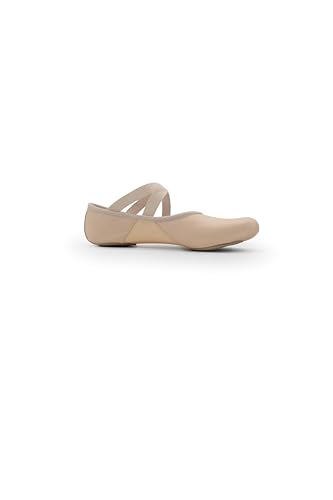 Capezio HanamiLeather that lasts$46Check price
Sizing, and why every chart disagrees
Ballet shoe sizing is not standardised, and the makers do not pretend otherwise. On their own product pages:
Bloch say to start about two sizes down from your normal street shoe size.
Capezio say women start about two sizes up and men about four sizes up.
Stelle sidestep the whole thing and tell you to measure your foot heel to toe and match it to their chart.
Those are four-size-apart instructions from two respected makers, and both are correct for their own lasts. This is why generic advice about ballet shoe sizing is worse than useless.
So: use the maker's own chart, for the specific model, every time. Measure your foot in centimetres — stand on paper, mark heel and longest toe, measure — and match that number rather than converting from a shoe size.
And fit is snug with the toes flat and fully extended, no bunching and no spare fabric at the end. A ballet slipper should look like a second skin, because the line of the foot is part of the point.
Canvas or leather, full sole or split
Two choices, and neither has a universally right answer.
Canvas is cheaper, lighter, breathes better and can go through a washing machine in a bag. It grips the floor slightly more, which most people find helpful, and it moulds quickly. It also wears out faster, particularly at the toe if you do a lot of floor work.
Leather lasts considerably longer, moulds slowly into a shape that is genuinely yours, and slides a little more, which some teachers prefer for turns. It is warmer, does not wash, and takes longer to break in.
For a first pair, canvas. For someone in class several times a week where shoes are a recurring cost, leather often works out cheaper per month.
Full sole has one continuous piece of suede under the whole foot. It resists the foot pointing, which makes the foot work harder, so it is used for absolute beginners and many children to build strength.
Split sole has suede under the ball and heel with bare fabric between. It lets the foot articulate and shows the arch, which is why nearly every adult dancer wears them. All three shoes here are split sole.
 Best first pair
Stelle Ballet Shoes for Women Highly Stretch Canvas Split
Highly stretchy canvas with a cotton lining, pre-sewn wide elastics and a split suede sole, at a price that makes trying ballet as an adult an easy decision rather than a considered one. The elastics being already sewn matters more than it sounds: most ballet slippers arrive with loose elastic and expect you to sew it on yourself in the right place, which is a genuine barrier for a first-timer. Handmade pleats at the toe give the foot room without pressure. The suede sole is anti-abrasive and grips properly. Stelle ask you to measure heel to toe and match their chart rather than converting from a street size, which is the right instruction. Canvas wears faster than leather, so expect to replace them sooner.
What's good
- Elastics pre-sewn — nothing to do before your first class
- Very stretchy canvas moulds quickly
- Split suede sole with proper grip
- Cheap enough to just try ballet
What's not
- Canvas wears faster than leather
- Not as refined a line as the pricier pairs
- Measure heel to toe — street size will mislead you
- Cotton lining holds moisture
 Best for regular class
Bloch Dance Women's Synchrony Split Sole Stretch Canvas
Bloch build the canvas around fibres that stretch and recover, so the shoe keeps returning to the natural shape of the foot instead of gradually bagging out, which is what happens to cheaper stretch canvas after a term. The result is a noticeably sleeker line on the foot, which matters in a form where the line is the point. Wide elastic at the top plus pre-sewn crossed elastic holds it without digging in. The outsole is wider than usual with no ridges, letting the toes spread naturally, which genuinely helps balance and turning. Bloch's own instruction is to start about two sizes down from street shoe size, with B for narrow and C for medium — follow that, not a generic chart.
What's good
- Fibres stretch and recover — keeps its shape over a term
- Sleeker line on the foot than cheaper canvas
- Wider ridge-free outsole helps balance and turns
- Crossed elastic already sewn on
What's not
- Sizing runs very differently — two sizes down from street
- Narrow and medium widths only
- Canvas still wears faster than leather
- Dearer than a first-pair shoe needs to be
 Best leather
Capezio Women's Hanami Leather Ballet Shoe, Light Pink,8.5M
Burro leather with stretch textile panels and a four-way stretch neoprene arch, which is the combination that makes a leather shoe worth the extra: leather where you want durability and shape, stretch where the foot needs to articulate. Leather takes longer to break in than canvas and then keeps going far longer, moulding into something specific to your foot rather than generic, and the leather sole and heel patches wear well on a studio floor. If you are in class several times a week, that longevity usually makes it cheaper per month than replacing canvas. Capezio's sizing runs the opposite way to Bloch's: women start about two sizes up from street size and men about four, which is on their own listing.
What's good
- Leather lasts far longer than canvas
- Neoprene arch stretches four ways where the foot bends
- Moulds into a shape specific to your foot
- Leather sole and heel patches wear well
What's not
- Sizes UP two, the opposite way to Bloch
- Longer to break in than canvas
- Warmer, and cannot go in the wash
- Twice the price of a first pair
Pointe work needs years of training and a proper professional fitting, because going en pointe before the foot and ankle are strong enough causes real, lasting injury. No soft slipper prepares you for it and none converts. A teacher decides when a student is ready, and the answer for an adult beginner is usually "not yet, and possibly not ever" — which takes nothing away from the class.
What else you actually need for a first class
Very little, which is one of the nicer things about starting ballet.
Shoes. The one thing you genuinely have to buy, and the one thing you cannot borrow, because a slipper moulds to a foot.
Something you can move in. Leggings and a fitted top are fine for almost every adult beginner class. Nobody expects a leotard, and most studios say so explicitly if you ask.
Socks or tights, or bare feet in the shoe. Ballet slippers are usually worn over tights or thin socks, and many adults wear them barefoot. Thick socks change the fit, so decide before sizing.
Hair tied back, if it is long enough to be in your eyes.
That is it. You do not need a skirt, warm-ups, or anything with a brand on it. Turn up to a beginner adult class in leggings with slippers in a bag and you are correctly equipped, and every studio worth attending will tell you the same.
Before you buy
Use the maker's own chart for that model. Generic rules are wrong more often than right.
Measure your foot heel to toe in centimetres and match the number.
Split sole for adults, full sole only if a teacher asks for it.
Canvas for a first pair, leather if you are in class weekly.
Check whether the elastic is pre-sewn or you have to sew it yourself.
Ballet slipper questions
What size ballet slippers should I buy?
Canvas or leather ballet shoes?
What is the difference between full sole and split sole?
Can I use ballet slippers for pointe work?
Buy the maker's size, not a rule you read somewhere, and measure your foot in centimetres first. The Stelle canvas pair is the sensible first buy: elastics already sewn on, so there is nothing standing between the parcel and your first class. Move to the Bloch Synchrony if you are going weekly and want canvas that holds its shape through a term. The Capezio leather lasts longest, and remember it sizes the opposite way to the Bloch.
Ready to actually do it?
The first ballet quest takes an evening, and it tells you whether the gear was worth it better than any review can.
Start BalletThe HobbyStack editorial team researches each guide against manufacturer specifications, published resources and practitioner sources. Every product is checked for availability and described against its current listing before publication, and prices are re-checked when guides are updated.
About our editorial process →More gear guides
All guides
Best Twirling Baton (2026): Length Is Measured Against Your Arm
A baton is sized to the twirler, not to a category. Hold your arm out straight and the baton should reach from the centre of your chest to the tip of your middle finger. Too long and it catches your shoulder on a horizontal roll; too short and the balance is wrong for every release you try.

Best Men's Ballroom Dance Shoes (2026): The Sole Is the Point
Turning in street shoes means your foot grips the floor while your body keeps rotating, and something has to absorb that difference. It is your knee. A suede sole lets the foot pivot instead, which is why dance shoes exist and why the sole matters more than anything else about them.

Best Voice Recorder for Actors (2026): Hearing Yourself Is the Whole Point
Actors improve fastest by hearing themselves, because the performance you feel giving is not the performance that arrives. A recorder makes that gap visible — the rushed line, the dropped ending, the habit you did not know you had. What surprises most people is that the room you record in matters more to the result than the device you record with.

Best Beginner Drum Kits: Electronic vs Acoustic and What to Buy First
For most beginners the real decision is not which kit: it is electronic or acoustic, and that usually comes down to how much noise your home can take. Here are the three kits worth buying, how we chose them, and what to expect once you start playing.

Best Drum Practice Pads for Beginners
A practice pad is where most of your real progress happens: quietly, anywhere, building the hands that the kit can't teach as efficiently. Here are three, how we chose them, and what to expect from daily pad practice.

Best Drum Thrones for Beginners
A throne is not a chair: where you sit sets your posture, reach, and how long you can play without back pain. Beginners skip it and regret it. Here are three thrones worth sitting on, how we chose them, and what to expect.