Best Twirling Baton (2026): Length Is Measured Against Your Arm
A baton is sized to the twirler, not to a category. Hold your arm out straight and the baton should reach from the centre of your chest to the tip of your middle finger. Too long and it catches your shoulder on a horizontal roll; too short and the balance is wrong for every release you try.
HobbyStack may earn a commission from links on this page at no extra cost to you. Our picks are chosen on merit; the commission helps fund the research.
- Measure from the centre of the chest to the fingertip. That is your length.
- 3/8 inch is the standard shaft. Thinner shafts flex and feel cheap.
- The ball end is heavier than the tip. That is what makes it spin predictably.
- Rubber ends save your floor, your shins and the baton itself.
- Learn outdoors or in a high room. Ceilings end more batons than drops do.

Sizing, which decides everything else
The measurement. Hold one arm straight out to the side. A correctly sized baton runs from the centre of your chest to the tip of your middle finger. An equivalent check is armpit to fingertip.
As a rough guide by height, that lands at 20 to 24 inches for young children, 24 to 26 for most juniors, and 26 to 30 for teenagers and adults. The Starlet II here at 28 inches suits an average adult or a tall teenager; the 22 inch SIRCLES suits a smaller child.
Why it matters so much. Twirling is a sequence of rotations around the hand, the wrist and the body, and the baton has to clear your shoulder and your hip on horizontals. Too long and it clips you on every pass, which both hurts and stops the rotation dead. Too short and the weight distribution gives you too little rotational inertia, so releases tumble unpredictably and nothing stays flat.
Do not buy long to grow into. Unlike a bike, a too-long baton teaches compensations that have to be unlearned. Batons are cheap enough to replace as a child grows.
Then the weighting. A baton is not uniform: the ball end is heavier than the tip end, which is what gives it a consistent axis and makes rolls and releases behave the same way every time. Learning which end is which by feel, without looking, is one of the first real skills.
Shaft, ends and the practical realities
Shaft diameter. The competition standard is 3/8 inch, and both the SIRCLES and the Starlet II here use it. Thinner shafts are cheaper and they flex noticeably in fast work, which makes the baton feel vague and makes precise finger rolls harder. A flexing baton is the most common reason a beginner's twirl looks loose.
Material. Stainless steel and powder-coated steel are both normal. Powder coat gives a slightly grippier surface and hides scuffs; bare stainless is slicker and brighter. Aluminium shafts exist, are lighter, and bend.
The ends are consumable. Rubber or plastic tips take every drop, and a baton spends a lot of its early life on the floor. They protect the shaft from flaring, protect your floor from dents, and protect your shins. Replacement ends are sold separately and are worth having spares of.
Ribbons are for something else. Several budget batons, including the Dasiyoki here, bundle a long dance ribbon. That is rhythmic gymnastics equipment, not twirling equipment, and it will not help you learn baton. Treat it as a bonus rather than a feature.
Where you practise matters more than you expect. Vertical tosses need serious height, and the overwhelming majority of broken batons and broken light fittings come from practising a toss indoors. Learn rolls and horizontals inside; take tosses outside or into a sports hall.
Expect to drop it constantly. That is the activity, not a sign of failure, which is why the rubber ends and the hard shaft matter.
 Best for trying it
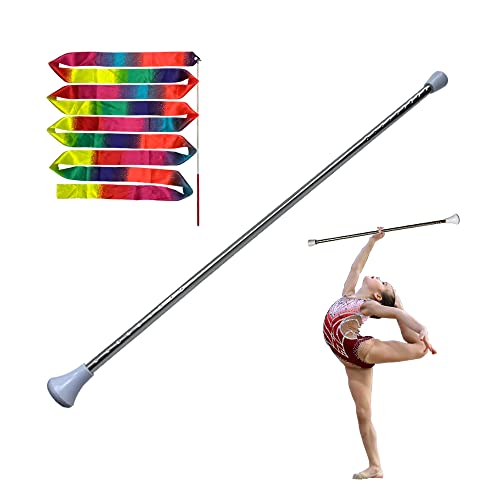
Dasiyoki 26-inch Twirling Baton Spinning Dance Baton Metal Rhythmic Gymnastics Conducting Batons for Child in
A twenty-six inch metal baton with sturdy plastic ends, which is a sensible length for most juniors and the cheapest honest way to find out whether twirling appeals. The shaft is smooth metal in the traditional pattern and the ends take the drops. A long rainbow dance ribbon is bundled in, which belongs to rhythmic gymnastics rather than twirling, so treat it as a bonus. Build quality is what the price suggests.
What's good
- 26 inches suits most junior twirlers
- Plastic ends take the constant drops
- Cheapest way to test whether it appeals
- Dance ribbon included as a bonus
What's not
- Shaft is thinner than the 3/8 inch standard
- Flexes in fast work, which feels vague
- Ribbon is gymnastics kit, not twirling kit
- No brand backing or spare parts
 Best for smaller twirlers
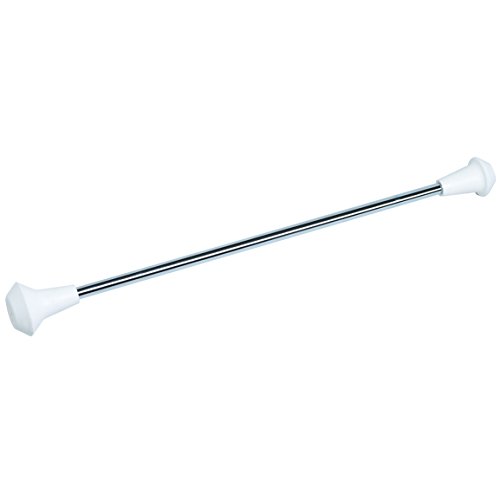
SIRCLES 22 Inch Twirling Marching Baton in Stainless Steel with Rubberized Ends Mini Shaft 3/8 with 2 Dancing
Twenty-two inches on a proper 3/8 inch stainless shaft, which is the right combination for a smaller child: short enough to clear the shoulder on horizontals and stiff enough not to flex when the speed comes up. Rubberised ends protect the floor and the shaft through the inevitable drops, and two ribbons are included for group and display work. At 22 inches it is simply too short for most teenagers and adults.
What's good
- Proper 3/8 inch shaft, so it does not flex
- Stainless steel is bright and holds up
- Rubberised ends protect floors and shins
- Correct length for a smaller child
What's not
- 22 inches is too short for teens and adults
- Bare stainless is slicker than powder coat
- Ribbons are display kit rather than training kit
- Less established than Starline
 Best for most beginners
Starline (SR28) Starlet II 28" Mini Shaft Baton
Starline make batons for the sport rather than for a marketplace listing, and this is their class model: twenty-eight inches on a standard 3/8 inch shaft with a very durable powder coat. The maker describes it as the most popular model for class participants and the one many coaches prefer for beginner students, which is the closest thing to a recommendation the category offers. Twenty-eight inches suits adults and taller teens.
What's good
- The model coaches actually hand to beginners
- Standard 3/8 inch shaft with no flex
- Durable powder coat grips better than bare steel
- Spare ends and parts are easy to source
What's not
- 28 inches is too long for most children
- No ribbon or extras included
- Dearest here
- Plain finish compared with marketplace batons
A vertical toss needs far more height than a normal ceiling gives, and the overwhelming majority of bent batons, cracked light fittings and holes in plasterboard come from someone trying one in a living room. Learn finger rolls, wrist twirls and horizontals inside where the baton stays near your body. Take anything that leaves your hand upward outdoors or into a hall, and keep other people well clear while you are learning to catch.
The first few weeks
Learn the ends by feel. Ball end and tip end behave differently and almost every move specifies one. Being able to find the right end without looking is the foundation everything else sits on.
Start with the figure eight. Wrist rotation with the baton flat, tracing a figure eight beside your body. It builds the loose wrist that every other move needs and it is almost impossible to hurt yourself with.
Then the horizontal twirl. Baton flat, spinning around the hand between thumb and fingers. Keep the plane level — a wobbling plane is the usual beginner fault and it comes from gripping too hard.
Grip lightly. A tight grip stops the baton rotating and causes most dropped catches. The hand guides, it does not clamp.
Spot your catches. Watch the ball end specifically rather than the whole baton, the same way a juggler watches the apex rather than the hands.
Protect your knuckles early. Finger rolls bruise the back of the hand while you are learning, and long sleeves genuinely help in the first fortnight.
Keep spare ends. A baton with a missing tip flares at the shaft end, scratches floors and becomes unsafe to catch.
Before you buy
Measure chest-centre to fingertip, and buy that length.
Do not buy long to grow into. It teaches bad habits.
3/8 inch shaft so it does not flex at speed.
Rubber or plastic ends, and buy spares.
Ignore bundled dance ribbons. They are gymnastics kit.
Twirling baton questions
How do I work out what length baton I need?
Why does shaft thickness matter?
Are the two ends of a baton different?
Do I need the ribbon that comes with cheap batons?
The Starline Starlet II is the one to buy for an adult or taller teenager: a proper 3/8 inch shaft, a tough powder coat, and the model coaches actually hand to beginners. Take the 22 inch SIRCLES for a smaller child, since length matters more than anything else here. The budget 26 inch is a reasonable way to test the water. Measure your arm before you order any of them.
Ready to actually do it?
The first baton twirling quest takes an evening, and it tells you whether the gear was worth it better than any review can.
Start Baton TwirlingThe HobbyStack editorial team researches each guide using practitioner communities, published resources, and direct input from active hobbyists. Every guide is reviewed for accuracy before publication and updated when practices change.
About our editorial process →More gear guides
All guides
Best Men's Ballroom Dance Shoes (2026): The Sole Is the Point
Turning in street shoes means your foot grips the floor while your body keeps rotating, and something has to absorb that difference. It is your knee. A suede sole lets the foot pivot instead, which is why dance shoes exist and why the sole matters more than anything else about them.

Best Ballet Slippers (2026): There Is No Universal Size Rule
Two of the shoes below come with sizing instructions that point in opposite directions. Bloch say start two sizes down from your street shoe size; Capezio say women start two sizes up and men four. Neither is wrong, and if you buy either based on a rule you read elsewhere you will get the wrong shoe.

Best Voice Recorder for Actors (2026): Hearing Yourself Is the Whole Point
Actors improve fastest by hearing themselves, because the performance you feel giving is not the performance that arrives. A recorder makes that gap visible — the rushed line, the dropped ending, the habit you did not know you had. What surprises most people is that the room you record in matters more to the result than the device you record with.

Best Beginner Drum Kits: Electronic vs Acoustic and What to Buy First
For most beginners the real decision is not which kit: it is electronic or acoustic, and that usually comes down to how much noise your home can take. Here are the three kits worth buying, how we chose them, and what to expect once you start playing.

Best Drum Practice Pads for Beginners
A practice pad is where most of your real progress happens: quietly, anywhere, building the hands that the kit can't teach as efficiently. Here are three, how we chose them, and what to expect from daily pad practice.

Best Drum Thrones for Beginners
A throne is not a chair: where you sit sets your posture, reach, and how long you can play without back pain. Beginners skip it and regret it. Here are three thrones worth sitting on, how we chose them, and what to expect.