Best Beginner Journal 2026: value 3-pack vs Leuchtturm1917 vs Rhodia
Here is the honest truth about starting a journal: the notebook barely matters. People have filled beautiful journals with a 3 dollar spiral pad, and people have let a 200 dollar leather one sit empty out of fear of ruining it. What keeps you journaling is showing up, not the paper. That said, a notebook that lies flat and does not bleed ink can make the habit feel a little more inviting, and a bad one can quietly annoy you into quitting. So this guide keeps it simple: three real journals people actually buy, from cheap-but-good to a treat you can grow into. Pick one, start writing, and do not overthink it.
HobbyStack may earn a commission from links on this page at no extra cost to you. Our picks are chosen on merit; the commission helps fund the research.
- The habit matters far more than the notebook. Almost any journal works, so do not let picking one stall you.
- For most people the Leuchtturm1917 A5 dotted is the sweet spot: numbered pages, a built-in index, and paper that lies flat.
- Dotted is the most flexible ruling for beginners. It guides your writing without boxing you in like lines or leaving you adrift like blank.
- Paper weight is the thing you feel every day. 80gsm and up keeps ink from ghosting and bleeding to the next page.
 Dotted A5 Journal Value 3-PackStarting cheap without overthinking it$22Check price
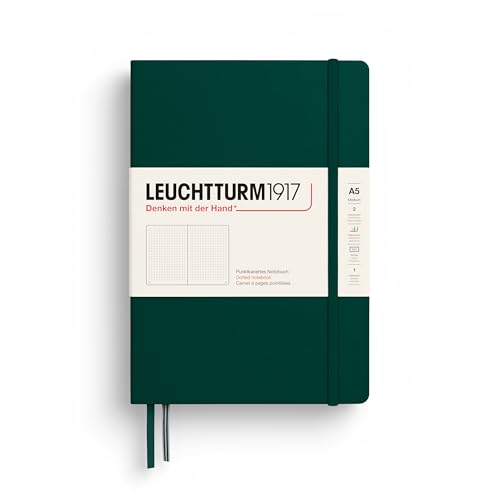 Our pickLeuchtturm1917 Medium (A5) Dotted HardcoverAlmost everyone. The default beginner journal that you will not outgrow.$26Check price
 Rhodia Webnotebook (Webbie) A5 Dot GridAnyone who writes with fountain pens or just wants the paper to feel like a treat.$32Check price
The first real decision is the ruling, meaning what is printed on the page. You have three options. Lined is familiar and good for pure writing, but it locks you into horizontal rows. Blank is total freedom, which sounds nice until your sentences drift downhill and you wish you had a guide. Dotted is the middle ground almost everyone lands on: a faint grid of dots that keeps your writing straight, helps with the occasional list or little sketch, then disappears when you do not need it. If you are unsure, get dotted. The second decision is size. A5 is the standard journal size, roughly 5.8 by 8.3 inches, about the size of a paperback book. It is big enough to write freely and small enough to carry in a bag. You will see A6 (pocket) and B5 (larger) too, but A5 is the safe default that every brand supports. Get comfortable with those two words, dotted and A5, and you have basically filtered the whole market down to a handful of notebooks.
After that it comes down to paper and binding, which is where the cheap and the nice notebooks separate. Paper weight is measured in gsm (grams per square meter). Thin office paper is around 70gsm and tends to show ghosting, where you can see your writing through the page, or outright bleed with a marker. Journals worth buying start at 80gsm and climb to 120gsm or more, which handles almost any pen you throw at it. Binding matters just as much. A journal that lies flat when you open it, instead of fighting to snap shut, is the difference between writing comfortably and pinning the page down with your forearm. Thread-sewn binding does this well and holds up for years. Small extras add up too: numbered pages and a blank index let you find old entries, a ribbon marker saves your spot, and an elastic band keeps it closed in a bag. None of these are essential, but once you have used a journal with them, going back feels like a downgrade.
 Best budget value
Dotted A5 Journal Value 3-Pack
If you just want to start writing today without spending much, a value multipack like this is the honest budget answer. You get three dotted A5 journals with reasonable 120gsm paper for roughly what a single Leuchtturm costs, so you can journal freely, make mistakes, and not feel precious about a pricey notebook. The dot grid is faint enough to guide your writing without dominating the page, and A5 is the standard size most people settle on. The tradeoff is what you would expect at this price: these are unbranded, the covers and binding are not as durable or as nice in the hand as a Leuchtturm or Rhodia, and paper quality varies a little between batches, so a very wet fountain pen may ghost through. But for building the habit, or for anyone who fills notebooks fast, three-for-one is hard to argue with.
What's good
- Three journals for about the price of one nicer one
- Dotted A5 with usable 120gsm paper
- No reason to feel precious, so you actually write
- Great for anyone who fills notebooks quickly
What's not
- Unbranded, so covers and binding feel budget
- Paper can ghost with very wet fountain pens
 Best for most people
Leuchtturm1917 Medium (A5) Dotted Hardcover
The Leuchtturm1917 (say it 'loysht-toorm') quietly became the standard for a reason. Open it and it lies dead flat thanks to the thread-sewn binding, so you are never wrestling the page. Every page is numbered, there is a blank table of contents in the front, and it ships with stickers to label the spine, which together make it genuinely easy to find an entry from three months ago. The 80gsm ivory paper is smooth and handles everyday pens well, and you get 251 pages, two ribbon markers, an elastic closure, and a back pocket. The one honest catch: that 80gsm paper, while great for gel and ballpoint, will show some ghosting and can bleed a little with wet fountain pens or markers, which frustrates people who journal with those. For plain pen-and-notebook journaling, though, it is hard to do better without spending real money, and it comes in a huge range of colors so you find one you actually want to pick up.
What's good
- Lies completely flat from page one thanks to thread-sewn binding
- Numbered pages plus a blank index make old entries easy to find
- 251 pages, two ribbons, elastic, and a back pocket come standard
- Sold in dozens of colors so you find one you like
What's not
- 80gsm paper ghosts and can bleed with wet fountain pens or markers
- Costs roughly twice a budget journal for a similar page count
 Best paper to grow into
Rhodia Webnotebook (Webbie) A5 Dot Grid
The Rhodia Webnotebook, nicknamed the Webbie, is what you buy when the writing experience itself is the point. Its 90gsm Clairefontaine paper is famously smooth and about as ink-friendly as notebook paper gets, which is why fountain pen users reach for it: most inks sit on top and dry to crisp lines instead of feathering. The leatherette hardcover, elastic closure, and ribbon marker feel genuinely nice in the hand. It is not overkill for a beginner, but it is a treat rather than a necessity, and it makes a couple of honest trade-offs to get that paper. There are no page numbers and no index, so it is less organized than a Leuchtturm out of the box, and it has fewer pages. The ivory paper and leatherette cover are not to everyone's taste either. Buy this one if you already know you love writing and want the page to reward it, not as your very first experiment.
What's good
- 90gsm Clairefontaine paper is exceptional with fountain pens and gel ink
- Leatherette hardcover and elastic feel like a genuine upgrade
- Ink dries crisp with very little feathering or bleed
- Compact and well made for carrying around daily
What's not
- No page numbers or index, so it is less organized out of the box
- Fewer pages than the Leuchtturm at a higher price
The most common journaling mistake has nothing to do with which notebook you pick. It is buying a beautiful one and then being too afraid to 'ruin' it, so it sits blank on a shelf. Blank pages are the goal, not a risk. Whatever you buy, write the first messy, boring entry on page one today. A cheap journal full of scribbles beats a perfect one that stays empty, every single time.
If you want a simple answer: buy the Leuchtturm1917 A5 dotted. It is the one most people should start with, and it does everything a beginner needs without you ever bumping into its limits. Only go cheaper, to the value 3-pack, if you genuinely are not sure the habit will stick and want to spend as little as possible to find out, which is a completely reasonable plan. Only go pricier, to the Rhodia Webbie, if you already know you love the feel of writing, especially with fountain pens, and want the paper to match. But if you are staring at the options and just want to start, the Leuchtturm is the safe pick you will not regret.
Before you buy
Write your first entry the day it arrives, even if it is one boring sentence. Breaking the blank-page seal is the whole battle.
Do not buy a fancy pen to match. A basic gel pen or ballpoint you already own works fine, and cheaper paper handles those best anyway.
If you journal with a fountain pen or markers, prioritize paper weight (90gsm or higher) over features, or you will fight bleed-through.
Keep the journal somewhere you will see it, next to your bed or your coffee spot. Out of sight really does mean out of habit.
Journal questions beginners actually ask
Dotted, lined, or blank: which should a beginner pick?
Do I really need an expensive journal to start?
What does gsm mean and how much do I need?
Why does everyone recommend A5 size?
How many pages should a first journal have, and will I fill them?
What is the difference between Leuchtturm1917 and Moleskine?
The honest bottom line: pick the Leuchtturm1917 A5 dotted and start today. It is the notebook most beginners should own, with numbered pages, an index, and paper that lies flat, and you are very unlikely to outgrow it. Grab the budget 3-pack instead if you want to spend as little as possible while you test whether the habit sticks, or the Rhodia Webbie if great paper is its own reward to you. Any of the three will do the job. The only wrong move is letting the choice keep you from writing the first page.
Ready to actually do it?
The first journaling quest takes an evening, and it tells you whether the gear was worth it better than any review can.
Start JournalingThe HobbyStack editorial team researches each guide against manufacturer specifications, published resources and practitioner sources. Every product is checked for availability and described against its current listing before publication, and prices are re-checked when guides are updated.
About our editorial process →More gear guides
All guides
Best Pen for Journaling (2026): Gel, Ballpoint or Fountain
The pen is the only piece of journaling gear that can actually stop you writing. A pen that skips makes you reluctant to start, and ink that bleeds through ruins the other side of the page, which quietly halves the notebook you just bought. None of the fixes are expensive. They mostly come down to matching ink to paper.

Best Beginner Meditation Cushions (2026): 3 Zafus
A zafu is the round cushion you sit on to meditate. It lifts your hips above your knees, which lets your back stack up straight so you can sit still without slumping or going numb. You can start free by folding a firm blanket, and honestly that works fine for a while. The one real choice here is the fill: buckwheat hulls (heavy, firm, adjustable) or foam (lighter, softer, holds its shape). Most people should get buckwheat.
Best Singing Bowl (2026): Size Decides the Note
Singing bowls are sold with a great deal of claim attached, and almost none of it helps you choose one. The things that actually differ between bowls are acoustic and checkable: how big it is, how thick the wall is, whether it was hammered or spun, and how long it rings. Those decide the note you get and whether you enjoy playing it.

Best Yoga Mat for Beginners 2026: Gaiam vs JadeYoga vs Manduka
The only thing that really matters in a beginner yoga mat is grip, a mat that slides turns downward dog into a battle. Thickness and material are the next decisions. Here are three mats that nail it, from an inexpensive Gaiam to a buy-it-for-life Manduka.

Best Beginner Pilates Mats (2026): 3 Picks
A Pilates mat is just a thicker exercise mat, usually 6mm to 12mm, so your spine, hips, and tailbone are not grinding into the floor during roll-ups and bridges. The one spec that actually matters is thickness plus a surface that does not slide when you push into it. Everything else is a nice-to-have.

Best Essential Oil Diffuser for Beginners (2026): 3 Picks for Every Room
A diffuser is the heart of aromatherapy at home, and the kind you want is an ultrasonic diffuser: it disperses a cool mist of water and essential oil without heat, so the oils keep their properties instead of being cooked off. The main things that matter are tank size (how long it runs) and your room size. Here are three good ones, from a tiny bedside unit to a large-room diffuser with oils included.