Best Beginner RPG Dice Set 2026: Wiz Dice vs Chessex vs Haxtec
Good news: dice are the cheapest part of getting into tabletop RPGs, and almost any 7-dice set will get you through your first game just fine. You do not need to overthink this. What actually matters for a beginner is that you can read the numbers quickly, that you have a full set of the right shapes, and that you are not spending a fortune on your very first purchase. The fancy stuff (metal, gemstone, glow-in-the-dark) is fun, but it is a want, not a need. Below are three honest picks: a cheap bag that gets dice into everyone's hands, the standard single set most players end up with, and a metal set for when you know this hobby is sticking around.
HobbyStack may earn a commission from links on this page at no extra cost to you. Our picks are chosen on merit; the commission helps fund the research.
- A polyhedral set is 7 dice (d4 through d20), and it's the one piece of gear every tabletop RPG actually needs.
- Readable numbers beat pretty numbers. High-contrast ink you can read across a dim table matters more than swirl and sparkle.
- Acrylic is the right call for your first set. Metal looks great but it's heavy, loud, and can ding a table.
- Buy cheap first, upgrade later, because a few sessions will teach you what you actually like.
 Wiz Dice 140-Dice Bulk PackGroups, teachers, and anyone who wants a pile of dice without spending much$20Check price
 Our pickChessex Gemini Polyhedral 7-Die SetThe one set most players should start with and stick with$13Check price
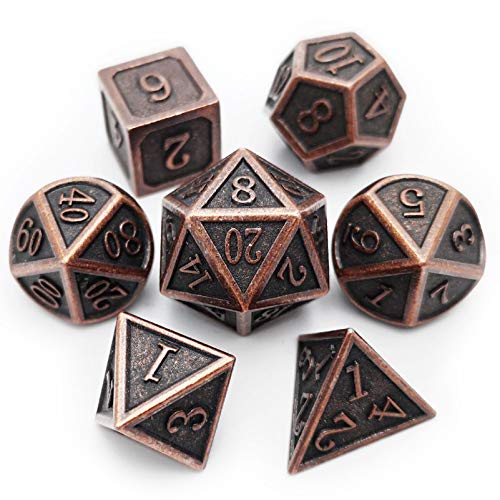 Haxtec Antique Metal DND Dice SetPlayers who know they're staying, and want dice that feel like an event$13Check price
A polyhedral set is seven dice, and each one does a specific job. The d20 (twenty sides) is the star, since most RPGs ask you to roll it for attacks, checks, and saves. Then there is the d12, d10, d8, d6, and d4, plus a second d10 marked in tens (00 through 90) so you can roll percentages. If you are coming from board games, the d6 is the only shape you already know. The rest look intimidating for about ten minutes and then feel completely normal. You do not need to memorize anything, because you can tell the dice apart by their shape, and your game's rules tell you which one to grab.
The single biggest thing that separates a good beginner set from an annoying one is readability. When you are new, you want to glance at a die and instantly know what you rolled, ideally without leaning across the table or asking someone. That means high-contrast numbers: white ink on a dark die, or dark ink on a light die. The gorgeous translucent sets with numbers the same color as the body look amazing in photos and are genuinely hard to read in a dimly lit living room. Save those for later. For now, boring and legible wins.
Almost every beginner set is acrylic or resin, and that is exactly what you want. Acrylic is light, cheap, rolls fairly, and does not hurt your table or your dice tower. Metal dice are the upgrade people lust after, and they do feel fantastic in the hand, but they are heavy, they are loud, and dropped on a hard table they can leave a mark (on the table or on themselves). Metal is a treat for when you already know you love the hobby, not a smart first buy. Gemstone and resin art dice are their own rabbit hole, and you can happily ignore them until you have played a while.
The other choice is one set versus a bulk bag. A single set is all one player needs. But bulk bags (often 15 to 20 complete sets for the price of two or three nice singles) are quietly one of the best beginner buys, especially if you are the one teaching friends. You can hand everyone dice, not care if they wander off, and slowly figure out which colors you can actually read. A lot of experienced players started with a random bulk bag and never regretted it. Buy cheap, play a few sessions, then spend money on the set you actually want.
 Best budget pick
Wiz Dice 140-Dice Bulk Pack
This bulk pack is 140 dice, which is 20 complete seven-dice sets in different colors, for roughly the price of two or three nice single sets. That math is the whole pitch. If you are the person getting friends into the hobby, this bag means everyone at the table gets their own dice on night one, and it does not matter if a set walks home in someone's pocket. The quality is genuinely fine: the acrylic is standard, the numbers are inked, and they roll like normal dice. This is not artisan gear, and it does not pretend to be. Colors are pot luck, a few sets will have combinations you find hard to read, and the ink can be a little uneven up close. But as a first purchase, or as the communal bowl of dice for a group, it is hard to beat. A lot of people keep this bag around for years even after they buy fancier dice.
What's good
- 20 complete sets means nobody at the table is left without dice
- Costs about the same as two or three single sets
- Full range of colors lets you find what you can actually read
- Great for lending out without worrying about losing them
What's not
- Colors are random, so a few sets will be hard to read
- Standard quality, not the crisp edges or bold ink of a nicer single set
 Best for most beginners
Chessex Gemini Polyhedral 7-Die Set
Chessex is the closest thing tabletop dice have to a default. Walk into any game store and this is what is on the shelf, which is a good sign. The Gemini line swirls two colors together with contrasting numbers, and it hits the sweet spot for a first real set: it looks nice without being so busy that you cannot read it. These are 16mm, the standard size, so they feel right in the hand and match what everyone else at the table is rolling. Edges are crisp, the numbers are cleanly inked, and they roll true. This is the set a lot of players buy once and keep using for years. The honest catch is that a few Gemini color combos are lower contrast than others, so pick a version with white or clearly light numbers rather than one where the ink blends into the swirl. And because these are so common, your dice will not exactly stand out, but that is a small price for reliable quality.
What's good
- The standard size and quality most tables use
- Crisp edges and clean, readable numbering
- Sold almost everywhere, so easy to replace or match
- Looks good without sacrificing legibility
What's not
- Some color combos have lower contrast, so choose carefully
- Very common, so nothing about it feels unique
 Best premium pick
Haxtec Antique Metal DND Dice Set
Metal dice are a want, not a need, and Haxtec makes the version a lot of people actually buy when they finally give in. Each die is cast zinc alloy, so they have real weight and a satisfying clack, and the numbers are deeply engraved and paint-filled, which usually makes them very easy to read. They come in a small leather-style pouch, and the whole thing feels like a gift, which is often exactly what it is. Here is the honest part. Metal is heavy, and a full set thrown hard will chip a table, ding a dice tower, or scuff the dice themselves, so you really do want a dice tray or a mat. They are also louder than plastic, which some tables love and some find distracting. Haxtec sensibly makes the smaller dice a touch smaller to keep the set from feeling like a pocket full of change. This is a treat to earn, not a first buy, but as a treat it is a good one.
What's good
- Real heft and a satisfying roll plastic can't match
- Deeply engraved, paint-filled numbers are easy to read
- Comes with a leather-style storage pouch
- Durable enough to last for years
What's not
- Heavy and loud, and can damage tables without a tray or mat
- Costs several times more than a good acrylic set
New players often think their set has a duplicate die by mistake. It doesn't. One d10 is numbered 0 to 9 and the other in tens (00, 10, 20, up to 90). Roll them together and you get a number from 1 to 100, which games call a percentile or d100 roll. So the extra d10 is not a spare, it is half of a two-dice combo. Keep both, even though you'll use the single d10 far more often than the pair.
If you are buying one thing, get the Chessex single set. It is the size and quality most tables use, it is easy to read, and you will not feel a need to replace it. If you are getting a group into the hobby or you just want maximum dice for minimum money, the Wiz Dice bag is the smarter move, and honestly a lot of people should start there. Save the Haxtec metal set for when you already know you love this, or for gifting it to someone who does. There is no wrong answer here, and unlike most gear, you can own all three without spending much.
Before you buy
Read before you buy. Look at a photo of the actual numbers and ask yourself if you could read them fast across a table. If the ink matches the die color, skip it.
Get a dice tray or even a shallow bowl. It keeps dice from flying off the table, protects the surface, and matters a lot the moment you switch to metal.
One d10 is the tens die (00 to 90). Do not panic that you got two of the same die. Rolled together they make a d100.
Start cheap on purpose. Play a few sessions with a budget set, notice which colors you keep reaching for, then buy the nice set knowing what you actually like.
Dice questions beginners actually ask
How many dice do I need to start playing D&D?
What is the difference between the two d10s in my set?
Are metal dice worth it for a beginner?
Does the material (acrylic or resin) actually matter?
Why are some dice so hard to read?
Do I need special dice for other RPGs, or just D&D?
For your first dice, keep it simple. A single Chessex set is the safe pick most players are happy with, and a Wiz Dice bag is the smarter buy if you are outfitting a group or just want the most dice for the least money. Metal sets like the Haxtec are a genuine treat, but they are something to grow into, not to start with. Whatever you pick, go for numbers you can read fast, grab a tray to roll into, and remember that the cheapest gear in this hobby is also the part you least need to agonize over.
Ready to actually do it?
The first tabletop rpg quest takes an evening, and it tells you whether the gear was worth it better than any review can.
Start Tabletop RPGThe HobbyStack editorial team researches each guide against manufacturer specifications, published resources and practitioner sources. Every product is checked for availability and described against its current listing before publication, and prices are re-checked when guides are updated.
About our editorial process →More gear guides
All guides
Best Cutting Mat for Prototyping (2026): Rotary Mats and Knives Do Not Mix
Self-healing mats are not all built for the same blade. OLFA say plainly that their rotary mat is for rotary cutters only and not for fixed-blade utility knives, which is exactly what you cut prototype cards with. It is the kind of thing you find out from the packaging rather than from the product name.

Best Cooperative Board Games (2026): Playing With the Table, Not Against It
Cooperative games are the easiest way into board games with people who do not think they like board games, because nobody gets knocked out and nobody has to be the one who ruins a friendship over a trade. They also have one specific failure mode that no box warns you about: the loudest player quietly starts telling everyone else what to do.

Best Gateway Board Games for Beginners (2026): 3 to Start With
Here is the honest truth: you do not need all three of these, any one of them is enough to get a good game night going. Gateway games are the ones built to win over people who think they do not like board games, the friends and family who groan at the word Monopoly. They teach in about five minutes, finish in under an hour, and leave everyone wanting another round. What they are not is Monopoly, Risk, or Trivial Pursuit, the long, luck-heavy, knock-you-out games most of us grew up quietly dreading. This guide is three different games at rising price and complexity, not three versions of one thing. Start with an easy, gorgeous crowd-pleaser, move to the classic that got a generation into the hobby, and step up to a richer game once your table is hooked. Buy one, get it played a few times, and add another only when your group is asking for more. Here are three good ones, and honest advice on where to start.

Best Poker Chip Set for Beginners (2026): 3 Sets for Every Home Game
A proper chip set is what turns a card game into poker night, and the thing that separates a cheap set from a great one is the weight and feel of the chips. A 500-count set covers a full table, and heavier clay-composite chips just feel like the real thing. Here are three good sets, from a light-but-complete starter to a casino-grade box.

Best Pottery Tool Set (2026): Six of the Twelve Do Nearly Everything
Open a twelve-piece pottery set and six tools will do nearly all your work: the wire cutter, a wooden rib, a metal rib, a loop trimming tool, a sponge and a needle tool. The rest get picked up once, found to duplicate something, and left in the canister for years.

Long Blade Freediving Fins (2026): Stiffness Is Matched to Your Legs, Not Your Ambition
Long blades are not about speed. A long blade moves a large volume of water per kick, so you cover distance at a slow, unhurried cadence instead of a fast one, and on a breath-hold the thing you are conserving is oxygen. A stiff blade you cannot load properly burns more of it than a soft blade you can.