Best Chess Clock (2026): Delay, Increment and Why It Matters
A chess clock changes the game more than any other piece of equipment, because it turns thinking time into a resource you can run out of. The part beginners rarely have explained is that not all timed chess is the same: delay and increment are different rules that produce very different endgames, and the clock you buy determines which ones you can play.
HobbyStack may earn a commission from links on this page at no extra cost to you. Our picks are chosen on merit; the commission helps fund the research.
- Increment adds time after every move and accumulates. Delay waits before your clock starts, and does not accumulate.
- Increment is what almost all modern online and tournament chess uses. Make sure your clock does it.
- Digital over analogue. An analogue clock cannot do delay or increment at all.
- If you play at a club, buy what the club uses — usually DGT. Familiar buttons matter under time pressure.
- Set-up matters more than features. A clock you cannot configure quickly is a clock you leave in a drawer.
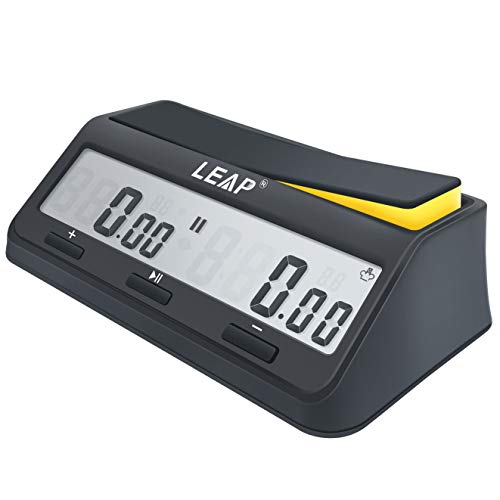 LEAP Digital Chess ClockHome and casual play$26Check price
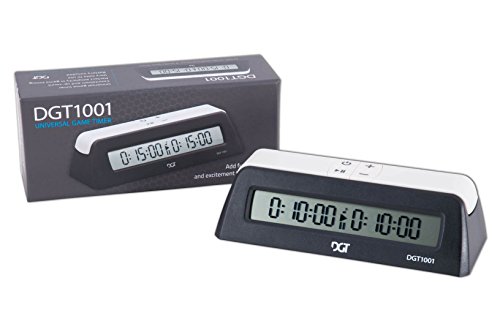 Our pickDGT 1001Most people$40Check price
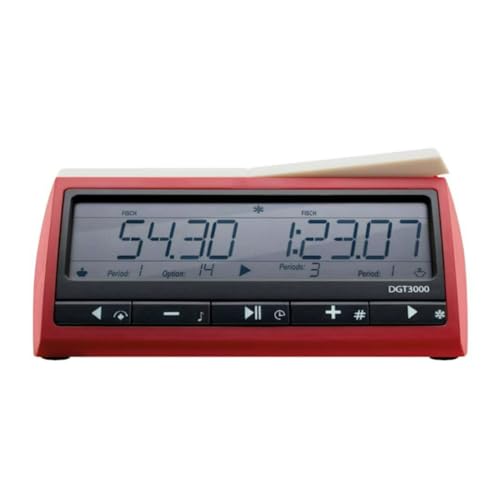 DGT 3000Club and tournament play$80Check price
Delay and increment, which are not the same thing
Both exist to stop games being decided by who can move a mouse or a hand fastest in a lost position. They do it differently.
Increment (also called Fischer) adds a fixed amount to your clock after every move you make, and it accumulates. In a 5+3 game you start with five minutes and gain three seconds each move — so if you move quickly you can finish with more time than you started. This is what online chess uses almost universally, and what most modern tournaments use.
Delay (Bronstein or simple delay) waits a few seconds before your clock begins counting down. Move within the delay and you lose nothing, but you never gain time. In a 5 d3 game you always have three free seconds per move and your five minutes only shrinks.
The practical difference shows up in endgames. With increment you can always earn enough time to play accurately, so games are decided by chess. With delay, a long endgame still grinds your main time away.
If you are buying one clock, buy one that does increment properly.
Why not analogue
Analogue clocks — the two-dial ones with the little flag that falls — are handsome and are still the picture most people have of a chess clock. They also cannot do delay or increment, because both require the clock to count in a way mechanical movements cannot.
That rules them out of most modern play. They are also less precise, they need winding, and the flag makes the final seconds a matter of interpretation.
Buy analogue if you want the object. Buy digital if you want to play the formats other people are playing.
 Best for home play
LEAP Chess Clock Digital Timer Advanced
A capable digital clock at a price that makes buying one an easy decision, and it genuinely does the modes that matter — both delay and increment, plus straight countdown. For playing at home, teaching a child, or running a casual game with friends, there is nothing here you will miss. The compromises are physical rather than functional: the plastic case is light enough that it slides on a table, and the buttons are less satisfying than the tournament clocks, which you notice when slapping them at speed in a blitz game. Menu navigation is also fiddlier, so expect to keep the manual for the first few sessions. For a first clock, this is the right amount to spend.
What's good
- Does delay and increment properly
- Very cheap for a full-feature digital clock
- Clear display
- Fine for home and teaching
What's not
- Light plastic case slides on the table
- Buttons feel cheap under fast play
- Fiddly to configure from memory
- Not what clubs use
 Best for most people
DGT 1001 Digital Chess Clock
DGT is the brand chess actually runs on, and this is their straightforward one. The case is solid enough to stay put when a button is hit hard, the buttons themselves are large and positive so you always know your move registered, and the display is readable across a table. Configuration is deliberately simple — a small set of preset modes rather than a deep menu — which is exactly right if you play a handful of time controls and do not want to relearn a menu each time. The trade-off is that it does not carry the full tournament mode list of the 3000. If you play at home and occasionally at a club, this is the clock to buy.
What's good
- Solid case, stays put when slapped
- Large positive buttons
- The brand clubs and tournaments use
- Simple to set without the manual
What's not
- Fewer preset modes than the 3000
- No Bronstein-style options on some settings
- Plainer display than the flagship
- Costs more than the function gap suggests
 Best for club and tournament
DGT 3000 Digital Chess Clock
The clock you will see on the boards at serious events, and the reason to buy it is compatibility rather than features. It carries the full set of official time controls as presets, including the multi-stage ones that longer tournaments use — where the format changes after a set number of moves, which cheaper clocks simply cannot express. The display shows move count and the current stage, so both players can see where they are in a long game. It is more clock than a home player needs, and setting it up rewards reading the manual once properly. Buy it if you play rated chess, or if your club uses them and you would rather practise on the buttons you will compete on.
What's good
- Full official tournament time controls
- Handles multi-stage formats cheaper clocks cannot
- Move counter and stage display
- What you will meet at events
What's not
- Twice the price of the 1001
- Deep menu — read the manual once
- Overkill for home play
- Larger footprint
One hand for both the piece and the clock — it is a rule in tournament play, and it is a good habit anywhere. Using two hands lets you move and press simultaneously, which is how people accidentally claim time they did not use, and it is the most common thing beginners get pulled up on at their first club night.
What time control to actually play
For learning, longer is better. 15+10 or 10+5 gives you enough time to calculate and to notice why a move failed, which is where improvement comes from.
Blitz (3+2 or 5+0) is enormous fun and teaches pattern recognition and nerve, but it does not teach calculation — you are running on instinct by design.
Bullet (1+0) is a different game wearing chess as a costume.
A reasonable rule while learning: play mostly at 10 minutes or more, and treat blitz as dessert rather than dinner.
Before you buy
Check it does increment, not just delay. That is what modern chess uses.
Digital, unless you want an analogue clock as an object.
Playing at a club? Buy what they use — the buttons matter under pressure.
Try setting it up in the shop or from the manual before committing.
Heavier is better. Light clocks slide when you slap them.
Chess clock questions
What is the difference between delay and increment?
Do I need a digital chess clock?
What time control should a beginner play?
Which chess clock do tournaments use?
Buy a digital clock that does increment. The DGT 1001 is the one for most people — solid, simple to set, and the brand your club will already be using. The LEAP is a genuinely capable clock for home and teaching at a third of the price. The DGT 3000 is worth it if you play rated chess and need the full multi-stage tournament controls. And press the clock with the hand you moved with.
Ready to actually do it?
The first chess quest takes an evening, and it tells you whether the gear was worth it better than any review can.
Start ChessThe HobbyStack editorial team researches each guide against manufacturer specifications, published resources and practitioner sources. Every product is checked for availability and described against its current listing before publication, and prices are re-checked when guides are updated.
About our editorial process →More gear guides
All guides
Best Beginner Chess Sets (2026): 3 Real Picks
A tournament-style set is the right first chess set: standard-size Staunton pieces, weighted so they don't tip, on a board with 2.25 inch squares. Skip the decorative themed sets for now. The one real decision is vinyl (cheap, portable, what clubs actually use) versus wood (nicer to own, costs more). Everything below is a set people genuinely buy and play on.

Best Go Books (2026): Beginners Want Joseki and Need Life and Death
Every beginner reaches for a book of joseki, the memorised corner sequences, because they look like the secret. They are not. Strength at Go comes from reading life and death and recognising good shape, and a player who has memorised openings without those will play twenty moves of professional theory and then lose the group.

Best Go Sets for Beginners (2026)
A Go set is just a board, a bowl of black stones, and a bowl of white, but the details make a real difference when you are learning. Magnetic stones that do not slide, a full 19x19 grid, and a board that lies flat all make the game easier to focus on. Here are three complete sets, from a travel board to a bamboo one.

Best Poker Chip Set for Beginners (2026): 3 Sets for Every Home Game
A proper chip set is what turns a card game into poker night, and the thing that separates a cheap set from a great one is the weight and feel of the chips. A 500-count set covers a full table, and heavier clay-composite chips just feel like the real thing. Here are three good sets, from a light-but-complete starter to a casino-grade box.

Best Speed Cubes for Beginners (2026)
The jump from a stiff hardware-store Rubik's Cube to a real magnetic speed cube is the single biggest upgrade in solving: it turns smoothly, corner-cuts instead of locking up, and the magnets snap each layer into place. Here are three, from a $10 cube that already does all that to a maglev flagship.

Best Cooperative Board Games (2026): Playing With the Table, Not Against It
Cooperative games are the easiest way into board games with people who do not think they like board games, because nobody gets knocked out and nobody has to be the one who ruins a friendship over a trade. They also have one specific failure mode that no box warns you about: the loudest player quietly starts telling everyone else what to do.