Best Go Sets for Beginners (2026)
A Go set is just a board, a bowl of black stones, and a bowl of white, but the details make a real difference when you are learning. Magnetic stones that do not slide, a full 19x19 grid, and a board that lies flat all make the game easier to focus on. Here are three complete sets, from a travel board to a bamboo one.
HobbyStack may earn a commission from links on this page at no extra cost to you. Our picks are chosen on merit; the commission helps fund the research.
- Buy a complete set, not just a board. A real Go set includes the board plus 361 stones (181 black, 180 white) in two bowls. All three picks here are complete — you are ready to play out of the box.
- Our pick: the YMI Large Magnetic 19x19 Set (~$26). A full-size standard board with magnetic stones that stay put through a bump or a lap game, and it folds flat for storage. The best all-round beginner set.
- Budget: the YMI Magnetic Travel Set (~$19). The same magnetic, stays-put idea in a compact 11-inch folding board. Great for learning, travel, and small tables — just a tighter squeeze on the full grid.
- Lifetime set: the YMI Bamboo Reversible Set (~$129). A beautiful solid-bamboo board (19x19 one side, 13x13 the other) with proper stones and bamboo bowls. The set you keep once Go sticks.
- Skip: cheap sets with too few stones (you need 361), and tiny 'toy' boards with painted-on lines that warp — a flat board and a full stone count matter more than looks.
 Our pickYMI Large Magnetic 19x19 Go Set (14.6-Inch)Best for most beginners$26Check price
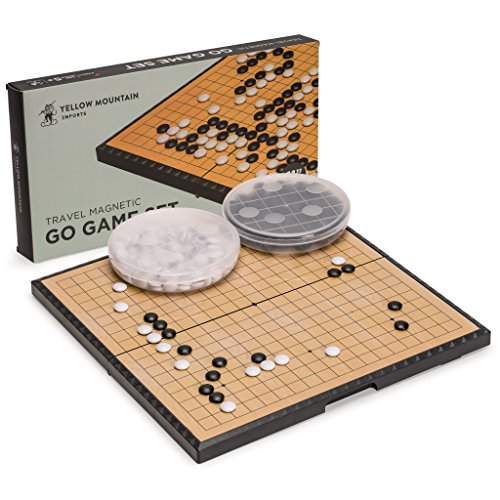 YMI Magnetic Travel Go Set (11-Inch)Best for learning and travel$19Check price
 YMI Bamboo Reversible 19x19 / 13x13 Go SetThe set to keep$129Check price
What makes a good beginner Go set
Go needs remarkably little — a 19x19 grid and a pile of black and white stones — so the differences between sets come down to a few things that genuinely affect learning:
- Magnetic vs loose stones. This is the big one for beginners. Magnetic stones cling lightly to the board, so a bumped table or a game on your lap does not scatter the position. Loose stones on a wooden board feel more traditional and satisfying, but they slide. For learning, magnetic is far more forgiving.
- Full 19x19 vs smaller. The standard board is 19x19 lines. Beginners often start games on 9x9 or 13x13 (faster, easier to grasp), so a board that offers a smaller grid too is a nice bonus — but you want a real 19x19 available, because that is the game you are working toward.
- A flat, stable board. Cheap folding boards can warp or bow at the hinge; a good one lies dead flat. A board where stones roll toward a crease is a genuine annoyance.
- The right stone count. A complete set has 361 stones (181 black, 180 white) — enough to fill the board. Sets that skimp leave you short in a long game.
Material is mostly feel and longevity: plastic magnetic sets are practical and cheap; a bamboo or wood board with bowls is the beautiful version you grow into.
 Best for most beginners
YMI Large Magnetic 19x19 Go Set (14.6-Inch)
The Yellow Mountain Imports Large Magnetic set is the sweet spot for a first Go set: a full-size, standard 19x19 grid — the real game, not a shrunk-down version — with magnetic stones that stay exactly where you place them through a bump, a lean, or a game on the couch. It folds flat, comes with storage bowls, and lays properly level when open, which is where cheaper folding boards fail. At around $26 it is affordable enough to be a first set yet complete and full-size enough that you will not outgrow it quickly. For most people learning Go, this is the one to buy.
What's good
- Full-size standard 19x19 board — the real game
- Magnetic stones stay put through bumps and lap play
- Folds flat with storage bowls; lays properly level
- Complete 361-stone set at an easy price
What's not
- Plastic, not a heirloom wood board
- Magnetic set is for a table, and heavier than the travel board
 Best for learning and travel
YMI Magnetic Travel Go Set (11-Inch)
The same magnetic, stays-put design in a pocket-friendly size. The travel set folds to about the size of a paperback, weighs under two pounds, and its magnetic stones cling through a train ride or a game on your knees — ideal for learning the rules and playing anywhere. The board is a compact 11 inches, so a full 19x19 game is a tighter squeeze than on the large set, but it is genuinely playable and the cheapest honest way in. Many people keep it as a travel board even after buying a bigger one.
What's good
- Compact and light — a real Go set that fits in a bag
- Magnetic stones stay put on the move
- Complete 361-stone set, folds shut for storage
- The lowest-cost way to start learning Go
What's not
- 11-inch board is a tight fit for a full 19x19 game
- Small stones suit small hands or small boards
 The set to keep
YMI Bamboo Reversible 19x19 / 13x13 Go Set
For someone who already loves the game, the bamboo set is the one to own for good. The board is solid pressed bamboo — beautiful, durable, and sustainable — and it is reversible: a full 19x19 on one side, a 13x13 on the other for quick games and learning. It comes with proper 22mm single-convex stones and two turned bamboo bowls with securing straps, plus a beginner rules booklet. The stones are not magnetic, so it wants a stable table rather than a lap, but as a set to leave out and play on for years, it is a genuine pleasure. Buy it once Go has stuck.
What's good
- Solid bamboo board, reversible 19x19 / 13x13
- Proper convex stones and turned bamboo bowls
- Beautiful enough to leave out; built to last
- Includes a beginner rules booklet
What's not
- Stones are not magnetic — for a stable table, not a lap
- Premium price, more than a first set needs
The full 19x19 board can feel overwhelming at first. Almost every Go teacher starts beginners on a 9x9 grid: the same rules, but a game takes ten minutes and you can see the whole fight at once. It is the fastest way to understand capturing, territory, and life-and-death before you scale up to 13x13 and then the full 19x19. You can play 9x9 on any of these boards by just using a corner.
Before you buy
Count the stones — you want 361. A complete set has 181 black and 180 white. Some cheap sets ship short, which leaves you unable to finish a full-board game.
Magnetic is the beginner-friendly choice. If you will play on a couch, a train, or a wobbly table, magnetic stones save the position from every bump. Loose stones are lovely but only on a stable surface.
A flat board matters more than a fancy one. Check that a folding board lies flat with no bow at the hinge. Stones rolling toward a crease is the most common complaint about cheap sets.
Learn the rules with a free app or site first. Go's rules are simple but not obvious. A quick tutorial before your first game means your set gets used for playing, not puzzling over setup.
Single convex stones are the beginner standard. Flat on one side, domed on top — easy to pick up and place. Double-convex stones are a traditional upgrade you do not need to start.
Common questions about Go sets
What comes in a Go set?
Should a beginner get a magnetic Go set?
What size Go board should I start with?
How many stones does a Go set need?
Plastic or wood/bamboo board?
Is Go hard to learn?
Ready to actually do it?
The first go (game) quest takes an evening, and it tells you whether the gear was worth it better than any review can.
Start Go (Game)The HobbyStack editorial team researches each guide against manufacturer specifications, published resources and practitioner sources. Every product is checked for availability and described against its current listing before publication, and prices are re-checked when guides are updated.
About our editorial process →More gear guides
All guides
Best Go Books (2026): Beginners Want Joseki and Need Life and Death
Every beginner reaches for a book of joseki, the memorised corner sequences, because they look like the secret. They are not. Strength at Go comes from reading life and death and recognising good shape, and a player who has memorised openings without those will play twenty moves of professional theory and then lose the group.

Best Beginner Chess Sets (2026): 3 Real Picks
A tournament-style set is the right first chess set: standard-size Staunton pieces, weighted so they don't tip, on a board with 2.25 inch squares. Skip the decorative themed sets for now. The one real decision is vinyl (cheap, portable, what clubs actually use) versus wood (nicer to own, costs more). Everything below is a set people genuinely buy and play on.
Best Chess Clock (2026): Delay, Increment and Why It Matters
A chess clock changes the game more than any other piece of equipment, because it turns thinking time into a resource you can run out of. The part beginners rarely have explained is that not all timed chess is the same: delay and increment are different rules that produce very different endgames, and the clock you buy determines which ones you can play.

Best Poker Chip Set for Beginners (2026): 3 Sets for Every Home Game
A proper chip set is what turns a card game into poker night, and the thing that separates a cheap set from a great one is the weight and feel of the chips. A 500-count set covers a full table, and heavier clay-composite chips just feel like the real thing. Here are three good sets, from a light-but-complete starter to a casino-grade box.

Best Speed Cubes for Beginners (2026)
The jump from a stiff hardware-store Rubik's Cube to a real magnetic speed cube is the single biggest upgrade in solving: it turns smoothly, corner-cuts instead of locking up, and the magnets snap each layer into place. Here are three, from a $10 cube that already does all that to a maglev flagship.

Best Pottery Tool Set (2026): Six of the Twelve Do Nearly Everything
Open a twelve-piece pottery set and six tools will do nearly all your work: the wire cutter, a wooden rib, a metal rib, a loop trimming tool, a sponge and a needle tool. The rest get picked up once, found to duplicate something, and left in the canister for years.