Best Flower Presses for Beginners (2026)
Pressing flowers is almost foolproof: stack blooms between paper, clamp them flat, and wait a couple of weeks. A real screw-down press does it far better than a heavy book, drawing out moisture evenly so colours stay bright and petals do not go mouldy. Here are three, from a compact starter to an extra-large press.
HobbyStack may earn a commission from links on this page at no extra cost to you. Our picks are chosen on merit; the commission helps fund the research.
- A screw-down press beats a book. Tightening bolts apply firm, even pressure and the wooden boards plus cardboard and paper layers wick moisture away, so flowers dry flat and keep their colour instead of browning or moulding the way they can in a book.
- Our pick: the Aboofx 11-inch, 10-layer press (~$32). Ten layers means you press a lot at once, and 11 inches fits most blooms and leaves. The size and capacity most people are happiest with.
- Compact starter: the Aboofx 10.8 x 6.9-inch press (~$24). Fewer layers and a smaller footprint, perfect if you press a few flowers at a time and want to spend the least.
- Big blooms: the Aboofx Extra-Large 15-inch press (~$70). For pressing large flowers, full stems, and ferns, or pressing in volume for crafts and framing. More than a casual presser needs.
- Skip: pressing only in a book long-term (uneven pressure, slow, and pages can stain and mould), and microwaving flowers to rush it (you lose the colour a slow press keeps).
 Our pickAboofx Flower Press (11 x 11 in, 10-Layer)Best for most people$32Check price
 Aboofx Flower Press (10.8 x 6.9 in, 6-Layer)Best compact starter$24Check price
 Aboofx Extra-Large Flower Press (15 x 15 in)For big blooms and volume$70Check price
What a flower press actually does
Pressing is simple, but a proper press does three things a book cannot:
- Even, firm pressure. A screw press has bolts at the corners you tighten down, pressing the whole surface flat and hard. A book presses unevenly (the spine side more than the edge) and never as firmly, so flowers can wrinkle or dry lumpy.
- Moisture wicking. The layers between the wooden boards — corrugated cardboard and blotting or plain paper — pull water out of the petals as they dry. Getting the moisture out quickly and evenly is what keeps colours bright; slow, damp pressing is what turns flowers brown or mouldy.
- Volume, in layers. A multi-layer press lets you press several batches at once, separated by cardboard, so you are not limited to one flat stack.
The main choice is size and number of layers. Size sets the biggest flower or leaf you can press; layers set how much you can press at one time. A mid-size, 10-layer press is the sweet spot for most people; a compact one is cheaper and fine for small batches; an extra-large one is for big blooms and high volume.
 Best for most people
Aboofx Flower Press (11 x 11 in, 10-Layer)
The do-everything flower press. At 11 inches it handles most garden flowers, leaves, and small ferns without cutting them down, and its ten layers mean you can press a real batch at once — several stacks of flowers separated by cardboard — rather than a single flat layer. The wooden boards and corner bolts give firm, even pressure, and it comes with the cardboard and paper to start pressing the day it arrives. It is the size and capacity most people settle on and rarely outgrow, which is exactly why it is the pick for a first press.
What's good
- Ten layers press a real batch at once
- 11 inches fits most flowers and leaves uncut
- Firm, even pressure from corner bolts
- Comes with cardboard and paper to start
What's not
- Bigger footprint to store than a compact press
- Overkill if you only ever press one or two flowers
 Best compact starter
Aboofx Flower Press (10.8 x 6.9 in, 6-Layer)
The same screw-press job in a smaller, cheaper package. At 10.8 by 6.9 inches with fewer layers, the compact Aboofx presses flat flowers and leaves just as well as its bigger sibling — the same bolts, boards, and moisture-wicking layers — you are simply limited to a smaller batch at a time. It is the right pick if you press a few flowers here and there, are pressing with a child, or just want to spend the least to find out whether the hobby grabs you. Nothing about the results is compromised; only the volume is.
What's good
- Real screw press at the lowest sensible price
- Presses flat flowers and leaves just as flat
- Small footprint, easy to store
- Great for small batches or pressing with kids
What's not
- Smaller surface limits big blooms and long stems
- Fewer layers means fewer flowers per session
 For big blooms and volume
Aboofx Extra-Large Flower Press (15 x 15 in)
The press for someone who presses a lot, or presses big. At 15 inches the extra-large Aboofx takes large flowers, full stems, ferns, and foliage that a mid-size press makes you cut down, and the bigger surface presses far more at a time for anyone making framed art, resin pieces, or cards in quantity. It is the same firm-pressure, moisture-wicking screw design, just scaled up. It is more press than a casual hobbyist needs and takes real shelf space, but if you already know you will press in volume or want to keep long stems intact, the size earns its place.
What's good
- 15 inches fits big blooms, full stems, and ferns
- Presses far more at once for crafts in quantity
- Same firm, even screw-press design, scaled up
- No cutting flowers down to fit
What's not
- Large and heavier to store
- More press (and cost) than a casual presser needs
The most common beginner mistake is opening the press too soon, or never changing the paper. Flowers hold a lot of water. Press them fresh and dry (pat off any dew), then after 3 to 5 days swap the damp blotting paper for fresh dry sheets, retighten, and leave it. Most flowers need two to four weeks to press flat and fully dry. Peek too early and they wrinkle or mould; be patient and they come out paper-flat with the colour locked in.
Before you buy
Press flowers fresh and dry. Pick them at their best, pat off any moisture, and press the same day. Wilted or wet flowers press poorly and can mould.
Flat flowers press easiest. Pansies, cosmos, daisies, ferns, and leaves are the friendliest first subjects. Bulky flowers like roses need slicing in half or splitting into petals.
Change the paper early. Swap the damp paper for dry sheets after the first few days to speed drying and protect the colour, then leave the press alone for two to four weeks.
Retighten the bolts as it dries. As the flowers flatten and lose water the stack shrinks, so nip the bolts down again to keep firm, even pressure.
Store pressed flowers flat and dry. Once done, keep them between paper in a book or box away from humidity until you use them, or they can reabsorb moisture and curl.
Common questions about flower presses
Is a flower press better than pressing in a book?
How long does it take to press flowers?
What size flower press should I get?
Which flowers press best?
How do I keep the colour from fading?
What goes between the flowers in the press?
Ready to actually do it?
The first pressed flowers quest takes an evening, and it tells you whether the gear was worth it better than any review can.
Start Pressed FlowersThe HobbyStack editorial team researches each guide against manufacturer specifications, published resources and practitioner sources. Every product is checked for availability and described against its current listing before publication, and prices are re-checked when guides are updated.
About our editorial process →More gear guides
All guides
Best Beginner Crochet Hooks (2026): 3 Picks
A beginner crochet hook set gives you the common sizes (roughly 2mm to 6mm) in one case so you never have to guess which one your yarn needs. The one thing that actually matters starting out is a comfortable grip and a smooth hook head, because a hook that snags or cramps your hand is the fastest way to quit. Metal shafts with a soft rubber handle are the easy default.

Best Aida Cloth (2026): The Count Is Stitches Per Inch, Not Thread Thickness
Count is the number of stitches that fit in an inch, so a higher count makes a smaller finished piece from exactly the same pattern. Stitch a design on 18 count instead of 14 and it comes out around a fifth smaller, which is how people end up with a finished piece that will not fit the frame they bought.

Best Cross-Stitch Kit for Beginners (2026): 3 Picks, Stamped to Counted
A cross-stitch kit bundles everything a beginner needs in one box: the fabric, the threads, a needle, and the pattern, so there is nothing to source separately. The one choice that matters is stamped versus counted: stamped kits print the pattern right on the fabric (easiest to start), while counted kits have you follow a chart (the traditional method). Here are three good ones that cover both.

Best Beginner Embroidery Kits (2026): 3 Starter Kits Worth Buying
A beginner embroidery kit is a box that has everything you need to start stitching in one go: a hoop, floss, needles, fabric, and usually a pattern already printed on the cloth. The one spec that actually matters for a first kit is whether the fabric comes stamped with a pattern, because tracing your own design is the thing most people give up on before they even start.
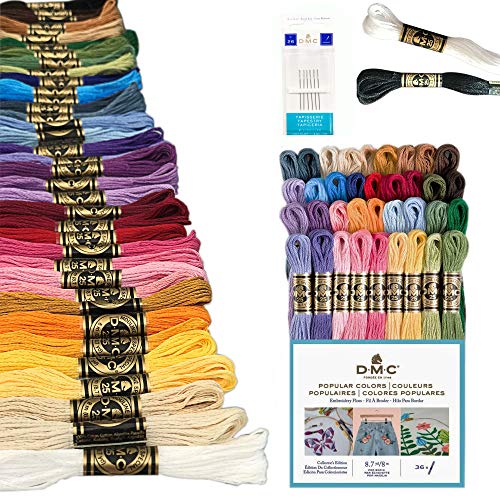
Best Embroidery Floss (2026): Six Strands, and You Rarely Use All Six
A skein of embroidery floss is six loosely twisted strands, and almost every pattern asks you to pull some of them out before you start. Stitching with all six because that is how it came off the shelf is the single most common beginner mistake, and it is why beginner work looks lumpy where it should look smooth.

Best Embroidery Hoop (2026): Drum-Tight Fabric Is the Whole Job
A hoop has one job: hold the fabric tight enough that your stitches sit where you put them. A hoop that slips lets the fabric sag, and a sagging ground gives you uneven tension, puckered stitches and a finished piece that will not lie flat. Almost every hoop complaint is really a grip complaint.