Best Embroidery Floss (2026): Six Strands, and You Rarely Use All Six
A skein of embroidery floss is six loosely twisted strands, and almost every pattern asks you to pull some of them out before you start. Stitching with all six because that is how it came off the shelf is the single most common beginner mistake, and it is why beginner work looks lumpy where it should look smooth.
HobbyStack may earn a commission from links on this page at no extra cost to you. Our picks are chosen on merit; the commission helps fund the research.
- Separate the strands. Two or three is normal, six is thick outlining.
- DMC numbers are a universal language. Patterns are written in them.
- Pull floss from the tail end, out of the paper bands, or it tangles into a knot.
- Buy the colours a project needs, not a rainbow you will never touch.
- Cheap variety packs are fine for practice and fade in the wash.
 Janlynn 105 skeinsPractice$17Check price
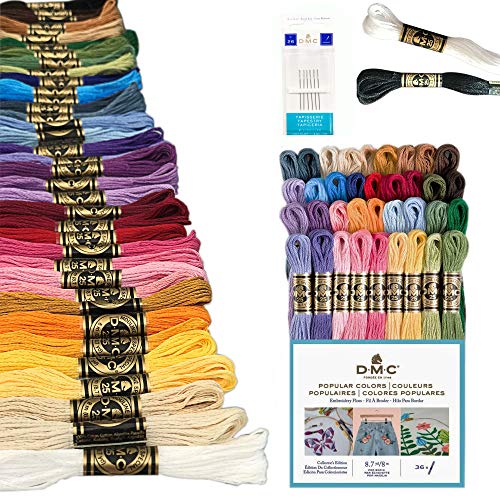 Our pickDMC 36-colour bundleMost stitchers$44Check price
 DMC 100-skein boxWorking from patterns$200Check price
Six strands, and how many to use
Embroidery floss is sold as a skein of six strands twisted together loosely enough to pull apart. Patterns specify how many to use, and the number changes the whole character of the stitch.
- 1 strand — fine detail, faces, delicate shading
- 2 strands — the default for most surface embroidery and cross stitch on 14-count
- 3 strands — fuller coverage, satin stitch, bolder lines
- 6 strands — thick outlining and chunky decorative work
Separating them properly matters. Cut your length first, then hold the bundle at one end and pull single strands out one at a time, straight up. Pulling two together twists them. Once separated, let them hang and untwist before you thread up, because strands laid back together untwisted lie flat and cover far better than a twisted bundle.
That last step is called stripping, and it is the difference between satin stitch that looks like glass and satin stitch that looks like string.
Cut about 18 inches. Longer thread tangles, frays from being pulled through fabric repeatedly, and wears thin before you use it up.
Colour numbers are the standard. DMC numbers are effectively the universal reference and patterns are written in them, which is why a pattern calling for DMC 310 is unambiguous everywhere in the world.
Buying it without wasting money
The variety pack trap. A 100-plus skein rainbow looks like tremendous value and mostly is not, because projects need specific colours and shade families rather than one of everything. You end up with 90 skeins of colours no pattern asked for and still make a trip for the three you need.
What variety packs are genuinely good for is practice. Learning stitches, testing tension and working samplers uses a lot of thread and does not care what colour it is.
Buy to the pattern for real projects. Most patterns list their DMC numbers, and individual skeins cost very little. That is cheaper overall and you finish with a stash of colours you actually use.
Shade families beat rainbows. If you buy speculatively, buy several shades of one colour rather than one shade of many. Embroidery reads through gradual shading, and having 3 blues that step gently is worth more than 12 unrelated colours.
Check colourfastness before you wash. Reds and dark blues are the usual bleeders. Test a scrap in warm water before you put a finished piece anywhere near a sink.
Storage decides whether you use it. Loose skeins tangle into an unusable ball within weeks. Bobbins, a box with compartments, or floss rings keep them findable, which is a real part of what the premium option here is selling.
 Best for practice
Janlynn Jumbo Pack 105 Skein Embroidery Floss
A hundred and five skeins for around twenty dollars, which is the right way into embroidery precisely because learning burns thread without caring what colour it is. Work samplers, practise satin stitch and get your tension right on this rather than on floss that costs real money. The colours are not DMC numbered, so you cannot follow a pattern with it, and the dyes are less reliable in the wash than DMC.
What's good
- 105 skeins for the price of a few DMC ones
- Ideal for samplers and learning stitches
- No guilt about wasting thread while practising
- Wide spread of colours to experiment with
What's not
- Not DMC numbered, so patterns cannot be followed
- Dyes are less colourfast than DMC
- Strands separate less cleanly
- Comes loose, so it tangles quickly
 Best for most stitchers
DMC Popular Pack 36 Colors Bundle
Real DMC in 36 colours, which matters because DMC numbers are the language patterns are written in and because the thread itself separates and lies flat in a way cheaper floss does not. The bundle adds white and black, which every project needs and variety packs always skimp on, plus needles to start with. Thirty-six colours is not enough for a complex pattern, so expect to buy singles alongside it.
What's good
- Genuine DMC, so patterns are followable
- Separates and strips cleanly for flat satin stitch
- Includes white and black, which packs skimp on
- Needles included to get going
What's not
- 36 colours will not cover a detailed pattern
- Twice the Janlynn for a third of the skeins
- Still needs singles bought to match patterns
- No storage included
 Best for working from patterns
DMC Modular Storage Box Includes 100 Skeins of DMC Six-Strand
A hundred DMC skeins in a modular storage box, and the box is half of what you are buying. Loose floss tangles into an unusable knot within weeks, so a compartmented system that keeps skeins findable by number is the difference between a stash you use and a bag you avoid. At a hundred colours you can start most patterns without ordering first. It is a serious outlay for a hobby you may still be trying.
What's good
- 100 genuine DMC skeins covers most patterns
- Modular box keeps skeins findable by number
- Stops the tangled-bag problem before it starts
- Expands as the collection grows
What's not
- A large outlay for a new hobby
- Still will not have every colour a pattern names
- Box takes real shelf space
- Overkill if you stitch occasionally
A skein has two paper bands and one loose tail. Find the tail, leave both bands in place, and pull the thread out from there — it feeds smoothly and the skein stays intact. Slide the bands off and the whole thing collapses into a knot you will spend twenty minutes on. If you cannot find the tail, pull gently from each end; the correct one comes away without dragging the skein out of shape.
Small things that improve the stitching
Thread conditioner is worth having if you work in a dry room or with long stitches. A pass through beeswax or a silicone conditioner reduces fraying and static, though it slightly dulls the sheen, so skip it on satin stitch you want to shine.
Do not knot the back. Knots create bumps that show through the front when the piece is framed or pressed, and they work loose over time. Use a waste knot or weave the tail under a few existing stitches instead.
Keep the back reasonably tidy. Long floats across the back get caught, pull stitches out of shape and shadow through pale fabric. Anything more than about an inch is worth anchoring.
Wash your hands before you stitch and keep the piece covered between sessions. Hand oils dull light-coloured floss surprisingly fast, and the marks do not always come out.
Store it out of sunlight. Floss fades on a sunny shelf over months, and a faded skein will not match the same number bought later.
Wind leftovers onto bobbins with the number written on. Unlabelled leftover floss is unusable for pattern work because you can no longer name the colour.
Before you buy
Buy DMC if you want to follow patterns. The numbers are the standard.
Cheap variety packs are for practice, not for finished work.
Buy shade families rather than one of every colour.
Get storage at the same time, or the stash becomes a knot.
Cut about 18 inches and separate the strands before stitching.
Embroidery floss questions
How many strands of floss should I use?
Does the brand of floss matter?
Are big variety packs worth buying?
How do I stop my floss tangling?
The DMC 36-colour bundle is the sensible buy: real DMC so patterns are followable, white and black included, and thread that strips and lies flat properly. Get the Janlynn jumbo pack alongside it for practice, because learning stitches uses a lot of thread and colour does not matter. The 100-skein box is the one to buy if you work from patterns regularly and are tired of ordering singles. Then separate the strands.
Ready to actually do it?
The first embroidery quest takes an evening, and it tells you whether the gear was worth it better than any review can.
Start EmbroideryThe HobbyStack editorial team researches each guide against manufacturer specifications, published resources and practitioner sources. Every product is checked for availability and described against its current listing before publication, and prices are re-checked when guides are updated.
About our editorial process →More gear guides
All guides
Best Beginner Embroidery Kits (2026): 3 Starter Kits Worth Buying
A beginner embroidery kit is a box that has everything you need to start stitching in one go: a hoop, floss, needles, fabric, and usually a pattern already printed on the cloth. The one spec that actually matters for a first kit is whether the fabric comes stamped with a pattern, because tracing your own design is the thing most people give up on before they even start.

Best Embroidery Hoop (2026): Drum-Tight Fabric Is the Whole Job
A hoop has one job: hold the fabric tight enough that your stitches sit where you put them. A hoop that slips lets the fabric sag, and a sagging ground gives you uneven tension, puckered stitches and a finished piece that will not lie flat. Almost every hoop complaint is really a grip complaint.

Best Embroidery Scissors (2026): Sharp All the Way to the Tip
Embroidery scissors do one job that ordinary scissors cannot: cut a single thread flush against the fabric without nicking it. That needs blades sharp right to the very point, meeting cleanly with no gap. It is a surprisingly demanding specification, and it is why a good small pair costs more than a large pair of household scissors.

Best Fabric Scissors (2026): Why You Never Cut Paper With Them
Fabric scissors are the tool most likely to be ruined by the person who owns them, usually within a month, usually by cutting paper. Fabric is soft and slippery, so shears rely on a very fine edge to catch and slice rather than push — and paper is abrasive enough to take that edge off in a few cuts. Everything else about choosing a pair follows from protecting that edge.

Best Beginner Knitting Needles (2026): 3 Picks
The needle that fits your first project matters more than the brand. Most beginners should start with a single pair of size US 8 (5mm) straight needles in bamboo, since bamboo grips the yarn and slows dropped stitches. A cheap starter set covers more sizes for less money, and an interchangeable circular set is the thing to grow into once you know you're sticking with it.

Best Beginner Crochet Hooks (2026): 3 Picks
A beginner crochet hook set gives you the common sizes (roughly 2mm to 6mm) in one case so you never have to guess which one your yarn needs. The one thing that actually matters starting out is a comfortable grip and a smooth hook head, because a hook that snags or cramps your hand is the fastest way to quit. Metal shafts with a soft rubber handle are the easy default.