Best Grow Light for Hydroponics (2026): Coverage, Not Watts
Grow lights are sold on wattage, which is the one number that tells you almost nothing about whether plants will grow. Watts measure electricity consumed; what a plant responds to is how much usable light actually lands on its leaves. Two lights drawing the same power can differ enormously on that, and the specification that describes it is on the datasheet rather than the box.
HobbyStack may earn a commission from links on this page at no extra cost to you. Our picks are chosen on merit; the commission helps fund the research.
- Buy for coverage area first. A light sized for 2x2 ft will not fill a 4x4 ft tent however bright it looks.
- PPFD is the number that matters: how much usable light reaches the plant, measured at a stated distance.
- Leafy greens want roughly 200-400 PPFD. Fruiting plants want 600-900.
- Ignore "equivalent wattage" claims. Compare actual power draw and coverage.
- Full-spectrum white LED is the sensible default. Blurple lights make it impossible to see plant problems.
 Our pickSpider Farmer SF1000A first small setup$70Check price
 Mars Hydro TS1000A bit more headroom$90Check price
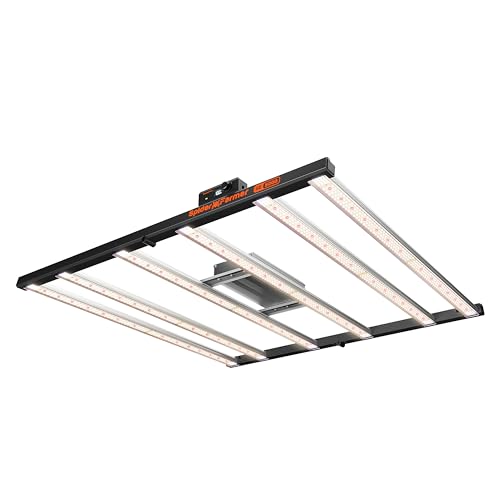 Spider Farmer SE5000A full tent$340Check price
PPFD, PPF and why watts mislead
Three terms, and only one of them is about your plants.
Watts is electricity going in. It tells you the running cost and nothing about output — an inefficient light draws more watts for less light.
PPF (photosynthetic photon flux) is the total usable light the fixture emits, in micromoles per second. It is a property of the light itself.
PPFD (photosynthetic photon flux density) is how much of that lands on a given area, at a stated height. This is the number that matters, because a fixture with high PPF hung too high, or spread over too large an area, still leaves your plants underlit.
Rough targets: 200-400 PPFD for lettuce, herbs and leafy greens; 400-600 for the vegetative stage of larger plants; 600-900 for fruiting tomatoes and peppers.
Any manufacturer worth buying from publishes a PPFD map — a grid of readings across the coverage area at a given height. If a listing only advertises "1000W equivalent", that absence is itself the answer.
Sizing to your space
Work from the area you are lighting, not from a wattage you have in mind.
A 2x2 ft space is what most people actually start with — a shelf, a corner, a small tent — and wants something in the region of 100W of efficient LED.
A 3x3 ft space needs roughly double that, and 4x4 ft roughly four times, because area grows with the square.
The common mistake is buying a light rated for a larger space in the belief it will be "better". It will not: the extra output falls outside your growing area, you pay for electricity lighting the floor, and the centre of the space can be too intense while the edges stay dim.
Height is the other half of it. Most LED fixtures are hung 12-24 inches above the canopy, and moving a light closer raises PPFD sharply — which is a useful adjustment and also a way to bleach leaves if you overdo it.
 Best for a first setup
Spider Farmer SF1000 100W LED Grow Light for Indoor Plants
A full-spectrum white LED panel sized properly for a 2x2 ft space, which is what almost everyone actually starts with — a shelf, a cupboard or a small tent. Full-spectrum white matters more than it sounds: the old blurple lights make it genuinely difficult to see whether a leaf is yellowing or spotted, and diagnosing a problem by eye is most of early growing. Dimmable, so you can run it lower for seedlings and raise it as plants establish. Efficient enough that running cost is modest. It will not fill a larger tent, and there is no app or scheduling — you supply a plug timer. For a first hydroponic setup this is the right size and the right amount to spend.
What's good
- Correctly sized for a 2x2 ft space
- Full-spectrum white — you can see plant problems
- Dimmable for seedlings
- Efficient, modest running cost
What's not
- Will not cover a larger tent
- No built-in timer or scheduling
- Passive cooling, so it runs warm
- Hanging kit is basic
 Best for a little headroom
MARS HYDRO TS1000 150W LED Grow Light for Indoor Plants
More output than the entry panel, which buys you two useful things: a genuinely usable 3x3 ft footprint if you expand, and higher PPFD over a 2x2 ft space if you want to grow fruiting plants rather than leafy greens. That second point is the one people miss — the same area lit harder is what tomatoes and peppers need, and an under-lit fruiting plant grows tall and produces little. Also dimmable, so it works for seedlings without scorching them. It costs about half again as much and draws more power, so if you are only ever growing lettuce and basil in a small space it is more light than the job needs.
What's good
- Covers 2x2 comfortably or 3x3 adequately
- Enough PPFD for fruiting plants in a small area
- Dimmable across growth stages
- Room to expand without rebuying
What's not
- More light than leafy greens need
- Higher running cost
- Heavier fixture to hang
- Still no scheduling built in
 Best for a full tent
Spider Farmer SE5000 480W LED Grow Light,Smart Remote App
A 4x4 ft fixture, and the reason to buy it is area rather than ambition — this is what a full grow tent needs, and using a smaller light in that space simply leaves the edges dim. The bar-style layout spreads output evenly across the footprint instead of concentrating it under a single panel, which is what stops the centre plants outgrowing the corners. App control means scheduling and dimming without a separate timer, and it can be daisy-chained if you expand further. It is more than four times the entry light, draws real power, and is completely wrong for a shelf — an over-sized light in a small space wastes electricity lighting the floor. Buy it for the tent, not for the specification.
What's good
- Even coverage across a full 4x4 ft
- Bar layout avoids hot centre, dim corners
- App scheduling and dimming built in
- Daisy-chains for larger setups
What's not
- Far too much for a shelf or small tent
- Significant power draw
- Most expensive by a distance
- Needs proper hanging and headroom
A manufacturer confident in a light publishes a PPFD map: a grid of readings across the coverage area at a stated hanging height. If a listing leads with "2000W equivalent" and has no PPFD figures anywhere, that is not an oversight — it is the most important number being left out on purpose.
Photoperiod, and why timers are not optional
Plants respond to day length as well as intensity, and consistency matters more than getting the number exactly right.
Leafy greens and herbs do well on 14-16 hours of light a day. Seedlings want a similar long day at low intensity. Fruiting plants in flower are often run on 12 hours.
What they do not want is a schedule that changes because you forgot. Irregular photoperiod stresses plants and can trigger bolting in lettuce and premature flowering in herbs, which is a fast way to lose a crop.
A cheap mechanical or smart plug timer costs a few pounds and removes the whole problem. If your light has scheduling built in, use it — but a plug timer is the more reliable answer for anything that does not.
And give plants darkness. Running lights twenty-four hours does not double growth; most plants do necessary work in the dark period.
Before you buy
Measure your growing area first. That number chooses the light.
Look for a published PPFD map at a stated height.
Ignore "equivalent wattage". Compare real draw and coverage.
Full-spectrum white, so you can actually see plant problems.
Buy a plug timer at the same time unless the light schedules itself.
Grow light questions
How many watts of grow light do I need?
What is PPFD and what should I aim for?
Are purple grow lights better?
How long should I run grow lights each day?
Measure your space, then buy the light that covers it — coverage and PPFD, not watts. The Spider Farmer SF1000 is right for the 2x2 ft shelf or cupboard most people start with. Step up to the TS1000 if you want to grow fruiting plants in that space or expand to 3x3. The SE5000 is for a full 4x4 tent and wasteful anywhere smaller. Buy a plug timer at the same time, and keep the schedule consistent.
Ready to actually do it?
The first hydroponics quest takes an evening, and it tells you whether the gear was worth it better than any review can.
Start HydroponicsThe HobbyStack editorial team researches each guide against manufacturer specifications, published resources and practitioner sources. Every product is checked for availability and described against its current listing before publication, and prices are re-checked when guides are updated.
About our editorial process →More gear guides
All guides
Best Air Pump for Hydroponics (2026): Roots Drown Before They Starve
A plant in soil gets oxygen to its roots through air pockets between particles. A plant with its roots in a bucket of water has none of that, and roots without oxygen suffocate and rot within days. In deep water culture the air pump is not an accessory, it is the thing standing between your plants and root rot.

Best Hydroponic Grow Kit for Beginners (2026): 3 Countertop Systems
A countertop hydroponic garden is the easiest way into growing without soil: you drop seed pods into a water reservoir, the built-in LED light and pump do the work, and you get fresh herbs and greens in a few weeks. The two things that matter most are the number of pods (how many plants) and whether you want to tend it yourself or let it automate. Here are three good ones, from a simple herb garden to a large app-controlled system.

Best Hydroponic Nutrients (2026): Why Soil Feed Will Not Do
In soil, the soil itself is a buffer and a pantry — it holds trace elements, releases them slowly, and resists sudden pH swings. Hydroponics removes all of that. Everything the plant eats has to be in the water you mix, in the right proportions, at a pH where the roots can actually absorb it. That is why hydroponic nutrients are a different product from plant food, not a fancier one.

Best pH and EC Meter for Hydroponics (2026): Calibration Is the Whole Job
A pH meter is the only way to know whether the nutrients in your reservoir are actually available to your plants. Outside roughly 5.5 to 6.5 they are present but chemically locked out, which looks exactly like a deficiency — so people add more feed and make it worse. The catch is that a meter is only as good as its last calibration, and an uncalibrated meter gives you a confident number that is wrong.

Best Aquarium Filter for Beginners 2026: Sponge vs HOB vs Canister
A filter is the lungs of an aquarium: it keeps the water clear and, more importantly, houses the bacteria that keep your fish alive. The first decision is the type, and it's driven by your tank size: a sponge filter for small tanks, a hang-on-back for most beginner tanks, or a canister for big and planted ones. Here are three picks across that divide.

Best Aquarium Heater (2026): The One Component That Fails Dangerously
Every other piece of aquarium equipment fails by stopping. A heater can fail by staying on, and a stuck-on heater will cook a tank of fish in a day. That is why the interesting question is not which heater warms water — they all do — but which one fails safely and lets you check that it is telling the truth.