Best pH and EC Meter for Hydroponics (2026): Calibration Is the Whole Job
A pH meter is the only way to know whether the nutrients in your reservoir are actually available to your plants. Outside roughly 5.5 to 6.5 they are present but chemically locked out, which looks exactly like a deficiency — so people add more feed and make it worse. The catch is that a meter is only as good as its last calibration, and an uncalibrated meter gives you a confident number that is wrong.
HobbyStack may earn a commission from links on this page at no extra cost to you. Our picks are chosen on merit; the commission helps fund the research.
- Calibration is not optional. An uncalibrated pH meter drifts and reports a wrong number confidently.
- Buy calibration solution at the same time as the meter. pH 4.0 and 7.0 are the standard pair.
- A pH probe must be stored wet, in storage solution — never dry, and never in plain water.
- EC and TDS measure the same thing differently. EC is the raw reading; TDS is EC multiplied by a conversion factor.
- Cheap pen meters work, but they drift faster and their probes are usually not replaceable.
 Apera pH20 Value TesterA first meter$55Check price
 Our pickApera PC60 5-in-1Most people$131Check price
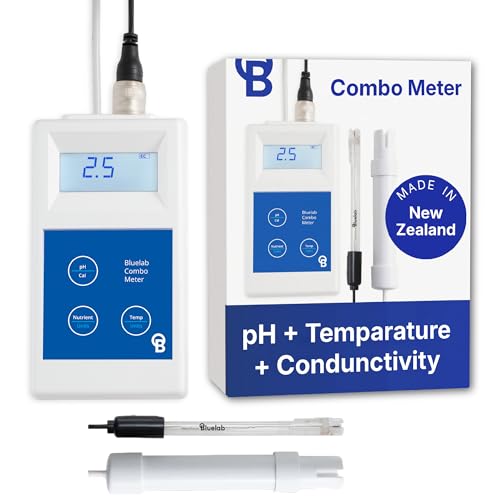 Bluelab Combo MeterSerious or continuous use$280Check price
Why calibration matters more than the meter
A pH probe works by measuring a tiny voltage across a glass membrane. That membrane changes slowly with use, temperature and age, so the relationship between voltage and pH drifts — and the meter has no way of knowing.
The result is the worst kind of instrument error: it still gives you a number to two decimal places, and the number is wrong.
Calibration re-establishes the relationship using solutions of known pH. Two-point calibration with pH 4.0 and pH 7.0 buffers covers the hydroponic range and is what most meters expect. Some support a third point at 10.0, which is unnecessary for growing.
How often? A cheap pen meter realistically wants checking weekly. A better meter holds calibration for several weeks. Either way, calibrate before any measurement you are about to act on.
Buy the buffer solutions with the meter. A meter without them is an ornament, and discovering that after your reservoir is mixed is a bad evening.
EC, TDS, PPM and the conversion mess
EC (electrical conductivity) measures how well your solution conducts electricity, which rises with dissolved salts. It is the honest, direct measurement, usually in mS/cm.
TDS (total dissolved solids) is EC converted into a parts-per-million figure — and here is the problem: there are three different conversion factors in common use (0.5, 0.64 and 0.7). The same solution reads as three different PPM numbers depending on which your meter uses.
That is why nutrient schedules and forum advice so often disagree. Someone saying "run it at 800 PPM" has not told you which scale they mean, and the spread between factors is large enough to matter.
Work in EC if you can. It is unambiguous, it is what most quality meters report natively, and it removes an entire category of confusion. If a schedule gives PPM, find out its conversion factor before trusting it.
 Best first meter
Apera Instruments AI209 pH20 Value pH Tester
A pocket pH tester from a manufacturer that makes actual laboratory instruments, which is the meaningful difference from the very cheap pens sold in bulk — the electronics are better and the readings are repeatable rather than wandering while you watch. Waterproof, which matters for something you will drop in a reservoir eventually. It measures pH only, so you will need a separate EC meter if you want to track nutrient strength, and that is the main reason to consider stepping up. Comes with calibration solution to start you off, though you should buy more. The probe is not replaceable, so treat this as a meter with a service life of a few years rather than a permanent instrument.
What's good
- Repeatable readings from a real instrument maker
- Waterproof — survives the inevitable drop
- Calibration solution included to start
- Cheapest sensible entry point
What's not
- pH only, no EC or TDS
- Probe is not replaceable
- Needs calibrating roughly weekly
- Slower to settle than pricier meters
 Best for most people
Apera Instruments PC60 5-in-1 pH/TDS/EC/Salinity/Temp
One instrument that reads pH, EC, TDS, salinity and temperature, and combining them is the practical argument — you check both of the numbers that matter in a single dip rather than juggling two pens and two calibrations. It reports EC natively as well as TDS, which is what lets you sidestep the parts-per-million conversion confusion entirely. Waterproof, reasonably quick to settle, and accurate enough that you can act on the reading. Crucially the probe is replaceable, so this is a meter you re-probe in a few years rather than replace. It costs more than twice the pH-only pen, which is only worth it if you actually track nutrient strength — but in hydroponics you should.
What's good
- pH and EC in one dip
- Reports EC natively, avoiding PPM confusion
- Replaceable probe — a long-term instrument
- Waterproof and quick to settle
What's not
- More than twice the pH-only meter
- Two calibrations to maintain
- Replacement probes are not cheap
- More than a lettuce grower strictly needs
 Best for continuous use
Bluelab Combo Meter for pH
A bench-style combo meter built for growers who measure constantly, and the difference is durability and convenience rather than a better number. The probes are separate and heavy-duty, designed to sit in solution rather than being dipped and wiped dozens of times a day, and everything is built to survive a working grow room rather than a shelf. Calibration is straightforward and it holds it well. The cost is real: it is more than five times the entry meter, it is not pocketable, and for someone checking a single reservoir twice a week it offers nothing the mid pick does not. Buy it if you run several reservoirs or check readings daily; otherwise the pen is the better tool.
What's good
- Built for constant use, not occasional dipping
- Robust separate probes
- Holds calibration well
- Convenient for a working grow space
What's not
- More than five times the entry meter
- Not portable
- No better accuracy than the mid pick in practice
- Overkill for one reservoir
The glass membrane must stay hydrated. Stored dry it degrades, and a dried-out probe often cannot be recovered — readings become slow, unstable and wrong. Store it in the little cap with storage solution, not plain water: distilled or tap water leaches ions out of the membrane and damages it more slowly but just as surely. If you have no storage solution, pH 4.0 buffer is a far better stand-in than water.
A measuring routine that works
Five habits that between them prevent almost every bad reading.
Calibrate before acting. Not before every glance, but before any measurement you intend to change the reservoir over.
Rinse between solutions with distilled water, and shake rather than wipe — rubbing the glass membrane damages it and creates a static charge that skews the reading.
Let it settle. A reading that is still moving is not a reading. Give it thirty seconds to stabilise.
Watch temperature. pH is temperature dependent, which is why meters have automatic temperature compensation. Measuring a cold reservoir with a warm probe gives a drifting number until both equalise.
Measure the reservoir, not the runoff, unless you specifically want to know what the medium is doing.
Before you buy
Buy pH 4.0 and 7.0 calibration solution with the meter, not later.
Buy storage solution too. A dried probe is often a dead probe.
Prefer a meter with a replaceable probe if you plan to keep growing.
Work in EC rather than PPM — three conversion factors exist and they disagree.
Rinse and shake, never wipe the glass membrane.
pH meter questions
How often should I calibrate a pH meter?
What is the difference between EC and TDS?
How do I store a pH probe?
Do I really need a pH meter for hydroponics?
Buy a meter and the calibration and storage solutions in the same order — a meter without them cannot be trusted and a dried probe is a dead one. The Apera PC60 is the right choice for most growers: pH and EC in one dip, a replaceable probe, and it reports EC natively so you can ignore the PPM conversion mess. The pH20 pen is a sensible cheaper start if you only track pH. The Bluelab is for people measuring daily across several reservoirs.
Ready to actually do it?
The first hydroponics quest takes an evening, and it tells you whether the gear was worth it better than any review can.
Start HydroponicsThe HobbyStack editorial team researches each guide against manufacturer specifications, published resources and practitioner sources. Every product is checked for availability and described against its current listing before publication, and prices are re-checked when guides are updated.
About our editorial process →More gear guides
All guides
Best Air Pump for Hydroponics (2026): Roots Drown Before They Starve
A plant in soil gets oxygen to its roots through air pockets between particles. A plant with its roots in a bucket of water has none of that, and roots without oxygen suffocate and rot within days. In deep water culture the air pump is not an accessory, it is the thing standing between your plants and root rot.

Best Grow Light for Hydroponics (2026): Coverage, Not Watts
Grow lights are sold on wattage, which is the one number that tells you almost nothing about whether plants will grow. Watts measure electricity consumed; what a plant responds to is how much usable light actually lands on its leaves. Two lights drawing the same power can differ enormously on that, and the specification that describes it is on the datasheet rather than the box.

Best Hydroponic Grow Kit for Beginners (2026): 3 Countertop Systems
A countertop hydroponic garden is the easiest way into growing without soil: you drop seed pods into a water reservoir, the built-in LED light and pump do the work, and you get fresh herbs and greens in a few weeks. The two things that matter most are the number of pods (how many plants) and whether you want to tend it yourself or let it automate. Here are three good ones, from a simple herb garden to a large app-controlled system.

Best Hydroponic Nutrients (2026): Why Soil Feed Will Not Do
In soil, the soil itself is a buffer and a pantry — it holds trace elements, releases them slowly, and resists sudden pH swings. Hydroponics removes all of that. Everything the plant eats has to be in the water you mix, in the right proportions, at a pH where the roots can actually absorb it. That is why hydroponic nutrients are a different product from plant food, not a fancier one.

Best Aquarium Filter for Beginners 2026: Sponge vs HOB vs Canister
A filter is the lungs of an aquarium: it keeps the water clear and, more importantly, houses the bacteria that keep your fish alive. The first decision is the type, and it's driven by your tank size: a sponge filter for small tanks, a hang-on-back for most beginner tanks, or a canister for big and planted ones. Here are three picks across that divide.

Best Aquarium Heater (2026): The One Component That Fails Dangerously
Every other piece of aquarium equipment fails by stopping. A heater can fail by staying on, and a stuck-on heater will cook a tank of fish in a day. That is why the interesting question is not which heater warms water — they all do — but which one fails safely and lets you check that it is telling the truth.