Best HF Base Station Ham Radio (2026): 3 Rigs to Grow Into
An HF base station is the radio that lets you talk across the country and around the world, not just to the local repeater a few towns over. Unlike a handheld, an HF rig needs a General-class license, an antenna, and a 12V power supply, but in return it opens up real long-distance contacts (what hams call DX). Here are three good ones, from an affordable SDR rig to an all-band radio you will not outgrow.
HobbyStack may earn a commission from links on this page at no extra cost to you. Our picks are chosen on merit; the commission helps fund the research.
- HF is the group of bands that reach across the country and around the world, not just to the local repeater. It is the real step up from a handheld.
- Full HF access needs a General-class license, a step up from the Technician most beginners start with. It is another 35-question exam, still no Morse code.
- You also need an antenna and a 12V power supply. The rig is only part of the station, so budget for all three.
- A radio with an SDR waterfall display (a live picture of the band) makes it far easier to see and find signals. It is the feature worth having.
 Xiegu G90 HF TransceiverGetting on HF affordably$466Check price
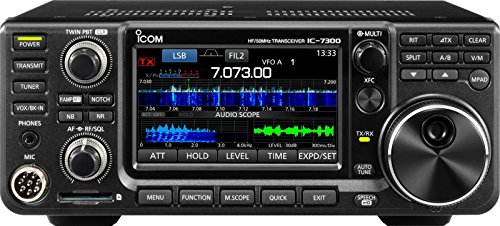 Our pickIcom IC-7300 HF/50MHz TransceiverThe classic first HF base station$1200Check price
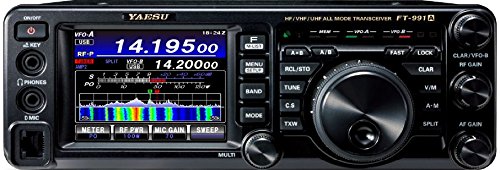 Yaesu FT-991A All-Band TransceiverOne radio that does everything$1530Check price
A handheld talks to repeaters a few towns away; an HF base station talks to the world. HF (high frequency) is the range of bands that bounce off the ionosphere and travel hundreds or thousands of miles, so from a rig on your desk you can make contacts across the country or across an ocean, which hams call DX. That reach is the whole appeal, and it is a genuinely different hobby from local VHF chatter. The catch is that an HF rig is not plug-and-play: you need an antenna (a simple wire dipole is cheap and works well), a 12V DC power supply to run it (100W radios pull 20 amps or more), and a General-class license for full HF access. One more thing worth paying for is a modern rig with an SDR (software-defined radio) waterfall display, a live scrolling picture of the band that shows every signal at a glance, so you can literally see a station calling and tune right to it. Older radios made you hunt blind across a quiet-sounding band; the waterfall is the single feature that makes HF easier to learn.
Choosing mostly comes down to bands and budget. Every rig here covers the HF bands where the long-distance action is, so the real question is how much more you want. A budget SDR rig gets you on HF affordably at lower power (fine with a decent antenna), the classic 100-watt rig adds the big, clear waterfall and full power that most beginners settle on, and an all-band radio throws in VHF and UHF (the 2m and 70cm your handheld uses) plus digital modes so one box does everything. More power helps you punch through when a band is crowded, but a good antenna matters far more than watts, so do not overspend on power at the expense of the wire outside. Pick the rig whose bands and screen you want, then put real thought into the antenna.
 Best budget HF rig
Xiegu G90 HF Transceiver
The affordable way onto the HF bands. The Xiegu G90 is a software-defined 20-watt HF radio covering 0.5 to 30 MHz, and it packs in features that cost far more elsewhere: a built-in automatic antenna tuner (so it is forgiving of an imperfect antenna), a genuine color spectrum and waterfall display, and a detachable front panel. Twenty watts is lower power than a full 100-watt rig, but with a decent antenna it makes real long-distance contacts, and plenty of hams run it as a first HF station or take it portable. If you want to find out whether HF grabs you without spending four figures, this is the one.
What's good
- A real SDR HF rig at an entry price
- Built-in tuner is forgiving of antennas
- Genuine color spectrum and waterfall display
- Doubles as a portable radio
What's not
- 20W is lower power than a 100W rig
- Small screen and fiddlier menus
 Best for most beginners
Icom IC-7300 HF/50MHz Transceiver
The rig that became the default first HF station, and deservedly so. The Icom IC-7300 covers all the HF bands plus 6 meters at a full 100 watts, and its direct-sampling SDR feeds a big, bright 4.3-inch color touchscreen with a real-time spectrum scope and waterfall that is a genuine joy to use: you see the whole band at once and touch a signal to jump to it. It has a built-in automatic antenna tuner, excellent receive performance, and an enormous community of owners, so almost any question you have is already answered online. It is not the cheapest way onto HF, but it is the one most beginners buy, keep, and recommend. The no-overthinking pick.
What's good
- The class-standard first HF rig, hugely supported
- Big 4.3-inch touchscreen waterfall, easy to read
- Full 100W with a built-in antenna tuner
- Excellent direct-sampling receiver
What's not
- HF and 6m only (no 2m or 70cm)
- Needs a separate 12V power supply and antenna
 Best to grow into
Yaesu FT-991A All-Band Transceiver
The radio for someone who wants one box that does the lot. The Yaesu FT-991A covers HF and 6 meters like the others, but adds 2 meters and 70 centimeters (the VHF and UHF bands your handheld uses) and every mode including SSB, CW, FM, and Yaesu C4FM digital, so it is a whole station in one unit. It runs 100 watts on HF, has a full-color spectrum-scope waterfall and a built-in antenna tuner, and can even work satellites. You pay more and the screen is a touch smaller than the IC-7300, but if you already suspect you will want VHF, UHF, and digital modes down the line, this is the rig you grow into rather than out of.
What's good
- All-band: HF, 6m, 2m and 70cm in one box
- All modes including C4FM digital and satellite
- 100W on HF with a built-in antenna tuner
- Full-color waterfall spectrum scope
What's not
- Costs more than an HF-only rig
- Smaller screen than the IC-7300
For full HF access you want a General-class license, a step up from the entry-level Technician: it is another 35-question multiple-choice exam, still with no Morse code, and it opens nearly all the HF bands. On top of the radio you also need an antenna (a simple wire dipole is cheap and works well) and a 12V DC power supply big enough to run it (a 100-watt rig wants around 25 to 30 amps). Budget for all three from the start, because the rig on its own will not get you on the air.
Which to buy: want to try HF affordably with a capable SDR rig? The Xiegu G90. Want the classic 100-watt station with the big waterfall that most beginners settle on? The Icom IC-7300 is the easy pick. Want one radio that also does VHF, UHF, and digital modes? The Yaesu FT-991A.
Before you buy
Get your General-class license for full HF access. It is one more 35-question exam after your Technician, with no Morse code.
Spend real effort (and money) on the antenna, not just the radio. A good wire antenna outside does more for you than extra watts.
Buy a 12V power supply rated comfortably above your rig's draw, around 25 to 30 amps for a 100W radio, so it runs cool.
Start by listening across the bands with the waterfall. You will quickly learn where the activity is and how conditions shift through the day.
HF base station questions
What is HF and why do I need a base station for it?
Do I need a different license for HF?
What is a waterfall display and does it matter?
What else do I need besides the radio?
How much power do I really need, 20 watts or 100 watts?
Which HF rig should a beginner buy?
For most beginners the Icom IC-7300 is the pick: a full 100-watt HF rig with a big, easy waterfall display and a built-in tuner that a huge community can help you with. Want to try HF for much less? The Xiegu G90 is a real SDR rig at 20 watts. Want one radio that also covers VHF, UHF, and digital modes? The Yaesu FT-991A is the one to grow into. Whatever you choose, get your General-class license, put real effort into the antenna, and budget for a 12V power supply, because the radio is only part of the station.
Ready to actually do it?
The first ham radio quest takes an evening, and it tells you whether the gear was worth it better than any review can.
Start Ham RadioThe HobbyStack editorial team researches each guide against manufacturer specifications, published resources and practitioner sources. Every product is checked for availability and described against its current listing before publication, and prices are re-checked when guides are updated.
About our editorial process →More gear guides
All guides
Best Antenna Analyzer (2026): An SWR Meter Tells You Less Than You Think
An SWR meter tells you that your antenna is wrong. An analyzer tells you which way it is wrong and by how much, which is the difference between trimming a dipole in one afternoon and cutting it four times and hoping. They are usually shelved together and they answer genuinely different questions.

Best Ham Radio for Beginners (2026): From a $30 Handheld to a 50W Base
The best first ham radio is a cheap handheld: for the price of a takeout meal you get a real dual-band radio to learn on, hit local repeaters, and pass your license test with. As you get into it, a higher-power handheld or a 50W mobile opens up far more range. Here are three good ones, and yes, you need a license to transmit (it is easy to get).

Best Pottery Tool Set (2026): Six of the Twelve Do Nearly Everything
Open a twelve-piece pottery set and six tools will do nearly all your work: the wire cutter, a wooden rib, a metal rib, a loop trimming tool, a sponge and a needle tool. The rest get picked up once, found to duplicate something, and left in the canister for years.

Long Blade Freediving Fins (2026): Stiffness Is Matched to Your Legs, Not Your Ambition
Long blades are not about speed. A long blade moves a large volume of water per kick, so you cover distance at a slow, unhurried cadence instead of a fast one, and on a breath-hold the thing you are conserving is oxygen. A stiff blade you cannot load properly burns more of it than a soft blade you can.
Best Millinery Wire (2026): Gauge Decides Whether the Brim Holds Its Line
Wire gauge runs backwards, so an 18 gauge wire is thicker than a 20. That catches people out in exactly the wrong direction: they buy a high number expecting something substantial, wire a brim with it, and watch the brim sag the first time the hat is picked up.

Best Go Books (2026): Beginners Want Joseki and Need Life and Death
Every beginner reaches for a book of joseki, the memorised corner sequences, because they look like the secret. They are not. Strength at Go comes from reading life and death and recognising good shape, and a player who has memorised openings without those will play twenty moves of professional theory and then lose the group.