Best Soap Carving Tools (2026): Loop Tools Cut, Knives Only Slice
A knife slices soap, which is fine for the first rough shape and useless for a curve. To hollow a concave surface you need a loop or ribbon tool that shaves a thin controlled ribbon away, and that single tool change is what separates a carved bar from a whittled one.
HobbyStack may earn a commission from links on this page at no extra cost to you. Our picks are chosen on merit; the commission helps fund the research.
- Loop and ribbon tools shave curves. Knives only cut flat planes.
- Soap age matters: too fresh is gummy, too old is brittle and chips.
- Dull tools tear soap. Sharp tools shear it cleanly.
- Work dry. Water turns the surface slimy and ruins detail.
- Keep the shavings. They press back together for repairs and practice.


Why loop tools, not knives
Soap is soft, slightly waxy, and it fractures rather than compressing. That changes what tools work.
A knife cuts a plane. Push it through soap and you get a flat facet. Excellent for blocking out a rough shape, squaring a bar, or cutting a straight edge, and incapable of producing a smooth concave curve.
A loop or ribbon tool is a shaped wire or steel band on a handle. Drawn across the surface it shaves a thin ribbon away, and because the loop has a curve, the cut it leaves has that curve. This is how you hollow a petal, a fold of cloth, or the inside of a shell.
It also gives you far more control. A knife removes whatever the blade passes through; a ribbon tool removes a controlled depth determined by how hard you press.
The useful set is small:
- A knife or flat chisel for blocking out and straight cuts
- Loop or ribbon tools in two or three sizes for hollowing and shaping curves
- A pointed tool for scoring guide lines and picking out detail
- A small flat or skew chisel for cleaning up and crisping edges
Clay tools transfer directly. Soap and air-dry clay behave similarly enough that pottery and sculpting tools are the standard answer, which is why the budget pick here is a clay set and why Kemper, a pottery tool maker, appears at all.
Sharpness matters more than it seems. A dull edge tears and drags soap, leaving a furry surface. A sharp one shears it cleanly and leaves a face that needs almost no finishing.
Soap condition, which decides everything
The bar you carve is as important as the tool, and this is the thing nobody mentions.
Too fresh and soap is gummy. It smears rather than shaving, clogs the tools and will not take detail. Supermarket soap straight from the wrapper is often like this.
Too old and dried out and it becomes brittle. Edges chip, thin sections snap, and a careless cut takes a piece off.
The window is in between, and you get there by unwrapping a bar and leaving it out for a few days to a week. It firms up, loses surface moisture, and starts shaving cleanly. Experienced carvers keep bars unwrapped and ageing so there is always one ready.
Hardness varies by type. Glycerin and clear soaps are harder and more brittle. Plain opaque bars like Ivory are softer and more forgiving, which is why they are the traditional practice soap.
Work completely dry. Any water makes the surface slimy, which destroys detail and makes tools slip. Carve dry, brush the shavings away with a dry brush, and keep your hands dry too.
Save the shavings. Pressed together firmly they make a workable mass for practising, patching a mistake, or filling a chip, which is a genuine advantage soap has over wood.
Smooth with the warmth of a finger or a scrap of nylon stocking at the end. Soap polishes, and a carving that has been burnished looks finished in a way a freshly cut one does not.
And expect to break things. Thin projections snap. Design with that in mind early on.
 Best for starting out
18PCS Clay Sculpting Tools, Double Head Air Dry Clay Carving Tools Kits for Beginners and Adults, Sculpting To
Eighteen double-ended clay sculpting tools, which covers loops, points and flats in several sizes for less than the price of a single proper carving chisel. Clay tools work on soap because the materials behave similarly, and having a spread of loop shapes is far more useful early on than one excellent tool, since you discover which profiles you reach for. The steel is soft and the edges are not sharp from the factory.
What's good
- Eighteen tools covering loops, points and flats
- Clay tools transfer directly to soap
- Lets you find which profiles you actually use
- Costs less than one proper chisel
What's not
- Edges are not sharp from the factory
- Soft steel loses its edge quickly
- Handles are basic plastic
- Not precise enough for fine detail
 Best for proper curves
Kemper Ribbon Tool - 6", R2
A six-inch double-ended ribbon tool from Kemper, who make pottery tools, and the difference against a bargain set is in the band itself: properly tensioned steel that holds its shape under pressure instead of flexing away from the cut. That matters because a ribbon tool works by shaving a controlled depth, and a band that gives under load removes an unpredictable amount. Two profiles on one handle. It is one tool, not a set.
What's good
- Properly tensioned band holds shape under pressure
- Removes a controlled, predictable depth
- Two profiles on one six-inch handle
- Kemper quality from a pottery tool maker
What's not
- One tool, so not a complete kit
- Twice the price of an eighteen-piece set
- Two profiles only
- Wire band will eventually fatigue
 Best for fine detail
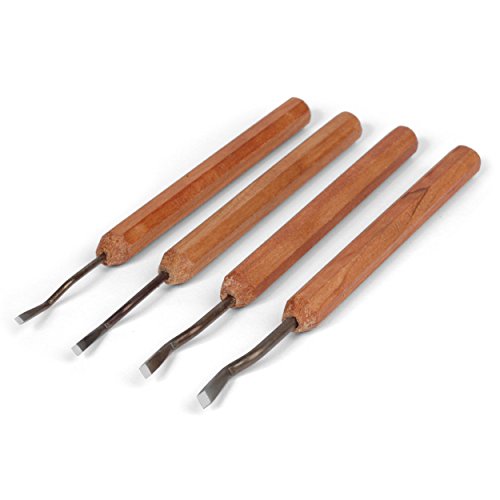
FLEXCUT Carving Tools, Skew Micro Tool Set, High-Carbon Steel Blades, with Solid Ash Handle, Set of 4 (MT200)
A set of high-carbon steel micro skew chisels with ash handles, made for detail wood carving and consequently far sharper and better finished than anything sold for soap. Sharpness is the point: a keen edge shears soap cleanly and leaves a face needing almost no smoothing, where a dull tool tears and leaves a furry surface. Skews crisp up edges and cut into corners. They are sharp enough to take a finger and demand respect.
What's good
- Genuinely sharp, so it shears instead of tearing
- High-carbon steel holds an edge properly
- Skew profile crisps edges and reaches corners
- Ash handles are comfortable for long sessions
What's not
- Over six times the clay set
- Sharp enough to be a real injury risk
- Carbon steel rusts if left damp
- No loop tools, so not a complete solution
Fresh soap is gummy: it smears instead of shaving, clogs tools and will not hold detail. Soap that has dried out for months is brittle and chips. The usable window is a few days to a week after unwrapping, so keep bars out of their wrappers somewhere dry and work through them in rotation. This single habit improves results more than any tool upgrade, and it costs nothing but patience.
Working a bar from square to finished
Draw on it first. A pencil marks soap clearly and wipes off. Sketch the outline on all the faces you can, so you are cutting to a plan rather than discovering the shape.
Remove the brand stamp early. Shave the whole face down past the imprint before you start, or it will reappear halfway through your form.
Block out with a knife, taking the bar down to a rough silhouette in flat planes. Do not try to curve anything yet.
Then round with loop tools, working the flats into curves and taking thin passes. Thin passes are the whole discipline, because soap does not grow back.
Work all round continuously. Rotating the piece and cutting a little everywhere keeps it symmetrical, where finishing one side first almost guarantees a lopsided result.
Detail last, and lightly. Fine lines go in when the form is right, using a pointed tool and very little pressure.
Burnish to finish. A warm finger, a soft dry cloth or a scrap of nylon brings up a slight sheen and softens the tool marks.
Keep it dry afterwards. A finished carving left in a humid bathroom will soften and lose its edges. Somewhere dry and out of direct sun.
Before you buy
Loop or ribbon tools for curves. A knife alone cannot do them.
Buy an assortment first to learn which profiles you use.
Sharpness matters. Dull tools tear soap.
Unwrap bars and let them firm up for a few days before carving.
Work dry, and keep the shavings for practice and repairs.
Soap carving questions
Why do I need loop tools rather than just a knife?
What soap is best for carving?
Should I wet the soap while carving?
Can I fix a piece that breaks off?
Start with the eighteen-piece clay set. Soap and clay behave similarly, a spread of loop profiles teaches you which ones you actually reach for, and it costs less than one good chisel. Add the Kemper ribbon tool once you know you want a band that holds its shape under pressure. The FLEXCUT set is for detail work and is genuinely sharp. Then unwrap your soap a week early.
Ready to actually do it?
The first soap carving quest takes an evening, and it tells you whether the gear was worth it better than any review can.
Start Soap CarvingThe HobbyStack editorial team researches each guide using practitioner communities, published resources, and direct input from active hobbyists. Every guide is reviewed for accuracy before publication and updated when practices change.
About our editorial process →More gear guides
All guides
Best Soap Carving Knife (2026): Sharp Enough to Slice, Not Crush
Soap is softer than wood and less forgiving of a dull blade. A sharp knife parts it cleanly; a blunt one compresses and tears, leaving a crumbling edge no amount of care recovers. Wood carving knives are the right tool, and the difference between a good session and a frustrating one is almost entirely the edge.

Best Macrame Cord (2026): Single Strand Combs Out, Three-Ply Does Not
Cord comes in three constructions and they behave completely differently at the one moment that matters most: whether you can comb the ends out into soft fringe. Single strand combs beautifully. Three-ply gives you a crinkled, curly fringe instead. Braided will not comb at all. Buy the wrong one for your project and the finish is decided for you.

Best Macrame Kit for Beginners (2026): 3 Picks for Your First Knots
A macrame kit gives you the cord, the rings and dowels, and (crucially) a guide, so you can knot your first plant hanger or wall hanging without buying anything separately. The cord is the heart of it: soft 3mm cotton is the beginner standard. Here are three good ones, from a single-project starter to a big multi-project kit with a project book.

Best Candle Fragrance Oils (2026): Why Essential Oils Are Not the Answer
The most common disappointment in candle making is a candle that smells wonderful cold and of nothing at all when lit. Almost always the cause is one of three things: the wrong kind of oil, too little of it, or not enough patience before burning. None of them are obvious, and shops sell essential oils next to fragrance oils as though they were interchangeable.

Best Candle Making Kit for Beginners (2026): 3 Picks
A soy candle starter kit is one box with everything you need to pour your first candles: wax, wicks, fragrance, a pouring pitcher, and jars or tins. The spec that actually matters for a beginner is soy wax (not paraffin or a "blend"), because it melts at a low temperature, pours easily, and is very forgiving when you get the amount or timing a little wrong.

Best Candle Pouring Pitcher (2026): The Spout Is the Whole Tool
Everything else in candle making tolerates improvisation. The pour does not. You are moving hot liquid wax into a narrow-mouthed jar around a centred wick, and a pot without a proper spout dribbles down the outside, floods the wick and leaves you cleaning wax off a worktop instead of making candles.