Best Soap Carving Knife (2026): Sharp Enough to Slice, Not Crush
Soap is softer than wood and less forgiving of a dull blade. A sharp knife parts it cleanly; a blunt one compresses and tears, leaving a crumbling edge no amount of care recovers. Wood carving knives are the right tool, and the difference between a good session and a frustrating one is almost entirely the edge.
HobbyStack may earn a commission from links on this page at no extra cost to you. Our picks are chosen on merit; the commission helps fund the research.
- Wood carving knives are the correct tool. Soap carving has no separate category of knife.
- Sharpness matters more than shape. Soap tears under a dull edge rather than cutting.
- A leather strop keeps an edge far longer than sharpening does. Strop often, sharpen rarely.
- Detail knife for fine work, sloyd or cutting knife for removing bulk. Most carvers use both.
- Let soap dry out for a few days first. Fresh soap is soft and gummy.
 Flexcut Detail Knife KN13Fine detail$26Check price
 Flexcut Cutting KnifeRemoving bulk$23Check price
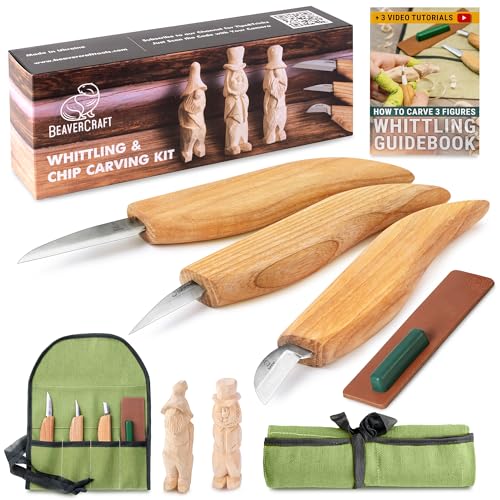 Our pickBeaverCraft S15 KitStarting out$40Check price
Why soap punishes a dull blade
Wood has grain and structure. It resists a blade and splits along predictable lines, which is forgiving — a slightly dull tool still cuts, just harder.
Soap has no grain and very little structural strength. A sharp edge parts it, leaving a glassy cut face. A dull edge compresses it ahead of the blade until it fails, which tears rather than cuts and leaves a ragged, crumbly surface.
So the sharpness threshold is higher for soap than for wood, and it is the single biggest determinant of results.
Two other things follow. Thin blades work better than thick ones, because a thick wedge does more compressing on the way through. And shallow cuts beat deep ones — trying to remove a lot in one pass loads the soap sideways and it snaps.
Let the soap dry. A fresh bar is soft and gummy and clogs the blade. A few days unwrapped in open air firms it up considerably and it carves far more cleanly. A week is better.
Stropping, which most people skip
Sharpening removes metal to form a new edge. Stropping realigns the edge you already have, and it is what keeps a carving knife working.
An edge under use rolls over microscopically long before it genuinely dulls. Drawing the blade backwards across leather charged with polishing compound straightens that roll and polishes the bevel. It takes about thirty seconds.
Do it every fifteen or twenty minutes of carving, not when the knife feels blunt. A knife stropped regularly may go a year without seeing a stone.
Direction matters. Always drag the blade spine-first across the strop, never edge-first — pushing the edge into leather rolls it the wrong way or slices the strop.
Compound matters more than the leather. The green chromium oxide compound that comes with most kits is around 0.5 micron and is what does the polishing. Bare leather alone does very little.
The BeaverCraft kit here includes both a strop and compound, which is a genuine part of its value rather than packaging.
 Best for fine detail
Flexcut Detail Knife, High Carbon Steel Blade, Ergonomic Ash
A 1.5-inch straight blade with a very fine point, in tempered spring steel at HRC 59-61, which holds an edge well. The fine point is what it is for: narrow cuts, tight corners and the detailing where a wider blade cannot reach. An ash handle keeps it comfortable over a long session and it weighs almost nothing. Made in the USA and sharpened at the factory, so it works straight out of the box.
What's good
- Very fine point reaches into tight detail
- HRC 59-61 spring steel holds an edge
- Sculpted ash handle, comfortable for hours
- Factory sharpened and ready to use
What's not
- Too fine to remove bulk material efficiently
- Delicate point will snap if levered
- High carbon steel, so keep it dry
- One knife, not a set
 Best for removing bulk
FLEXCUT Wood Carving Tools
The general-purpose partner to the detail knife, in 1095 high carbon steel. A longer, less pointed blade removes material efficiently and holds a straighter line, which is what you want getting a bar down to a rough shape before any detailing begins. Most carvers end up owning both this and the detail knife, since they do genuinely different jobs and neither substitutes well for the other at the same price.
What's good
- Removes bulk far faster than a detail knife
- 1095 carbon takes a very keen edge
- Holds a straight line for flat facets
- Same comfortable Flexcut handle
What's not
- Too broad for tight detail work
- Carbon steel rusts if left damp
- Nearly the same price as the detail knife, so budget for both
- No strop or compound included
 Best for starting out
BeaverCraft Wood Carving Knife Kit S15 Whittling Kit
Three knives rather than one — detail, chip and roughing — plus the thing the single knives leave out: a leather strop and polishing compound, which is what actually keeps an edge working. It also includes a canvas tool roll and a guide. Pre-sharpened and ready to use, made in Ukraine. For barely more than one Flexcut knife you get the whole workflow, which is why it is the pick for anyone starting.
What's good
- Three knife shapes covering roughing to detail
- Strop and compound included — the part that matters
- Canvas roll keeps blades from dulling each other
- Barely more than a single premium knife
What's not
- Individual knives are not as refined as Flexcut
- Aimed at beginners, so you may outgrow the roughing knife
- Handles are chunkier than the ash Flexcut
- Guide is aimed at wood, not soap
A bar straight out of its wrapper is soft and slightly gummy, and it clogs a blade and tears rather than cutting. Unwrap it and leave it in open air for a few days — a week is better — and it firms up considerably. Ivory-type bars are popular for carving partly because they are soft enough to work and dry out evenly without cracking.
Carving safely, which soap makes easier to forget
Soap is soft, so people relax in a way they would not with wood, and the knives are exactly as sharp.
Cut away from yourself. Obvious, routinely ignored, and the reason most carving injuries happen to the non-knife hand.
Know where your thumb is. The thumb-push cut, where the off hand's thumb drives the blade, is a real technique and it puts your thumb directly behind a moving edge. Learn it properly or avoid it.
A carving glove on the holding hand costs very little. Cut-resistant gloves are standard in wood carving and equally sensible here.
Sit down and brace. Carving standing up with the work held in mid-air removes all your control.
Keep the blade sharp. Counter-intuitively the sharp knife is the safe one — a dull blade needs force, and force is what makes a slip go somewhere unplanned.
And work over a tray. Soap shavings travel further than you would believe, and they are slippery underfoot.
Before you buy
Wood carving knives are correct. There is no separate soap knife.
Get a strop and compound. It matters more than a second knife.
A detail knife and a roughing knife do different jobs. Most people want both.
Dry the soap for several days before carving it.
Cut shallow. Deep cuts snap soap rather than removing it.
Soap carving questions
Do I need a special knife for soap carving?
Why does my soap crumble when I carve it?
What is stropping and how often should I do it?
What soap is best for carving?
The BeaverCraft S15 kit is the buy for anyone starting: three knife shapes plus the leather strop and compound that actually keep an edge working, for barely more than one premium single knife. Add the Flexcut detail knife when you want a finer point than the kit gives, and the Flexcut cutting knife if you rough out a lot of bulk. Then dry your soap for a week and strop every twenty minutes.
Ready to actually do it?
The first soap carving quest takes an evening, and it tells you whether the gear was worth it better than any review can.
Start Soap CarvingThe HobbyStack editorial team researches each guide against manufacturer specifications, published resources and practitioner sources. Every product is checked for availability and described against its current listing before publication, and prices are re-checked when guides are updated.
About our editorial process →More gear guides
All guides
Best Soap Carving Tools (2026): Loop Tools Cut, Knives Only Slice
A knife slices soap, which is fine for the first rough shape and useless for a curve. To hollow a concave surface you need a loop or ribbon tool that shaves a thin controlled ribbon away, and that single tool change is what separates a carved bar from a whittled one.

Best Macrame Cord (2026): Single Strand Combs Out, Three-Ply Does Not
Cord comes in three constructions and they behave completely differently at the one moment that matters most: whether you can comb the ends out into soft fringe. Single strand combs beautifully. Three-ply gives you a crinkled, curly fringe instead. Braided will not comb at all. Buy the wrong one for your project and the finish is decided for you.

Best Macrame Kit for Beginners (2026): 3 Picks for Your First Knots
A macrame kit gives you the cord, the rings and dowels, and (crucially) a guide, so you can knot your first plant hanger or wall hanging without buying anything separately. The cord is the heart of it: soft 3mm cotton is the beginner standard. Here are three good ones, from a single-project starter to a big multi-project kit with a project book.

Best Candle Fragrance Oils (2026): Why Essential Oils Are Not the Answer
The most common disappointment in candle making is a candle that smells wonderful cold and of nothing at all when lit. Almost always the cause is one of three things: the wrong kind of oil, too little of it, or not enough patience before burning. None of them are obvious, and shops sell essential oils next to fragrance oils as though they were interchangeable.

Best Candle Making Kit for Beginners (2026): 3 Picks
A soy candle starter kit is one box with everything you need to pour your first candles: wax, wicks, fragrance, a pouring pitcher, and jars or tins. The spec that actually matters for a beginner is soy wax (not paraffin or a "blend"), because it melts at a low temperature, pours easily, and is very forgiving when you get the amount or timing a little wrong.

Best Candle Pouring Pitcher (2026): The Spout Is the Whole Tool
Everything else in candle making tolerates improvisation. The pour does not. You are moving hot liquid wax into a narrow-mouthed jar around a centred wick, and a pot without a proper spout dribbles down the outside, floods the wick and leaves you cleaning wax off a worktop instead of making candles.