Best Weighted Hula Hoops for Beginners (2026)
The trick to hula hooping as an adult is not skill, it is the hoop. The tiny light hoops from childhood fall straight down; a bigger, weighted hoop turns slowly enough to actually keep up. Here are three beginner hoops, from a simple weighted one to a heavier ACU Hoop.
HobbyStack may earn a commission from links on this page at no extra cost to you. Our picks are chosen on merit; the commission helps fund the research.
- Bigger and heavier is easier, not harder. A larger, weighted hoop turns more slowly and gives your body time to react, so it stays up. The little light hoops from childhood are actually the hardest to keep going.
- Our pick: the NEOWEEK 2lb Hoop (~$24). Smooth padded surface, snaps together from sections to adjust the size, and 2lb is the sweet spot — enough momentum to stay up without much bruising. The one most beginners should get.
- Budget: the Auoxer Weighted Hoop (~$20). The same detachable, size-adjustable idea at 1.9lb. A perfectly good, cheaper way to start if you want to try before committing.
- Step up: the ACU Hoop 3L (~$47). A wider 41-inch, 3.3lb hoop with grippy wavy ridges — the extra size and weight make it the easiest of the three to keep spinning, if you do not mind more of a workout.
- Skip the 'infinity' or 'smart' hoops with a weighted ball on a track. They cannot fall off, which means they do not teach you to actually hoop — they are a different gadget, not a hula hoop.
 Our pickNEOWEEK 2lb Weighted Hula HoopBest for most beginners$25Check price
 Auoxer Weighted Fitness Hoop (1.9lb)Best on a budget$20Check price
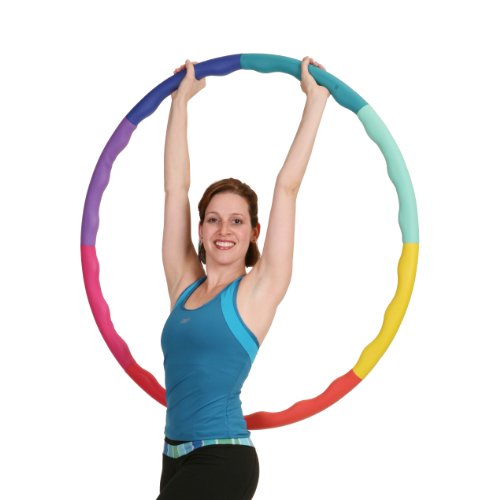 ACU Hoop 3L Weighted Hula Hoop (3.3lb)The easiest to keep up$40Check price
Why a weighted hoop is the secret
Most adults "cannot hula hoop" because they are using the wrong hoop. The thin, light hoops sold as kids' toys spin fast and drop the instant your rhythm is off — they need constant, quick hip movement most beginners have not learned yet.
A larger, weighted hoop flips the difficulty. More weight means more momentum, so it keeps turning even when your form is rough. A bigger diameter means it travels a longer, slower circle, giving your hips time to catch each rotation. The result: it stays up while you learn, instead of dropping before you start.
Two numbers matter:
- Weight. For learning, 1.5 to 2.5lb is the sweet spot. Enough momentum to forgive a beginner's timing, not so heavy it bruises your hips — which is why very heavy 3lb-plus hoops are a "once you are comfortable" step, not a day-one one.
- Diameter. Bigger is easier. A hoop that reaches somewhere between your waist and mid-chest when stood on the floor is a good beginner size. The 38 to 41 inch hoops here are sized for adults.
Most beginner hoops are detachable — they snap together from 6 to 8 curved sections. That makes them adjustable (remove a section to shrink the hoop as you improve), easy to store, and it is why they arrive in a small box.
 Best for most beginners
NEOWEEK 2lb Weighted Hula Hoop
The NEOWEEK is the standard beginner hoop, and it earns it. At 2lb it sits right in the forgiving sweet spot — enough momentum to keep spinning through rough timing, not so heavy it hammers your hips. The surface is smooth high-density foam rather than aggressive ridges, which is noticeably gentler while your body builds tolerance in the first week. It snaps together from sections, so you can set it around 38 inches to start and remove a piece or two to shrink it to 32 or 28 inches as you improve, and it comes apart for easy storage. If you buy one hoop to learn on, this is it.
What's good
- 2lb — the forgiving sweet spot for learning
- Smooth padded surface is gentler on the waist than ridged hoops
- Sectional: adjust from ~38 down to 32 or 28 inches as you improve
- Detaches for easy storage and travel
What's not
- Still bruises a little in the first week, like any weighted hoop
- Not for off-body 'hoop dance' tricks — it is a fitness hoop
 Best on a budget
Auoxer Weighted Fitness Hoop (1.9lb)
A few dollars less than our pick, and it behaves almost identically. The Auoxer is a 1.9lb detachable weighted hoop — the same sectional, size-adjustable design, wrapped in soft NBR foam over an ABS core. At about 38 inches and just under 2lb it has the same forgiving momentum that keeps a beginner's hoop up, and you remove sections to shrink it as you get better. It is a touch lighter and a little less refined than the NEOWEEK, but for finding out whether hooping is for you, it is a genuinely good hoop for the money.
What's good
- 1.9lb — nearly the same forgiving weight as our pick
- Detachable, size-adjustable sections
- Soft foam over an ABS core, comfortable to learn on
- The cheapest way to start with a real weighted hoop
What's not
- Slightly lighter and less polished than the NEOWEEK
- A fitness hoop, not a dance/trick hoop
 The easiest to keep up
ACU Hoop 3L Weighted Hula Hoop (3.3lb)
If you want the hoop that does the most work for you, size and weight are the answer, and the ACU Hoop has both. At 41 inches across and 3.3lb it is bigger and heavier than our other picks, so it turns slowly and carries real momentum — genuinely the easiest of the three to keep spinning. The patented wavy ridges grip your waist to help hold the hoop up and add a massage-like intensity. The trade-off is that the extra weight and ridges bruise more while your core toughens up, so many people start with a 2lb hoop and graduate to this. As a first hoop it works if you are okay pushing through a tougher first week, and it is a great second hoop once hooping feels natural.
What's good
- 41 inches and 3.3lb — the easiest of the three to keep spinning
- Wavy ridges grip the waist and add workout intensity
- Recognized Sports Hoop / ACU Hoop brand, patented design
- Great as a step-up once basic hooping clicks
What's not
- Heavier and ridged — bruises more while you adjust
- More hoop (and more cost) than a first-timer strictly needs
Search results are full of 'infinity hoops' and 'smart hoops' — a weighted ball on a track that circles your waist and cannot fall off. They are fine as a gentle waist workout, but they are not hula hooping: because they cannot drop, they never teach the timing and hip movement that actually keeping a hoop up requires. If your goal is to genuinely hula hoop, and to do tricks later, get a real weighted hoop like the three here, not a ball-on-a-track gadget.
Before you buy
Size it to your body. A hoop that reaches between your waist and mid-chest when stood on the floor is a good beginner size. Bigger is more forgiving; you can remove sections to shrink it as you improve.
Wear a layer the first week. A t-shirt or leggings over bare skin cuts the early bruising while your body toughens up. The tenderness fades within a week or two.
Start with 5-minute sessions, both directions. Short and frequent beats one long session that leaves you sore and put off.
Smooth foam is kinder than wavy ridges to start. Ridged hoops grip and massage harder, which means more intensity and more early bruising. A smooth padded hoop is gentler while you learn.
Keep the sections snug. If the hoop feels loose or rattles, push the segments fully together — a loose joint wobbles the spin. Store it taken apart to save space.
Common questions about beginner hula hoops
Why can't I keep a hula hoop up?
How heavy should a beginner hula hoop be?
Do weighted hula hoops actually bruise you?
What size hoop should I get?
What's the difference between these and an 'infinity' or 'smart' hoop?
Is the heavier ACU Hoop worth it over a 2lb hoop?
Ready to actually do it?
The first hula hooping quest takes an evening, and it tells you whether the gear was worth it better than any review can.
Start Hula HoopingThe HobbyStack editorial team researches each guide against manufacturer specifications, published resources and practitioner sources. Every product is checked for availability and described against its current listing before publication, and prices are re-checked when guides are updated.
About our editorial process →More gear guides
All guides
Best Footbag (2026): Panel Count Decides Whether It Stalls or Bounces
A two-panel sand bag and a thirty-two-panel bag are barely the same object. The first is soft, dead, and sits still on your foot. The second is round, lively, and will bounce off. Panel count and fill decide which tricks are even possible, and almost nobody mentions it when you buy your first one.
Best Diabolo for Beginners (2026): Bearings Change What You Can Learn
A bearing diabolo holds its spin almost indefinitely, which sounds like pure upside and is a real trade. Spin is what keeps a diabolo stable, so bearings make tricks much easier to hold together. They also remove the one thing that forces a beginner to learn a clean, powerful acceleration.

Best Beginner Ukulele (2026): Soprano, Concert, and Tenor Picks
The great thing about the ukulele is that a good beginner one is cheap and genuinely easy to start on. The main decision is not budget, it is size: soprano, concert, or tenor. They are all tuned the same and played the same, they just differ in body size, which changes the tone and how much room your fingers have. All three picks here are from Kala, the brand most teachers point beginners toward, so you get a properly set-up instrument that stays in tune rather than a toy that fights you.

Best Beginner Harmonica (2026): 3 Honest Picks
Here is the honest truth most gear guides skip: the harmonica is one of the cheapest instruments to start, and the thing that actually matters is not spending more, it is not buying a toy. A real 10-hole diatonic harmonica in the key of C from a known brand is airtight, stays in tune, and lets you bend notes, which is the whole point. The cheap no-name harp and the giant multi-key gift set fight you the entire way, drift out of tune within a week, and make you feel like you have no talent when the truth is the instrument is the problem. So this guide is not about which expensive harp to buy, it is about getting one honest, well-made harmonica in the right key so you actually enjoy learning. Key of C is the standard beginner key, nearly every lesson, song, and YouTube tutorial is in C, so start there. All three picks are proper 10-hole diatonics in C with plastic combs, and even the dearest one here is cheap. Here are three good ones, and honest advice on how little you need to spend.

Best Kendamas for Beginners (2026)
A kendama is a wooden ball-and-cup skill toy, and the one that makes it click for a beginner has a slightly tacky paint that grips the ball so it does not slide off the cups. A cheap glossy one is genuinely harder to learn on. Here are three, from a trusted starter to a premium competition kendama.

Best Pottery Tool Set (2026): Six of the Twelve Do Nearly Everything
Open a twelve-piece pottery set and six tools will do nearly all your work: the wire cutter, a wooden rib, a metal rib, a loop trimming tool, a sponge and a needle tool. The rest get picked up once, found to duplicate something, and left in the canister for years.