Best UV Flashlight (2026): 365nm Beats 395nm and Costs More
Nearly every cheap UV torch is 395nm, and nearly every good one is 365nm. The difference is not brightness — it is how much visible purple light comes out alongside the ultraviolet. That purple glare washes over faint fluorescence, which is exactly the thing you bought a UV light to see.
HobbyStack may earn a commission from links on this page at no extra cost to you. Our picks are chosen on merit; the commission helps fund the research.
- 365nm is the useful wavelength. 395nm is cheaper and floods the scene with visible purple.
- Fluorescence is faint. Any visible light from the torch itself competes with what you are trying to see.
- Good 365nm torches use a filter to block the residual visible light — that filter is much of the cost.
- Never shine UV at eyes, and do not stare at the fluorescing surface for long periods.
- More LEDs does not mean better. One good 365nm emitter beats a hundred cheap 395nm ones.
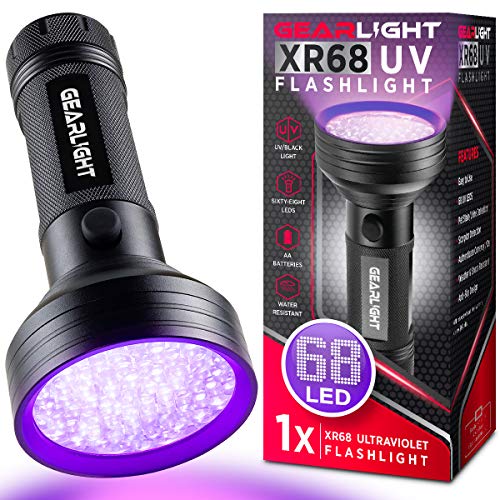 GearLight UV 68 LEDCasual use$12Check price
 Our pickKobra UV 100 LEDCovering an area$23Check price
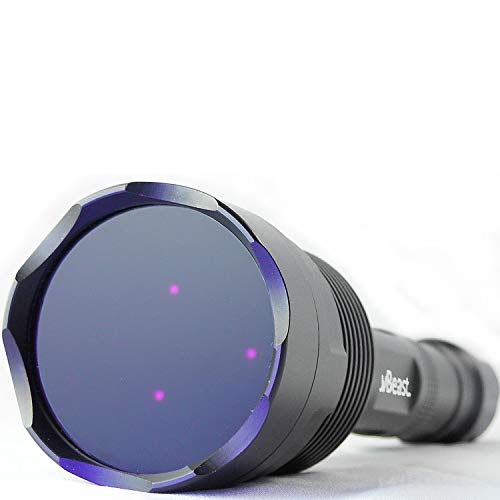 uvBeast V3 365nmSeeing faint fluorescence$80Check price
365nm versus 395nm
Ultraviolet below about 400nm is invisible to us. LEDs are not precise emitters, though — a "395nm" LED puts out a spread of wavelengths, and a good part of that spread lands in the visible violet range.
That is why a 395nm torch looks bright purple. You are seeing the light itself, not fluorescence.
At 365nm the emission sits further into the ultraviolet, so far less visible light escapes. The torch looks dim, almost useless — and then whatever is fluorescing under it stands out dramatically, because there is nothing competing with it.
Better 365nm torches also fit a filter over the emitter to absorb the remaining visible light. That filter is a real cost, which is much of why 365nm torches are three to five times the price.
For bright fluorescence — highlighter ink, tonic water, fresh laundry — 395nm is perfectly adequate. For anything faint, 365nm is not a refinement, it is the difference between seeing it and not.
What actually fluoresces
Useful to know before buying, because expectations are often wrong.
Reliably bright: highlighter ink, security marker pen, tonic water, laundry detergent residue and optical brighteners in white fabric, many minerals, scorpions.
Often visible: bodily fluids, some adhesives, certain plastics and papers, some inks and dyes.
Usually disappointing: most stains, most rocks, and anything already lit by ambient light.
The last point matters most. Fluorescence is faint, so it competes with every other light source in the room. A UV torch that seems useless in daylight often works well in a dark room — which is worth trying before deciding the torch is bad.
And remember that a 395nm torch is adding its own bright purple to the scene, so it competes with itself.
 Cheapest that works
GearLight UV Flashlight Black Light from 68 LED Blacklight
A 395nm torch with a large array of LEDs, which is the standard cheap format and genuinely fine for the bright end of fluorescence — highlighter marks, security pen, tonic water, checking whether the hotel bedding has been washed. It is cheap enough to keep in a drawer and not worry about. What it cannot do is show you anything faint, because the visible purple it floods the room with competes directly with the glow you are looking for. More LEDs sounds like more capability and mostly means more purple. Fine as a first UV torch and for party or puzzle use; do not buy it expecting to find subtle traces of anything.
What's good
- Very cheap
- Bright enough for strong fluorescence
- Wide flood from the LED array
- Pocketable, uses common batteries
What's not
- 395nm — floods the scene with visible purple
- Cannot show faint fluorescence
- LED count is marketing, not capability
- Basic build
 Best broad coverage
Kobra UV Black Light Flashlight 395nm
Still 395nm, but a larger array that throws a genuinely wide, even flood rather than a narrow hot spot — which is the practical advantage when you are sweeping a whole room or a large surface rather than examining one spot. For escape-room style puzzle hunting, where marks are usually deliberately bright and the job is finding them quickly across a wall, that coverage is worth more than wavelength precision. Better build than the cheapest torches and a more reliable switch. The fundamental limitation is unchanged: it is a 395nm light, so faint fluorescence will still be lost in its own purple glare. Buy it for area searching, not for sensitivity.
What's good
- Wide, even flood across a large area
- Better build and switch than the cheapest
- Ideal for finding deliberately marked clues
- Still inexpensive
What's not
- 395nm — same purple glare problem
- No filter
- Not for faint traces
- Array draws more battery
 Best for faint fluorescence
uvBeast V3 365nm Black Light UV Flashlight
A genuine 365nm torch with a filter over the emitter, and it is a different tool rather than a better version of the cheap ones. Because it emits far less visible light — and filters most of what remains — the scene stays dark and only what is fluorescing shows up. The first time you use one after a 395nm torch the effect is startling: things you could not see at all become obvious. It also looks disappointingly dim if you judge it by how bright the beam appears, which is exactly backwards. The costs are price, weight and battery drain. Buy it if you need to see faint fluorescence; for spotting a highlighter mark on a wall it is a lot of money.
What's good
- True 365nm — minimal visible glare
- Filtered, so the scene stays dark
- Shows fluorescence the cheap torches miss
- Solid, high-output build
What's not
- Three to five times the price
- Looks dim, which feels wrong
- Heavier and thirstier on batteries
- Overkill for bright marks
UV is invisible, so your blink reflex does not protect you — you can take a substantial dose without any of the discomfort that makes you look away from a bright torch. Never shine one at a face, do not look into the emitter to check whether it is on, and avoid staring at a strongly fluorescing surface for long periods. UV-blocking glasses are cheap if you use one regularly.
Getting the most from whatever you own
Three things matter more than the torch itself.
Darkness. Fluorescence is faint and loses to ambient light every time. Close curtains, turn lights off, and give your eyes a minute to adjust — the same dark adaptation that matters in stargazing helps here.
Angle. Light the surface obliquely rather than straight on. A direct beam reflects back at you and washes out the glow; a raking angle lets the fluorescence stand out against a darker background.
Distance. Closer is brighter, but too close puts a bright pool of purple on the surface. Back off until the beam covers the area evenly.
If a 395nm torch is disappointing, try it in a properly dark room before concluding you need a 365nm one. Quite often the room was the problem.
Before you buy
Check the wavelength. 365nm for faint fluorescence, 395nm for bright marks.
Ignore LED count. One good emitter beats a hundred cheap ones.
A filter is what makes a 365nm torch worth its price.
Never point it at eyes, and do not look into the emitter.
Try any torch in a properly dark room before judging it.
UV flashlight questions
What is the difference between 365nm and 395nm UV?
Does more LEDs mean a better UV flashlight?
Is UV light from a flashlight dangerous?
Why does my UV flashlight not show anything?
Choose the wavelength, not the LED count. For finding deliberately bright marks — highlighter, security pen, puzzle clues — a 395nm torch is genuinely fine and the Kobra floods a room well. If you need to see faint fluorescence, only a filtered 365nm torch like the uvBeast will do it, and the difference is dramatic rather than incremental. Whatever you buy, use it in a dark room, light surfaces at an angle, and never point it at anyone.
Ready to actually do it?
The first escape rooms quest takes an evening, and it tells you whether the gear was worth it better than any review can.
Start Escape RoomsThe HobbyStack editorial team researches each guide against manufacturer specifications, published resources and practitioner sources. Every product is checked for availability and described against its current listing before publication, and prices are re-checked when guides are updated.
About our editorial process →More gear guides
All guides
Best Cooperative Board Games (2026): Playing With the Table, Not Against It
Cooperative games are the easiest way into board games with people who do not think they like board games, because nobody gets knocked out and nobody has to be the one who ruins a friendship over a trade. They also have one specific failure mode that no box warns you about: the loudest player quietly starts telling everyone else what to do.

Best Gateway Board Games for Beginners (2026): 3 to Start With
Here is the honest truth: you do not need all three of these, any one of them is enough to get a good game night going. Gateway games are the ones built to win over people who think they do not like board games, the friends and family who groan at the word Monopoly. They teach in about five minutes, finish in under an hour, and leave everyone wanting another round. What they are not is Monopoly, Risk, or Trivial Pursuit, the long, luck-heavy, knock-you-out games most of us grew up quietly dreading. This guide is three different games at rising price and complexity, not three versions of one thing. Start with an easy, gorgeous crowd-pleaser, move to the classic that got a generation into the hobby, and step up to a richer game once your table is hooked. Buy one, get it played a few times, and add another only when your group is asking for more. Here are three good ones, and honest advice on where to start.

Best Beginner Chess Sets (2026): 3 Real Picks
A tournament-style set is the right first chess set: standard-size Staunton pieces, weighted so they don't tip, on a board with 2.25 inch squares. Skip the decorative themed sets for now. The one real decision is vinyl (cheap, portable, what clubs actually use) versus wood (nicer to own, costs more). Everything below is a set people genuinely buy and play on.
Best Chess Clock (2026): Delay, Increment and Why It Matters
A chess clock changes the game more than any other piece of equipment, because it turns thinking time into a resource you can run out of. The part beginners rarely have explained is that not all timed chess is the same: delay and increment are different rules that produce very different endgames, and the clock you buy determines which ones you can play.

Best Go Books (2026): Beginners Want Joseki and Need Life and Death
Every beginner reaches for a book of joseki, the memorised corner sequences, because they look like the secret. They are not. Strength at Go comes from reading life and death and recognising good shape, and a player who has memorised openings without those will play twenty moves of professional theory and then lose the group.

Best Go Sets for Beginners (2026)
A Go set is just a board, a bowl of black stones, and a bowl of white, but the details make a real difference when you are learning. Magnetic stones that do not slide, a full 19x19 grid, and a board that lies flat all make the game easier to focus on. Here are three complete sets, from a travel board to a bamboo one.