Best Beginner MIG Welder for Metal Sculpture (2026): 3 Real Picks
A MIG welder is the tool that turns a pile of steel into a single joined form, and MIG is the right process to start with because it is by far the easiest arc to learn: pull the trigger, wire feeds automatically, and a bead lays down. Most beginner sculpture is thin mild steel that a 110-volt machine handles from a normal outlet. The real choice is how far you plan to take it. Here are three good ones, all in stock, plus the gear beginners forget.
HobbyStack may earn a commission from links on this page at no extra cost to you. Our picks are chosen on merit; the commission helps fund the research.
- Start with MIG. It is the easiest arc to learn: wire feeds automatically, so you focus on the joint, not the machine.
- A 110-volt, ~140-amp machine covers most sculpture: rod, sheet, and light bar, from a normal wall outlet.
- Flux-core is cheapest (no gas bottle) but spatters; add gas later for cleaner beads on visible joints.
- The welder is one line on the bill. Budget for a helmet, gloves, wire, and gas too.
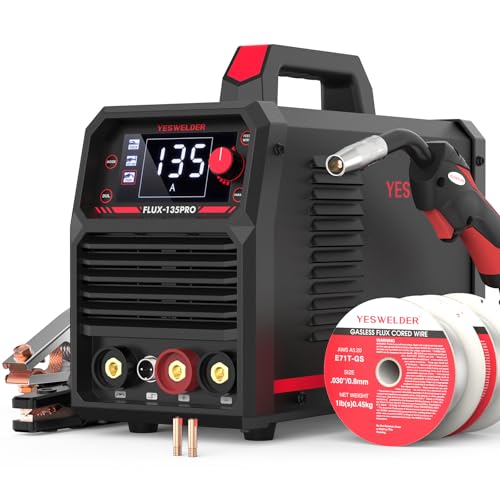 YESWELDER 135A Flux-Core MIG Welder (110V, 3-in-1)Laying your first beads for the least money$110Check price
 Our pickYESWELDER 205A Dual-Voltage MIG Welder (110V/220V)The do-it-all welder most sculptors should buy$340Check price
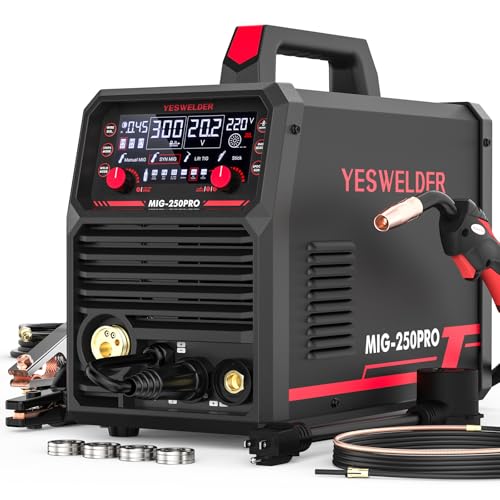 YESWELDER 250A Dual-Voltage MIG Welder (110V/220V)Welding thicker stock and keeping for years$500Check price
The first question for sculpture is not which brand but which process, and for a beginner it is MIG. The machine feeds wire through the gun automatically, so you hold a steady angle and travel speed and the arc does the rest, which is the fastest way from nothing to a real joint. MIG normally uses a bottle of shielding gas, which is an extra cost and a bottle to lug. Flux-cored wire gets around that: it carries its own shielding, so you can weld with no gas at all. Flux-core is cheaper and works in a breeze, but it spatters and leaves slag you chip off, so the welds are less tidy. Most sculptors start on flux-core to keep costs down, then add gas once they want cleaner beads. Either way, a 110-volt machine around 130 to 140 amps is the sweet spot for the thin steel most art is made from.
So choose by how far you plan to take it. If you just want to find out whether you like joining steel, a cheap gasless flux-core welder gets you laying beads for the least money. A dual-voltage machine that also runs gas is the one most people should buy: cleaner beads with a bottle, flux-core when you work outside, and more power later on a 220-volt outlet. And if you already know you will weld thick bar and plate, a higher-amp machine gives you the punch to fuse it cleanly. The three below are all YESWELDER, which dominates budget welding for a reason (in stock, well reviewed, priced right), but the same tiers exist from Forney, Hobart, and Lincoln if you want a name. Whichever you pick, the welder is only part of the cost, and a good auto-darkening helmet comes first.
 Best budget start
YESWELDER 135A Flux-Core MIG Welder (110V, 3-in-1)
The cheapest honest way to strike your first arc. This YESWELDER runs gasless flux-cored wire, so there is no gas bottle between you and your first weld, and it works outdoors where a breeze would ruin a gas weld. It runs off a normal 110-volt outlet, and its synergic control sets the wire speed for you, which flattens the learning curve. Flux-core spatters more and leaves slag you chip off, and this is a light-duty machine. But for finding out whether you enjoy joining steel, it does the job for little money and leaves budget for a helmet and gloves, which matter more than a nicer welder at this stage.
What's good
- Genuinely cheap way to start welding steel
- No gas bottle needed, works outdoors in wind
- Light and portable, runs on a normal 110V outlet
- Synergic control sets wire speed for you
What's not
- Flux-core only for MIG: more spatter and slag
- Light-duty, not for long high-amp sessions
 Best for most people
YESWELDER 205A Dual-Voltage MIG Welder (110V/220V)
The machine most sculptors should buy, because it keeps going as you improve. Add a gas bottle and it welds clean beads for visible joints; leave the gas off and it runs flux-core outdoors. It is dual-voltage, so it plugs into 110-volt now and 220-volt later for more power on thicker steel, and you do not outgrow it like a single-voltage starter. At up to 205 amps it handles everything beginner sculpture is made of, with headroom, and it is spool-gun ready if you ever want to weld aluminum. It costs several times the gasless starter and still needs a bottle for its best welds, but for most people getting serious about steel this is the sweet spot.
What's good
- Runs clean gas MIG plus flux-core when you want
- Dual-voltage: 110V now, 220V later for more power
- Spool-gun ready, so aluminum is a later add-on
- Popular, well-reviewed, and easy to get parts for
What's not
- Costs several times a gasless flux-core starter
- Needs a shielding-gas bottle for its best welds
 Best to grow into
YESWELDER 250A Dual-Voltage MIG Welder (110V/220V)
The step up if you already know you will weld heavy steel. Same dual-voltage flexibility as the 205A, but with more power (up to 250 amps) and pulsed MIG, which gives cleaner control and less distortion on thick bar and plate. It still welds thin steel fine at low settings, so you do not lose the low end. The catch: it is the most expensive here, more than light work needs, and full power wants a 220-volt outlet. But if you would rather buy once than upgrade in a year, this grows with you. Still finding your feet? Start with the 205A above and put the difference toward gas and a good helmet.
What's good
- More power (up to ~250 A) for thick bar and plate
- Pulsed MIG for cleaner control and less distortion
- Dual-voltage, still welds thin steel at low settings
- Buy-once machine you will not outgrow
What's not
- Most expensive option, more than light work needs
- Full power wants a 220V outlet
The welder is not the whole cost. Before you strike an arc you need an auto-darkening helmet (never a fixed-shade lens you flip up), thick leather gloves, and non-flammable clothing. Add wire, a wire brush, and a bottle of 75/25 argon-CO2 if you run gas. Budget $100 to $200 for the gear around the machine.
Before you buy
Buy the auto-darkening helmet first. A $40 to $60 auto helmet is the single best safety purchase.
Start on flux-core, add gas later for cleaner beads on visible joints.
Check your outlet before paying for power. Dual-voltage's extra amps only come on a 220V circuit.
Get more clamps than you think you need. Holding pieces in place is half of welding sculpture.
Common questions
Is MIG or flux-core better for metal sculpture?
Do I need 220-volt power to weld sculpture?
What else do I need besides the welder?
How thick of steel can a 140-amp welder handle?
For most people getting into steel sculpture, the dual-voltage YESWELDER 205A is the one to buy: gas or flux-core, 110V now and 220V later, enough to keep for years. Start with the gasless 135A to test the waters, or step up to the 250A only if you'll weld thick stock. The same tiers exist from Forney, Hobart, and Lincoln if you want a name. Spend on a good helmet first.
Ready to actually do it?
The first metal sculpture quest takes an evening, and it tells you whether the gear was worth it better than any review can.
Start Metal SculptureThe HobbyStack editorial team researches each guide against manufacturer specifications, published resources and practitioner sources. Every product is checked for availability and described against its current listing before publication, and prices are re-checked when guides are updated.
About our editorial process →More gear guides
All guides
Best Automata Kit (2026): A Cam Is a Shape That Stores a Movement
An automaton is a machine that turns one simple input, usually a crank, into a specific sequence of movement. The clever part is almost always a cam: a shape cut so that as it rotates, a follower riding on its edge rises and falls in exactly the pattern you designed. The movement is stored in the shape.

Best Laser Engraver for Beginners (2026): Diode to Enclosed
A laser engraver burns designs into wood, leather, acrylic, and slate, and cuts thin materials, all from a design on your computer. For a beginner the two things that matter are power (how thick you can cut) and whether the machine is open-frame or enclosed (safety and mess). Here are three good ones, from an affordable 10W diode to a fully enclosed xTool you can run on the kitchen table.
Best Laser Fume Extraction (2026): Ducting Outside Beats Filtering
Cutting anything with a laser vaporises it, and that vapour has to go somewhere. The honest hierarchy is simple and slightly awkward for a buying guide: sending fumes outside through a duct is better than filtering them, and it is also the cheapest option here. Filters are the answer when you have no window, not the upgrade.

Best Pottery Tool Set (2026): Six of the Twelve Do Nearly Everything
Open a twelve-piece pottery set and six tools will do nearly all your work: the wire cutter, a wooden rib, a metal rib, a loop trimming tool, a sponge and a needle tool. The rest get picked up once, found to duplicate something, and left in the canister for years.

Long Blade Freediving Fins (2026): Stiffness Is Matched to Your Legs, Not Your Ambition
Long blades are not about speed. A long blade moves a large volume of water per kick, so you cover distance at a slow, unhurried cadence instead of a fast one, and on a breath-hold the thing you are conserving is oxygen. A stiff blade you cannot load properly burns more of it than a soft blade you can.
Best Millinery Wire (2026): Gauge Decides Whether the Brim Holds Its Line
Wire gauge runs backwards, so an 18 gauge wire is thicker than a 20. That catches people out in exactly the wrong direction: they buy a high number expecting something substantial, wire a brim with it, and watch the brim sag the first time the hat is picked up.