Best Model Railroad Track (2026): Code Is Rail Height, and It Shows
Code 100 and Code 83 both say HO scale on the box and they are not the same height. The code is the rail height in thousandths of an inch, and Code 100 rail is noticeably taller than anything the real railroads used at that scale. Once you have seen the difference on a layout you cannot unsee it.
HobbyStack may earn a commission from links on this page at no extra cost to you. Our picks are chosen on merit; the commission helps fund the research.
- Code is rail height in thousandths of an inch. Code 83 looks right, Code 100 is taller and tougher.
- Nickel silver, never steel. Steel rail corrodes and stops conducting.
- Turnouts are where the money goes. Budget per turnout, not per foot.
- Sectional track is fast to lay. Flex track gives smooth curves.
- Match your minimum radius to your longest locomotive before you buy anything.


Code, which is the decision you make first
The code number is the rail height in thousandths of an inch. Code 100 rail is 0.100 inches tall. Code 83 is 0.083 inches.
That sounds trivial and it is the most visible choice on a layout, because Code 100 is oversized for HO scale. Scaled up, it represents rail heavier than anything American prototype railroads actually laid. Code 83 is very close to correct for mainline rail, which is why it has become the standard for anyone who cares how the layout looks.
So why does Code 100 still exist and still sell?
- It is cheaper, and on a big layout the difference adds up
- It is tougher, which matters if the layout gets handled, moved, or used by children
- Older and cheaper locomotives sometimes have deep wheel flanges that bump along the tie detail on Code 83 track. Code 100's taller rail gives them clearance
The two can be joined with transition joiners or by shimming, so a Code 100 loop is not a dead end. Mixing them within a visible scene looks wrong, though.
Nickel silver is not optional. Track is sold in nickel silver, brass and steel. Steel rusts and stops conducting. Brass oxidises to a non-conductive film and needs constant cleaning. Nickel silver oxidises to a coating that still conducts, which is why every serious layout uses it. All three products here are nickel silver, and it is worth checking on anything second-hand.
Sectional, flex, and the real cost of a layout
Sectional track comes in fixed lengths and fixed-radius curves that clip together. It is fast, it needs no tools, and the geometry is predictable because the pieces are designed to make standard shapes. The cost is that your curves are whatever radii the manufacturer offers, and the joints are frequent.
Flex track is a flexible yard-long length you bend to the curve you want and cut to fit. Smoother curves, far fewer joints, and much better-looking easements into and out of a bend. It needs rail nippers, a bit of practice, and you have to hold the curve while you fix it down.
Most layouts use both: flex for the main runs, sectional where geometry has to be exact.
Then the thing that surprises everyone: turnouts are the budget. A turnout, the piece that lets a train take one route or another, costs several times a comparable length of plain track. The Code 83 turnout here costs more than three times the pack of curves. A layout with a yard and a passing loop can easily have a dozen, and that is the real expense of track planning.
Turnout number is the frog angle, and bigger is gentler. A #4 diverges sharply and suits yards and tight spaces. A #8, like the one here, diverges gradually, looks far better on a main line and lets long equipment through without derailing. It also eats much more length.
Minimum radius decides what you can run. An 18-inch radius is the HO sectional standard and it is tight: short locomotives and 40-foot cars are fine, long passenger cars and big articulated steam will fight it or derail. Check your longest piece of rolling stock before you commit to a radius.
 Best for a first loop
Code 100 Nickel Silver 1/3-18" Radius Snap-Track (6/Bx) HO Scale Atlas Trains
Six pieces of Code 100 nickel silver snap-track in the standard 18-inch radius, which together make a large part of a circle and are the fastest way to get a train running on a table. Code 100 is taller than scale but it is cheaper and tougher, and the deep flanges on older locomotives run over it without complaint. Atlas snap-track geometry is predictable, so pieces fit without fuss. The rail height shows on close inspection.
What's good
- Nickel silver, so it keeps conducting
- Snap-together geometry needs no tools
- 18 inch radius is the HO sectional standard
- Tolerates deep flanges on older locomotives
What's not
- Code 100 rail is visibly oversized for HO
- 18 inch radius is tight for long equipment
- Frequent joints compared with flex track
- Fixed radius, so no gentle easements
 Best for filling the straights
Bachmann Trains 9" Straight Track 4PK NS Rail with Concrete Ties HO Scale
Four nine-inch straight sections in nickel silver with concrete ties moulded in, which is the detail worth noting: concrete tie track suits a modern-era layout and looks wrong on a steam-era one, so match it to what you are modelling. Nine inches is the standard sectional straight, so it works with the usual geometry. Straights are the cheap part of any layout and buying them in packs is how you extend a loop into something larger.
What's good
- Nickel silver rail that keeps conducting
- Concrete ties suit modern-era modelling
- Standard 9 inch sectional length
- Cheap way to extend a loop
What's not
- Concrete ties look wrong on a steam-era layout
- Bachmann tie detail is coarser than Atlas
- Straights only, so no curves included
- Joints every nine inches
 Best for anything beyond a loop
Code 83 Nickel Silver #8 Custom-Line Turnout Right HO Scale Atlas Trains
A Code 83 right-hand #8 turnout from the Atlas Custom-Line range, and this is where a layout stops being a circle. The #8 frog angle diverges gradually, which looks right on a main line and lets long passenger cars and big steam through without picking the points. Code 83 rail is close to correct height for HO. It costs more than three times a pack of curves, and a #8 needs a lot of length to fit.
What's good
- #8 angle is gentle enough for long equipment
- Code 83 rail is close to correct HO height
- Custom-Line detail is a clear step up
- Turns a loop into an actual layout
What's not
- Over three times the price of six curves
- A #8 needs considerable length to fit
- Code 83 needs transition joiners to meet Code 100
- Right hand only, so plan which you need
Minimum radius is the constraint that quietly determines what you can run, and 18 inches is tight for HO. Short switchers and 40-foot freight cars are happy on it; 85-foot passenger cars, long articulated steam and modern six-axle diesels will either derail or look absurd overhanging the rails. Measure the longest thing you own or intend to buy, check the manufacturer minimum radius, and plan the track to that rather than the reverse.
Laying it so trains actually run
Clean the railheads. New track has oil on it from manufacture and oxidises in storage. A track rubber or isopropyl alcohol on a cloth before the first run prevents a lot of mysterious stalling.
Solder your joiners on permanent track. Rail joiners conduct adequately when new and get worse as they loosen with temperature changes. Soldered joints are the difference between a layout that works for years and one that develops dead spots.
Feed power in several places. Relying on current travelling through dozens of joiners from one connection is how far-side stalling happens. Drop feeders every few feet.
Lay it on a roadbed. Cork or foam roadbed under the track quietens the noise substantially and gives the ballast the correct profile. Track nailed straight to plywood is remarkably loud.
Do not over-nail. Driving track pins hard distorts the gauge, which causes derailments that are very hard to diagnose. Pins should locate the track, not clamp it.
Check gauge at every turnout. A track gauge is cheap and turnouts are where gauge problems bite. Most persistent derailments are a gauge or a slightly lifted point rail.
Ease into curves. Even with sectional track, a short length of larger radius between straight and tight curve dramatically reduces lurching and derailments.
Before you buy
Code 83 if you care how it looks, Code 100 if it needs to be tough and cheap.
Nickel silver only. Never steel, and avoid brass.
Budget per turnout. They cost several times plain track.
Check your longest car against the radius you plan.
Match tie type to your era: concrete for modern, wood for steam.
Model railroad track questions
What does Code 100 and Code 83 mean?
Does the rail material matter?
Why are turnouts so expensive?
What does the number on a turnout mean?
Start with the Atlas Code 100 snap-track if you want a train running this weekend, and accept the rail height as the price of cheap and tough. Add Bachmann straights to stretch the loop, matching tie type to your era. The Code 83 #8 turnout is the piece that turns a circle into a layout, and it is where your money genuinely goes. Check your longest car against 18 inches before committing.
Ready to actually do it?
The first model railroading quest takes an evening, and it tells you whether the gear was worth it better than any review can.
Start Model RailroadingThe HobbyStack editorial team researches each guide using practitioner communities, published resources, and direct input from active hobbyists. Every guide is reviewed for accuracy before publication and updated when practices change.
About our editorial process →More gear guides
All guides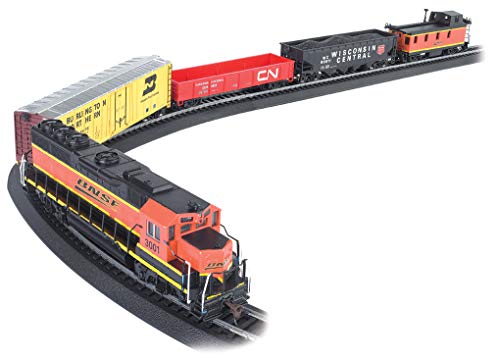
Best Model Train Set for Beginners (2026): 3 HO-Scale Starter Sets
The easiest way into model railroading is a ready-to-run starter set: a locomotive, a few cars, a loop of track, and a power pack, all in one box, so you can have a train running on the kitchen table the same day. For beginners the sweet spot is HO scale, the most popular size worldwide, big enough to handle easily and backed by a huge range of track, buildings, and trains to grow with. The main upgrade to understand is DC versus DCC (whether you can run and control more than one train independently, with sound). Here are three good HO starter sets, from a simple first loop to a premium digital set with sound.

Best Needle File Set (2026): Swiss Cut Numbers Run Backwards
Two things about needle files surprise people. Swiss cut numbers run the opposite way to sandpaper grit, so a higher number is finer, not coarser. And the most expensive set on this page is the coarser one, because cut grade and price are unrelated. Knowing both saves buying a set that does the wrong job beautifully.

Best Miniature Paint Brushes for Beginners (2026): 3 Real Picks
Beginners usually blame their hands. Nine times out of ten it is the brush. A cheap brush that will not hold a point puts paint where you did not aim it, and no amount of practice fixes a bristle that splays the moment it touches the model. The good news is that this is the cheapest problem in the hobby to solve, because a decent brush costs less than a pot of paint. What you actually need is fewer brushes than the big sets suggest: one that holds a fine point for detail, and one stiff flat brush for drybrushing. Here are three sets worth buying, and what each is genuinely for.
Best Cutting Mat for Prototyping (2026): Rotary Mats and Knives Do Not Mix
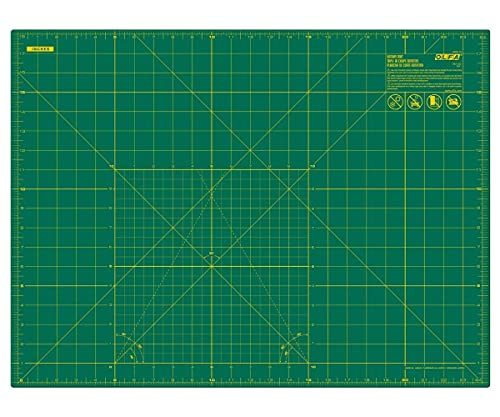
Self-healing mats are not all built for the same blade. OLFA say plainly that their rotary mat is for rotary cutters only and not for fixed-blade utility knives, which is exactly what you cut prototype cards with. It is the kind of thing you find out from the packaging rather than from the product name.

Best Hobby Knife Set for Models & Dioramas (2026): X-Acto vs Budget Kits
A dull, wobbly blade ruins more parts than any lack of skill. Spend $8 to $52 on a real hobby knife set with sharp blades and a tight collet, and your cuts get clean overnight.

Best Miniature Paint Set for Beginners (2026): 3 Picks That Actually Work
The paint set is the heart of miniature painting, and the beginner trap is buying random craft acrylics that go on thick and hide all the detail. A proper miniature paint set is finely pigmented, flows off the brush, and is built to layer. Here are three good ones, from a loaded all-in-one kit to a pro-grade range.