Best Needle File Set (2026): Swiss Cut Numbers Run Backwards
Two things about needle files surprise people. Swiss cut numbers run the opposite way to sandpaper grit, so a higher number is finer, not coarser. And the most expensive set on this page is the coarser one, because cut grade and price are unrelated. Knowing both saves buying a set that does the wrong job beautifully.
HobbyStack may earn a commission from links on this page at no extra cost to you. Our picks are chosen on merit; the commission helps fund the research.
- Swiss cut runs 0 to 6, and higher is finer. Cut 4 is finer than Cut 2.
- Files cut on the push stroke only. Dragging back dulls them and does nothing.
- Diamond files work on hardened steel and glass. Cut steel is better on soft material.
- Soft material clogs a file. A file card and chalk fix it.
- Shape matters more than brand. A set gives you the profile you need for the corner you are in.
 SE 10-Piece Diamond, 150 gritHard material and glass$11Check price
 Our pickGrobet Swiss Cut 4, set of 12Most modellers$89Check price
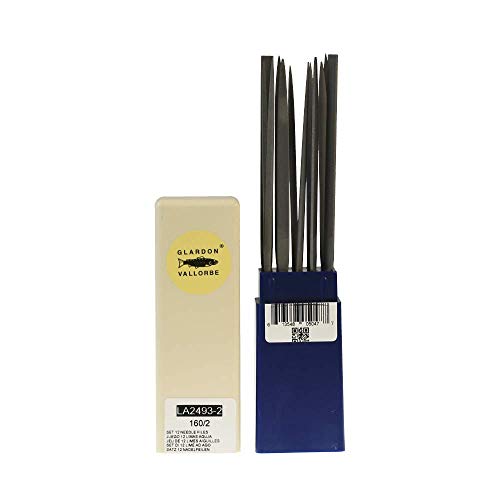 Vallorbe Cut 2, set of 12Faster stock removal$299Check price
Swiss cut numbers, which run the wrong way
Every other abrasive scale in the workshop gets finer as the number rises — sandpaper grit, wet and dry, polishing compounds. Swiss files do the same thing and people still get it wrong, because they expect files to work like drill bits or wire gauge.
Swiss cut runs 0 to 6, and higher is finer.
- Cut 0 and 1 — coarse. Fast removal, rough finish.
- Cut 2 — medium. General shaping, the most common single grade.
- Cut 4 — fine. Refining a shape and cleaning up, leaving a surface close to ready for abrasive.
- Cut 6 — very fine, close to burnishing.
So in this comparison the Grobet at Cut 4 is finer than the Vallorbe at Cut 2, despite costing a third as much. That is not a quality difference: Vallorbe is the more prestigious maker and its Cut 2 files are excellent Cut 2 files. It is a grade difference, and the price ladder and the fineness ladder simply are not the same ladder.
American pattern files use a different vocabulary — bastard, second cut, smooth — which roughly maps onto Swiss 0, 2 and 4.
For model work, Cut 2 for shaping and Cut 4 for finishing is the useful pair.
Using them without ruining them
Files are simple and almost everyone uses them wrong in the same two ways.
They cut on the push stroke only. The teeth are angled forward, so pushing removes material and pulling back does nothing except rub the teeth against the work and blunt them. Lift on the return. It feels slow and it doubles the life of the file.
They clog, especially on soft material — plastic, aluminium, brass, lead. Material packs into the teeth, and a clogged file stops cutting and starts scratching, dragging a lump of embedded swarf across your work. A file card, which is a short wire brush, clears it. Rubbing chalk into the teeth first slows the clogging considerably, which is the traditional trick for aluminium.
Do not stack them loose in a drawer. Files rubbing against each other dull each other, which is why good sets come in a wallet or a roll.
Do not use them wet unless they are diamond. Cut steel rusts, and rusted teeth are finished.
Diamond files are the exception to most of this: they cut on both strokes, tolerate water, and work on material too hard for steel — but they load up badly on soft plastic.
 Best for hard material
SE 10-Piece Diamond Needle File Set with 150 Grit - 744DF-R
Ten diamond files at 150 grit, in ten distinct profiles — barette, crossing, equaling, knife, warding, square, three square, half round, tapered round and round — which is a genuinely complete shape range for very little money. Diamond is a different tool from cut steel rather than a cheaper one: the abrasive is bonded to the surface, so it cuts on both strokes, tolerates being used wet, and works on material that would simply skate a steel file — hardened steel, glass, ceramic, cured resin and photo-etch brass. Where it is weak is soft material: plastic and aluminium load into the diamond matrix and are much harder to clear than from cut teeth. Buy this alongside a steel set rather than instead of one.
What's good
- Ten distinct profiles for a very low price
- Cuts hardened steel, glass, ceramic and cured resin
- Works on both strokes and tolerates water
- A genuinely different capability from cut steel
What's not
- Loads badly on plastic and aluminium
- 150 grit only — no choice of coarseness
- Diamond wears off eventually and cannot be re-cut
- Not a replacement for a cut steel set
 Best for most modellers
Grobet USA File Set, Tell Needle Set of 12
Twelve Swiss-made files at about 5.5 inches in Cut 4, which is the fine grade — and fine is what model work mostly wants, because you are refining a shape and cleaning up a joint rather than hogging metal away. Cut 4 leaves a surface close to ready for abrasive, so there is less sanding afterward and less risk of overshooting a delicate part. Swiss manufacture means the teeth are cut consistently along the whole length rather than fading at the tip, which is where cheap files disappoint. It comes in a protective plastic wallet, which matters because loose files dull each other. For plastic, brass, resin and wood at model scale this is the right grade and the right amount to spend.
What's good
- Cut 4 is the fine grade model work actually wants
- Consistent Swiss tooth cutting along the full length
- Twelve shapes covers the profiles you need
- Supplied in a wallet so they do not rub together
What's not
- Cut 4 is slow if you need real stock removal
- No coarser grade in the set
- Cut steel clogs on soft plastic
- Plastic wallet rather than a proper roll
 Best for shaping
VALLORBE LA249 GLARDON SWISS MADE NEEDLE FILES 12 SET CUT
Vallorbe are the files jewellers and watchmakers name, made from chrome steel hardened to 65 HRc and certified to ISO 9001, and that hardness is what keeps the teeth cutting long after softer files have gone smooth. Twelve files at 160mm in a broad range of shapes. The thing to understand before buying is the grade: this is Cut 2, which is medium — coarser than the Grobet Cut 4 above despite costing over three times as much, and therefore aimed at shaping and stock removal rather than final finishing. That makes it the right set for working brass fittings, hardwood or resin down to size, and the wrong one if you wanted a finishing file. Ideally you own a Cut 2 and a Cut 4; if you buy one, buy the grade that matches your work.
What's good
- Chrome steel at 65 HRc holds its teeth far longer
- Cut 2 removes material at a useful rate
- The set jewellers and watchmakers use
- ISO 9001 certified manufacture
What's not
- Cut 2 is COARSER than the cheaper Grobet Cut 4
- Over three times the Grobet for a different grade, not a better one
- Wrong set if you wanted a finishing file
- Serious money for model work
File teeth are angled forward and cut only when pushed. Dragging the file back across the work removes nothing and rubs the teeth backwards against the material, which is the fastest way to dull a good file. Lift it clear on the return. It feels inefficient for about a day and then becomes automatic, and it roughly doubles how long a set stays sharp.
Which shape for which job
A twelve-piece set looks excessive until you are trying to clean an internal corner with a flat file.
Flat and hand — general surface work. The hand file has one safe edge with no teeth, so you can file a surface without cutting the wall next to it.
Half round — a flat face for surfaces and a curved back for concave shapes. If you own one file, own this.
Round (rat tail) — enlarging and truing holes, and filing tight concave curves.
Square — internal right angles and slots, and squaring up a rounded corner.
Three square (triangular) — sharp internal angles under 90 degrees, and cleaning up between features.
Knife — a wedge cross-section for very tight V grooves and getting between close parts.
Barette — teeth on one face only, tapering, so it works flat into a corner without touching the adjoining face.
Crossing — two different curved faces, for shaping concave surfaces of differing radii.
That range is why a set beats individual files: the profile determines whether a job is possible, not just easy.
Before you buy
Check the cut grade, not just the price. Higher number means finer.
Cut 2 for shaping, Cut 4 for finishing. Ideally own both.
Diamond for hardened steel, glass and resin. Cut steel for plastic and brass.
Buy a file card at the same time. Clogged files scratch.
Store them apart. Files rubbing together dull each other.
Needle file questions
What do Swiss file cut numbers mean?
Should I buy diamond or cut steel needle files?
Why do my files stop cutting?
How do I stop files going blunt?
The Grobet Cut 4 set is the right buy for most model work: fine is the grade you actually want for refining and cleanup, the Swiss tooth cutting is consistent to the tip, and it comes in a wallet so the files do not dull each other. Add the SE diamond set alongside for hardened steel, glass and cured resin, which cut steel simply will not touch. The Vallorbe is superb and it is Cut 2 — coarser than the Grobet, for shaping rather than finishing. Check the grade before the price.
Ready to actually do it?
The first model ship building quest takes an evening, and it tells you whether the gear was worth it better than any review can.
Start Model Ship BuildingThe HobbyStack editorial team researches each guide against manufacturer specifications, published resources and practitioner sources. Every product is checked for availability and described against its current listing before publication, and prices are re-checked when guides are updated.
About our editorial process →More gear guides
All guides
Best Hobby Knife Set for Models & Dioramas (2026): X-Acto vs Budget Kits
A dull, wobbly blade ruins more parts than any lack of skill. Spend $8 to $52 on a real hobby knife set with sharp blades and a tight collet, and your cuts get clean overnight.

Best Model Railroad Track (2026): Code Is Rail Height, and It Shows
Code 100 and Code 83 both say HO scale on the box and they are not the same height. The code is the rail height in thousandths of an inch, and Code 100 rail is noticeably taller than anything the real railroads used at that scale. Once you have seen the difference on a layout you cannot unsee it.
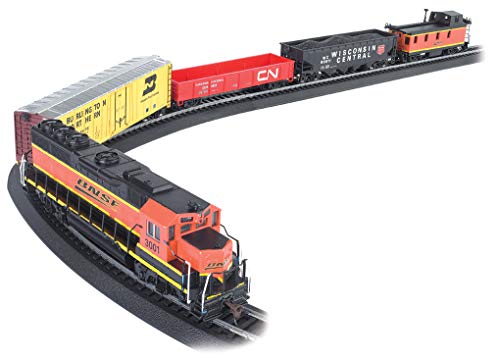
Best Model Train Set for Beginners (2026): 3 HO-Scale Starter Sets
The easiest way into model railroading is a ready-to-run starter set: a locomotive, a few cars, a loop of track, and a power pack, all in one box, so you can have a train running on the kitchen table the same day. For beginners the sweet spot is HO scale, the most popular size worldwide, big enough to handle easily and backed by a huge range of track, buildings, and trains to grow with. The main upgrade to understand is DC versus DCC (whether you can run and control more than one train independently, with sound). Here are three good HO starter sets, from a simple first loop to a premium digital set with sound.

Best Miniature Paint Set for Beginners (2026): 3 Picks That Actually Work
The paint set is the heart of miniature painting, and the beginner trap is buying random craft acrylics that go on thick and hide all the detail. A proper miniature paint set is finely pigmented, flows off the brush, and is built to layer. Here are three good ones, from a loaded all-in-one kit to a pro-grade range.
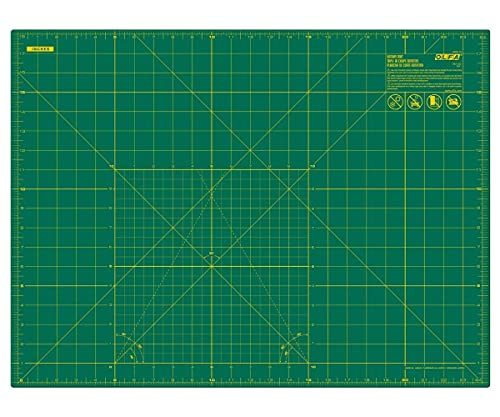
Best Cutting Mat for Prototyping (2026): Rotary Mats and Knives Do Not Mix
Self-healing mats are not all built for the same blade. OLFA say plainly that their rotary mat is for rotary cutters only and not for fixed-blade utility knives, which is exactly what you cut prototype cards with. It is the kind of thing you find out from the packaging rather than from the product name.

Best Miniature Paint Brushes for Beginners (2026): 3 Real Picks
Beginners usually blame their hands. Nine times out of ten it is the brush. A cheap brush that will not hold a point puts paint where you did not aim it, and no amount of practice fixes a bristle that splays the moment it touches the model. The good news is that this is the cheapest problem in the hobby to solve, because a decent brush costs less than a pot of paint. What you actually need is fewer brushes than the big sets suggest: one that holds a fine point for detail, and one stiff flat brush for drybrushing. Here are three sets worth buying, and what each is genuinely for.