Best Model Train Set for Beginners (2026): 3 HO-Scale Starter Sets
The easiest way into model railroading is a ready-to-run starter set: a locomotive, a few cars, a loop of track, and a power pack, all in one box, so you can have a train running on the kitchen table the same day. For beginners the sweet spot is HO scale, the most popular size worldwide, big enough to handle easily and backed by a huge range of track, buildings, and trains to grow with. The main upgrade to understand is DC versus DCC (whether you can run and control more than one train independently, with sound). Here are three good HO starter sets, from a simple first loop to a premium digital set with sound.
HobbyStack may earn a commission from links on this page at no extra cost to you. Our picks are chosen on merit; the commission helps fund the research.
- Start with a ready-to-run starter set. One box gives you a locomotive, cars, a loop of track, and a power pack, everything to have a train running the same day, with nothing to assemble.
- HO scale is the beginner sweet spot. It is the most popular size, big enough to handle and detail easily, with the widest range of track, buildings, and trains to expand into. N scale is smaller (space-saving) but fiddlier.
- Understand DC vs DCC. Basic (DC) sets run one train with a simple throttle; DCC (digital) sets let you independently control multiple trains and add realistic sound, which is the main thing the price buys.
- A starter set is a foundation, not the finished layout. You will soon want more track, a bigger power supply, and scenery, so pick a set from a brand (like Bachmann) whose track and parts are easy to add to.
 Bachmann Thoroughbred HO Scale Train SetA simple, affordable first train set$130Check price
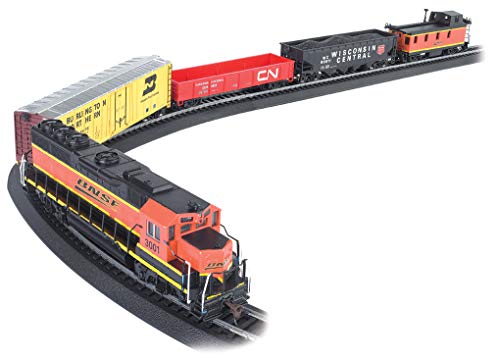 Our pickBachmann Rail Chief HO Scale Train SetA bigger starter with more to play with$216Check price
 Bachmann Thunder Chief DCC Sound HO Train SetDigital control and realistic sound$329Check price
The friendliest entry to the hobby is a ready-to-run (RTR) starter set, because it removes every barrier: in one box you get a locomotive, a few wagons or coaches, enough sectional track to make an oval, and a power pack (the controller that plugs into the wall and runs the train), so you unbox it, clip the track together, and a train is running in minutes with nothing to build or wire. That is a far better first experience than buying a locomotive, track, and controller separately and hoping they are compatible. The key choice of size is 'scale', and for beginners HO scale (1:87) is the standard recommendation: it is the world's most popular scale, so the trains are big enough to handle, see, and detail comfortably, and there is an enormous range of track, buildings, figures, and rolling stock to expand your layout however you like. The main alternative, N scale (1:160), is roughly half the size, which is great if space is tight but fiddlier for beginners to handle and re-rail.
The upgrade that mostly explains price differences is DC versus DCC. A basic starter set is 'DC' (analog): the power pack sends power to the track, and the train's speed is set by a simple throttle, this is perfectly good and simple, but you can only really control one train at a time on a loop. A 'DCC' set (Digital Command Control) puts a tiny decoder in each locomotive and a digital controller on the track, which lets you run and control several trains independently on the same track, and DCC 'Sound' sets add realistic engine, horn, and bell sounds from a speaker in the loco. DCC is more capable and more fun as your layout grows, but it costs more and has a slightly steeper learning curve. For a first set, either is fine, choose DC to keep it simple and cheap, or start with DCC if you already know you will build a bigger layout with multiple trains. Whichever you pick, buy from a brand whose track system and parts are widely available (Bachmann's E-Z Track, used here, clicks together with a roadbed already attached), so expanding later is easy.
 Best budget set
Bachmann Thoroughbred HO Scale Train Set
The affordable, no-fuss way to get a real HO train running today. The Bachmann Thoroughbred is a complete ready-to-run starter set: a locomotive, a few freight cars, an oval of Bachmann's E-Z Track (which clicks together with the roadbed already attached, no nailing or ballasting), and the power pack to run it, all in one box for a beginner price. It is a straightforward DC set, so you control one train with a simple throttle, which is exactly the right amount of complexity to start with. Being from Bachmann, the most common beginner brand, its track and parts are everywhere, so you can easily add more track and cars as you expand. It will not run multiple trains or make engine sounds like a DCC set, but as a low-cost, low-risk first layout that has a train circling the table within minutes of unboxing, it is hard to beat.
What's good
- Complete set, running the same day, nothing to build
- Affordable, low-risk entry to the hobby
- Snap-together E-Z Track, no track-laying skills needed
- Bachmann parts are everywhere for easy expansion
What's not
- DC only, controls one train, no sound
- Small starting loop, you will want more track soon
 Best for most beginners
Bachmann Rail Chief HO Scale Train Set
The starter set most beginners will be happiest with, because it gives you more railroad to enjoy from day one. The Bachmann Rail Chief is a larger ready-to-run HO set, a locomotive with a longer train of cars, a bigger loop of snap-together E-Z Track, and the power pack, often as a generous 130-piece package. That extra track and rolling stock means a more interesting layout straight away rather than a bare minimum oval, so it holds your interest longer before you feel the need to buy more. It is still a simple, beginner-friendly DC set (one-train control, no sound), which keeps things easy, and it is Bachmann, so expanding it is painless. It costs more than the entry set but not dramatically so, and the extra content makes it feel like a proper first railroad rather than a taster. For most people starting out, this is the sweet spot between price and having enough to enjoy.
What's good
- Bigger set with more track and rolling stock
- A more satisfying layout right out of the box
- Still simple DC control, beginner-friendly
- Easy to expand with common Bachmann parts
What's not
- Still DC, so no multi-train control or sound
- Costs more than the basic starter set
 Best to grow into
Bachmann Thunder Chief DCC Sound HO Train Set
The set for someone who knows they want a proper, growing layout with digital control and sound. The Bachmann Thunder Chief is a ready-to-run HO set built around DCC (Digital Command Control): each locomotive has a decoder so you can independently control several trains on the same track, and this is a 'Sound Value' set, so the engine comes with realistic chuffing, horn, and bell sounds from an onboard speaker, which transforms how alive the layout feels. You still get everything to run straight away, the loco, cars, E-Z Track, and a DCC controller, but you are starting on the more capable digital system that serious layouts use, rather than having to upgrade to it later. It is the most expensive option here and has a slightly steeper learning curve than a simple DC set, and a casual first-timer does not need it, but if you already know model railroading is for you and want multi-train digital control with sound from the start, this is the premium foundation to build on.
What's good
- DCC digital control runs multiple trains independently
- Realistic engine, horn, and bell sound built in
- Starts you on the capable system serious layouts use
- Complete and ready to run out of the box
What's not
- The most expensive option here
- Slightly steeper learning curve than simple DC
Scale is the size of the models, and for beginners HO scale (1:87) is the standard recommendation: the trains are big enough to handle, see, and detail comfortably, and it has the world's largest range of track, buildings, and rolling stock to expand into. N scale (1:160) is about half the size, which is wonderful when space is tight because you fit more railroad into less room, but the smaller parts are fiddlier to handle, re-rail, and maintain, which is harder when you are learning. Unless space is your main constraint, start in HO, you will find it more forgiving and better supported.
Which to buy: want the simplest, cheapest way to get a real train running today? The Bachmann Thoroughbred, a complete basic HO set. Want more track and rolling stock for a more satisfying first layout without a big price jump? The larger Bachmann Rail Chief, the pick for most beginners. Already know you want digital control and realistic sound with room to run multiple trains? The DCC Thunder Chief is the premium foundation. All three are HO scale with snap-together E-Z Track, so you can start today and expand easily as your layout grows.
Before you buy
Buy a set, not separate parts, to start. A ready-to-run starter set guarantees the locomotive, track, and controller all work together, avoiding the classic beginner mistake of buying incompatible pieces.
Keep the track and wheels clean. The most common reason a model train runs poorly or stalls is dirty track or wheels, a quick wipe with a track-cleaning pad or isopropyl alcohol fixes most jerky running.
Plan for more track and a bigger power pack. Starter sets come with a small loop and a modest controller, so expect to add track (and eventually a stronger power supply) as your layout grows.
Decide DC vs DCC before you invest heavily. It is fine to start on simple DC, but if you know you will want multiple trains and sound, starting on DCC saves you converting locomotives later.
Half the fun of model railroading is what you add after the starter set: more track and interesting layouts, buildings and scenery, extra locomotives and rolling stock, and eventually wiring and detailing. So think of your first set as a foundation to build on, not a finished product, and choose one from a well-supported brand (Bachmann's E-Z Track system here is a good example) so the track and parts you add later click straight in. The set gets you running and teaches you the basics; the layout you grow from it is where the hobby really opens up.
Beginner model train set questions
What model train set should a beginner buy?
What scale is best for a beginner: HO or N?
What is the difference between DC and DCC train sets?
Do model train starter sets come with everything?
Why does my model train run jerkily or stall?
Can I expand a starter set later?
For most beginners the Bachmann Rail Chief is the pick: a larger ready-to-run HO set with more track and rolling stock, so you get a satisfying first layout out of the box while keeping things simple with DC control. If you want the cheapest way to get a real train running today, the basic Bachmann Thoroughbred is a great low-risk start. If you already know you want digital control and realistic sound with multiple trains, the DCC Thunder Chief is the premium foundation to grow from. Start in HO scale with a snap-together set, keep the track clean, and expand from there.
Ready to actually do it?
The first model railroading quest takes an evening, and it tells you whether the gear was worth it better than any review can.
Start Model RailroadingThe HobbyStack editorial team researches each guide against manufacturer specifications, published resources and practitioner sources. Every product is checked for availability and described against its current listing before publication, and prices are re-checked when guides are updated.
About our editorial process →More gear guides
All guides
Best Model Railroad Track (2026): Code Is Rail Height, and It Shows
Code 100 and Code 83 both say HO scale on the box and they are not the same height. The code is the rail height in thousandths of an inch, and Code 100 rail is noticeably taller than anything the real railroads used at that scale. Once you have seen the difference on a layout you cannot unsee it.

Best Needle File Set (2026): Swiss Cut Numbers Run Backwards
Two things about needle files surprise people. Swiss cut numbers run the opposite way to sandpaper grit, so a higher number is finer, not coarser. And the most expensive set on this page is the coarser one, because cut grade and price are unrelated. Knowing both saves buying a set that does the wrong job beautifully.

Best Miniature Paint Brushes for Beginners (2026): 3 Real Picks
Beginners usually blame their hands. Nine times out of ten it is the brush. A cheap brush that will not hold a point puts paint where you did not aim it, and no amount of practice fixes a bristle that splays the moment it touches the model. The good news is that this is the cheapest problem in the hobby to solve, because a decent brush costs less than a pot of paint. What you actually need is fewer brushes than the big sets suggest: one that holds a fine point for detail, and one stiff flat brush for drybrushing. Here are three sets worth buying, and what each is genuinely for.
Best Cutting Mat for Prototyping (2026): Rotary Mats and Knives Do Not Mix
Self-healing mats are not all built for the same blade. OLFA say plainly that their rotary mat is for rotary cutters only and not for fixed-blade utility knives, which is exactly what you cut prototype cards with. It is the kind of thing you find out from the packaging rather than from the product name.

Best Hobby Knife Set for Models & Dioramas (2026): X-Acto vs Budget Kits
A dull, wobbly blade ruins more parts than any lack of skill. Spend $8 to $52 on a real hobby knife set with sharp blades and a tight collet, and your cuts get clean overnight.

Best Miniature Paint Set for Beginners (2026): 3 Picks That Actually Work
The paint set is the heart of miniature painting, and the beginner trap is buying random craft acrylics that go on thick and hide all the detail. A proper miniature paint set is finely pigmented, flows off the brush, and is built to layer. Here are three good ones, from a loaded all-in-one kit to a pro-grade range.