Best Singing Bowl (2026): Size Decides the Note
Singing bowls are sold with a great deal of claim attached, and almost none of it helps you choose one. The things that actually differ between bowls are acoustic and checkable: how big it is, how thick the wall is, whether it was hammered or spun, and how long it rings. Those decide the note you get and whether you enjoy playing it.
HobbyStack may earn a commission from links on this page at no extra cost to you. Our picks are chosen on merit; the commission helps fund the research.
- Bigger bowls sound lower and ring longer. Size is the main thing you are choosing.
- Hand-hammered bowls have a complex, slightly uneven tone. Machine-spun ones are cleaner and plainer.
- 6 to 7 inches is the practical size for one person at home.
- The mallet matters as much as the bowl. Suede rims and wood strikes are different instruments.
- A bowl that will not sing is usually being played too fast, not badly made.
 Our pickDharmaObjects 6-inchA first bowl$44Check price
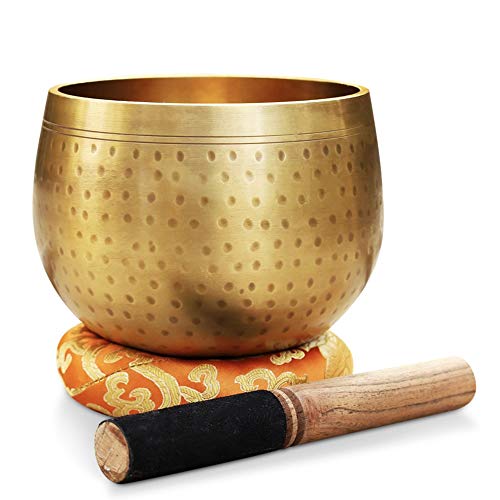 DharmaObjects Ring GongThicker wall, longer ring$64Check price
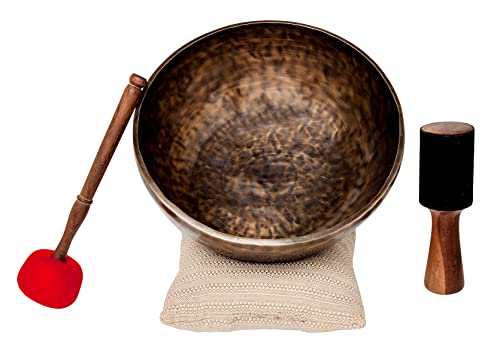 Ohm Store Jupiter 12-inchDeep tone and sound baths$795Check price
Size, wall thickness and what you actually hear
Three physical properties decide the sound, and none of them are mysterious.
Diameter sets the pitch. Bigger bowls vibrate more slowly and sound lower. A 5 or 6 inch bowl gives a bright, clear, relatively high note; a 12 inch bowl gives a deep tone you feel in your chest as much as hear. This is the main axis you are choosing along.
Wall thickness sets the sustain and the character. A thicker, heavier wall stores more energy and rings for longer, with a more solid fundamental note. Thin bowls speak quickly and fade faster. The Ring Gong here is 5.5 inches across with a 4-inch wall and weighs a full kilogram, which is a lot of metal for its diameter — that is a deliberately thick-walled bowl.
Hammering sets the complexity. A hand-hammered bowl is never perfectly symmetrical, so it produces several overtones slightly out of tune with each other, and that beating between them is the shimmer people associate with the sound. A machine-spun bowl is geometrically even and sounds cleaner, purer and, to most ears, plainer.
None of that is better or worse. It is what to listen for.
Playing one, which is the part people get wrong
Most bowls that "do not work" are being played impatiently.
Striking is the easy part. Hold the bowl flat on your open palm or on its cushion, and tap the outside wall about a third of the way down with the padded end of the mallet. A single clean note.
Singing — the continuous tone — is the one that takes practice. Hold the mallet like a pen, press the suede or leather side firmly against the outside rim, and move it around the bowl slowly and with constant pressure.
The two mistakes are universal. Too fast, which produces a rattle instead of a tone: go slower than feels productive and let it build. And too light, because it takes real pressure to keep the rim vibrating; a gentle touch never gets there.
Do not grip the bowl. Fingers on the wall damp the vibration instantly, which is what the cushion is for.
Once it is singing, back the pressure off slightly and it will sustain on its own. Getting there takes most people a few sessions.
 Best first bowl
Lungta Imports DharmaObjects Meditation Grade 6 Inches
Six inches across and three deep at about 490 grams, which is the practical size for one person at home: big enough for a warm note with real sustain, small enough to keep on a shelf and pick up without ceremony. It comes with a handcrafted rosewood mallet and an embroidered velvet cushion, and both matter more than they look — the cushion isolates the bowl so your hand does not damp it, and a bowl without one sitting on a hard surface sounds strangled. The eight auspicious symbols are etched on the face. The listing describes it as easy to play, which is a fair claim for this size and weight; very small bowls are much harder to get singing. A complete, sensible starting point.
What's good
- 6 inches is the right size for one person at home
- Rosewood mallet and cushion included, both necessary
- Heavy enough at 490g for a decent sustain
- Easier to get singing than smaller bowls
What's not
- Higher-pitched than the deep tone people often expect
- Nothing like the sustain of a large bowl
- Etched decoration is stamped rather than fine
- Tone is decent rather than remarkable
 Best thick-walled bowl
DharmaObjects Tibetan Ring Gong Meditation Singing Bowl
Smaller across than the 6-inch at 5.5 inches, and more than twice the weight at a full kilogram with a 4-inch wall — which is the interesting part, because that ratio makes it a genuinely different instrument rather than a bigger one. A thick, heavy wall stores more energy and rings longer, with a more solid fundamental than a thin bowl of the same diameter. It is hand-hammered in Nepal using traditional methods, and the hammer marks are visible, which is what gives it the slightly uneven, shimmering overtones a machine-spun bowl does not have. A dual-face wooden and suede mallet is included, so you have both a striker and a rim tool, plus a hand-sewn donut cushion. Cushion and mallet colours vary.
What's good
- Thick 4-inch wall at 1kg — long ring and solid fundamental
- Hand-hammered in Nepal, so complex shimmering overtones
- Dual-face mallet gives both strike and rim surfaces
- Cushion included
What's not
- Smaller diameter, so higher pitched than the weight suggests
- Hammered bowls vary — yours will not sound identical to a demo
- Colours of mallet and cushion are not specified
- Heavier to handle than the 6-inch
 Best for deep tone
Large Tibetan Singing Bowl Set by Ohm Store
Twelve inches of hand-hammered pure bronze, and the size is the entire reason for the price. A bowl this large vibrates slowly enough to produce a genuinely low tone — the kind you feel in your chest rather than only hear — and it rings for more than a minute from a single strike, which is a different experience from a small bowl that fades in fifteen seconds. That sustain is what makes it usable for sound baths, where the tone needs to fill a room and hold while you do something else. Hand-hammered in the Himalayan foothills, so the overtones are complex and slightly uneven. Two mallets and a cushion are included. It is eighteen times the 6-inch bowl, and what you are buying is size, sustain and depth.
What's good
- 12 inches — genuinely deep tone you feel as well as hear
- Rings for more than a minute from one strike
- Hand-hammered bronze with complex overtones
- Two mallets and a cushion included
What's not
- Eighteen times the price of a good starter bowl
- Large and heavy to store and handle
- Far more bowl than one person meditating needs
- Hand-hammered means yours will vary
The two reasons a bowl will not sing are going too fast and pressing too lightly. Move the mallet around the rim slowly enough that it feels unproductive, and press harder than seems polite. The tone builds gradually rather than starting — once it is going, ease off slightly and it sustains itself. Almost nobody manages it in the first minute, and almost everybody manages it within a few sessions.
What the mallet changes
The bowl gets all the attention and the mallet decides half the sound. Most bowls come with one; buying a second is cheap and changes what the same bowl can do.
Wooden mallets give a bright, immediate strike with a lot of high overtones. Good for a clear bell-like note, harsh if the bowl is already bright.
Suede or leather-wrapped mallets are what you use around the rim to make a bowl sing. The friction is what drives the vibration, and a bare wooden mallet will mostly rattle and skid.
Felt or padded mallets give the softest strike, with the fundamental note and very few high overtones. This is what you want on a large bowl for a sound bath, where a hard strike would be startling.
Size matters too. A mallet that is too light for a heavy bowl cannot get it moving, which is a common reason a big bowl seems disappointing.
A reasonable second purchase is a padded striker to pair with whatever suede rim mallet came in the box.
Before you buy
6 to 7 inches for one person at home. Bigger only if you want the deep tone.
Check a mallet and cushion are included. The cushion is not optional.
Thicker walls ring longer. Weight relative to diameter tells you a lot.
Hand-hammered for complex shimmer, machine-spun for a clean pure note.
Every hand-hammered bowl is different, so expect variation from any demo.
Singing bowl questions
What size singing bowl should I buy?
Why will my singing bowl not sing?
Is a hand-hammered bowl better than a machine-made one?
Does the mallet matter?
Buy the 6-inch DharmaObjects bowl. It is the right size for one person, it comes with the mallet and cushion you actually need, and it is heavy enough to sustain properly and easy enough to get singing in a few sessions. The thick-walled Ring Gong is worth the step up if you want a longer ring and hand-hammered overtones from a smaller bowl. The 12-inch Jupiter is a sound-bath instrument, and you are paying for depth and a minute of sustain.
Ready to actually do it?
The first sound healing quest takes an evening, and it tells you whether the gear was worth it better than any review can.
Start Sound HealingThe HobbyStack editorial team researches each guide against manufacturer specifications, published resources and practitioner sources. Every product is checked for availability and described against its current listing before publication, and prices are re-checked when guides are updated.
About our editorial process →More gear guides
All guides
Best Beginner Meditation Cushions (2026): 3 Zafus
A zafu is the round cushion you sit on to meditate. It lifts your hips above your knees, which lets your back stack up straight so you can sit still without slumping or going numb. You can start free by folding a firm blanket, and honestly that works fine for a while. The one real choice here is the fill: buckwheat hulls (heavy, firm, adjustable) or foam (lighter, softer, holds its shape). Most people should get buckwheat.

Best Yoga Mat for Beginners 2026: Gaiam vs JadeYoga vs Manduka
The only thing that really matters in a beginner yoga mat is grip, a mat that slides turns downward dog into a battle. Thickness and material are the next decisions. Here are three mats that nail it, from an inexpensive Gaiam to a buy-it-for-life Manduka.

Best Beginner Pilates Mats (2026): 3 Picks
A Pilates mat is just a thicker exercise mat, usually 6mm to 12mm, so your spine, hips, and tailbone are not grinding into the floor during roll-ups and bridges. The one spec that actually matters is thickness plus a surface that does not slide when you push into it. Everything else is a nice-to-have.

Best Essential Oil Diffuser for Beginners (2026): 3 Picks for Every Room
A diffuser is the heart of aromatherapy at home, and the kind you want is an ultrasonic diffuser: it disperses a cool mist of water and essential oil without heat, so the oils keep their properties instead of being cooked off. The main things that matter are tank size (how long it runs) and your room size. Here are three good ones, from a tiny bedside unit to a large-room diffuser with oils included.

Best Pottery Tool Set (2026): Six of the Twelve Do Nearly Everything
Open a twelve-piece pottery set and six tools will do nearly all your work: the wire cutter, a wooden rib, a metal rib, a loop trimming tool, a sponge and a needle tool. The rest get picked up once, found to duplicate something, and left in the canister for years.

Long Blade Freediving Fins (2026): Stiffness Is Matched to Your Legs, Not Your Ambition
Long blades are not about speed. A long blade moves a large volume of water per kick, so you cover distance at a slow, unhurried cadence instead of a fast one, and on a breath-hold the thing you are conserving is oxygen. A stiff blade you cannot load properly burns more of it than a soft blade you can.