Best Antenna Analyzer (2026): An SWR Meter Tells You Less Than You Think
An SWR meter tells you that your antenna is wrong. An analyzer tells you which way it is wrong and by how much, which is the difference between trimming a dipole in one afternoon and cutting it four times and hoping. They are usually shelved together and they answer genuinely different questions.
HobbyStack may earn a commission from links on this page at no extra cost to you. Our picks are chosen on merit; the commission helps fund the research.
- An SWR meter reads one frequency while you transmit. An analyzer sweeps a range without transmitting.
- A high SWR alone does not tell you whether the antenna is too long or too short. An analyzer does.
- Analyzers show resistance and reactance, which is what actually tells you what to change.
- A low SWR is not proof of a good antenna. Coax loss and a dummy load both read beautifully.
- Check the connector. SO-239 and N-type are not interchangeable without an adapter.
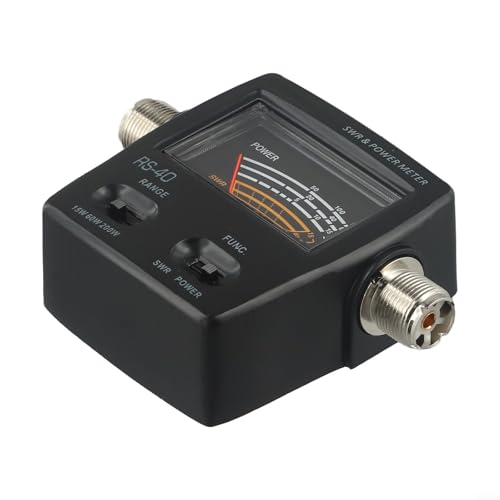 RS-40 Style SWR/Power MeterMonitoring a station$57Check price
 Our pickRigExpert Stick 230Most operators$368Check price
 RigExpert AA-650 ZoomUHF and detail$740Check price
What SWR actually measures
Standing Wave Ratio compares the power going out to your antenna against the power reflected back. A perfect match reflects nothing and reads 1:1. A bad match sends power back down the coax toward the transmitter.
So SWR is a symptom, and this is where people get stuck. A reading of 3:1 tells you something is mismatched. It does not tell you whether the antenna is too long, too short, badly grounded, or connected through a faulty length of coax — and those need opposite responses.
An SWR meter sits in line between radio and antenna, and you have to transmit to get a reading. It gives you one number at one frequency, and you are putting a signal on the air to get it.
An antenna analyzer generates its own tiny signal and sweeps a range, so it works out where your antenna is actually resonant without transmitting at all — no interference, no keying up on a band you have not checked.
That sweep is the useful part. It shows the dip, and the dip tells you which direction to cut.
R, X and Z, which is where the answer is
A good analyzer shows more than SWR, and those extra numbers are what turn guessing into measuring.
R (resistance) is the real part of the impedance. Most systems target 50 ohms, and a resonant half-wave dipole in free space is near 73, dropping as it gets closer to ground.
X (reactance) is the imaginary part, and it is the one that tells you what to do. X positive means inductive, which usually means the antenna is electrically too long. X negative means capacitive, usually too short. At resonance X passes through zero — which is why the analyzer can tell you which way to cut and a bare SWR number cannot.
Z (impedance) is the magnitude of the two combined.
The practical method: sweep the band, find where X crosses zero, and see whether that point is above or below where you want it. Too high in frequency means the antenna is short, so lengthen it. Too low means it is long, so trim.
That is one afternoon instead of four guesses.
 Best for monitoring a station
for RS-40 Power SWR Meter 200W Network Analyzer
A 200-watt in-line SWR and power meter in the familiar RS-40 style, sold under various generic labels rather than by an established instrument maker — which is worth knowing, because calibration and unit-to-unit consistency are not what you would expect from a named brand. What it does well is the job an analyzer does not: it lives permanently between radio and antenna and shows forward and reflected power while you are actually transmitting, so you see the match at your operating frequency under real conditions, and you notice immediately if something changes. Every station should have one in line. What it cannot do is tell you why a match is bad, or sweep a band, or work without you putting a signal on the air.
What's good
- Stays in line and reads while you transmit
- Shows the real match under real operating conditions
- Warns you immediately if something changes
- A fraction of the price of an analyzer
What's not
- Generic manufacture — calibration is not guaranteed
- One frequency at a time, and only while transmitting
- Cannot tell you which way the antenna is wrong
- No resistance or reactance reading
 Best for most operators
RigExpert Stick 230 Pocket Size Antenna Analyzer
A pocket analyzer covering 100 kHz to 230 MHz, which spans everything from the LF end through the whole HF spectrum and up through 2 metres — the range the overwhelming majority of amateur antenna work happens in. It measures SWR and return loss, and crucially capacitance and inductance of reactive loads, which is what lets you see whether an antenna is electrically long or short instead of merely mismatched. Because it generates its own signal you can sweep a band without transmitting, so no interference and no risk of keying into a bad match. Pocket-sized, so it goes up the ladder with you. UHF (SO-239) connector, which suits most HF and VHF gear. This is the tool that pays for itself on the first antenna you build.
What's good
- 100 kHz to 230 MHz covers HF and 2 m
- Measures reactance, so you know which way to cut
- Sweeps without transmitting — no interference
- Pocket-sized for working at the antenna
What's not
- Stops at 230 MHz — no 70cm or above
- SO-239 connector needs an adapter for N-type gear
- Small display compared to the AA-650
- Six times the price of an SWR meter
 Best for UHF and detail
RigExpert AA-650 Zoom Antenna Analyzer
Coverage to 650 MHz, which brings 70 centimetres and the UHF bands into range where the Stick 230 stops at 230, and a colour display with a 100-point SWR chart so you see the whole shape of the response rather than one number at a time. It resolves frequency to 1 kHz and can measure against 25, 50, 75, 100, 150, 200, 300, 450 and 600-ohm systems, which matters for ladder line, matching networks and anything that is not plain coax. It displays SWR, return loss, R, X, Z, magnitude and phase angle, and has Bluetooth for logging to a computer. N-type connector. It is twice the Stick 230, and the honest position is that most HF operators never need past 230 MHz.
What's good
- To 650 MHz — covers 70cm and UHF
- Colour display with a 100-point SWR chart
- Non-50-ohm systems: ladder line and matching networks
- Bluetooth logging and full R, X, Z, phase display
What's not
- Twice the Stick 230
- Most HF operators never need above 230 MHz
- N-type connector needs an adapter for SO-239 gear
- Larger and less pocketable
A dummy load reads 1:1 and radiates nothing. So does a long run of lossy coax, because the loss attenuates the reflection on the way back and flatters the reading at the shack end. If a new antenna shows a suspiciously perfect match across a whole band, suspect the feedline before congratulating yourself — measure at the antenna feedpoint, not at the radio.
Trimming a dipole without guessing
The classic first antenna, and the classic first frustration.
Start long. You can always cut more off; adding it back means soldering, and a joint in the middle of a leg is a weak point. The usual starting formula for a half-wave dipole in feet is roughly 468 divided by the frequency in MHz, and it will come out long in practice because of end effects and nearby objects.
Measure at the feedpoint if you can, with the antenna at its final height. An antenna measured at three feet off the ground and hoisted to thirty behaves differently, because ground proximity changes the feedpoint impedance.
Sweep and find where X crosses zero. If that point is below your target frequency the antenna is too long — trim. If it is above, it is too short.
Trim both legs equally, a small amount at a time, and re-measure. Frequency moves faster than people expect, and you cannot put it back.
Then check the ends. Antennas that will not behave are often too close to gutters, wires or a wet fence, all of which detune them.
Before you buy
Decide whether you want to monitor a station or diagnose an antenna. They are different tools.
Check the frequency range covers the bands you actually use.
Check the connector — SO-239 and N-type need an adapter between them.
Reactance display is the feature that saves you guessing.
Keep an in-line SWR meter regardless. It is the early warning.
Antenna analyzer questions
What is the difference between an SWR meter and an antenna analyzer?
Why does my antenna have high SWR?
Can a low SWR reading be misleading?
How do I know which way to trim a dipole?
Keep an in-line SWR meter permanently between radio and antenna as an early warning, and buy an analyzer when you start building antennas rather than buying them. The RigExpert Stick 230 is the one for most operators: it covers HF through 2 metres, shows reactance so you know which way to cut, and sweeps without putting a signal on the air. Step up to the AA-650 Zoom only if you work above 230 MHz or with non-50-ohm systems.
Ready to actually do it?
The first ham radio quest takes an evening, and it tells you whether the gear was worth it better than any review can.
Start Ham RadioThe HobbyStack editorial team researches each guide against manufacturer specifications, published resources and practitioner sources. Every product is checked for availability and described against its current listing before publication, and prices are re-checked when guides are updated.
About our editorial process →More gear guides
All guides
Best HF Base Station Ham Radio (2026): 3 Rigs to Grow Into
An HF base station is the radio that lets you talk across the country and around the world, not just to the local repeater a few towns over. Unlike a handheld, an HF rig needs a General-class license, an antenna, and a 12V power supply, but in return it opens up real long-distance contacts (what hams call DX). Here are three good ones, from an affordable SDR rig to an all-band radio you will not outgrow.

Best Ham Radio for Beginners (2026): From a $30 Handheld to a 50W Base
The best first ham radio is a cheap handheld: for the price of a takeout meal you get a real dual-band radio to learn on, hit local repeaters, and pass your license test with. As you get into it, a higher-power handheld or a 50W mobile opens up far more range. Here are three good ones, and yes, you need a license to transmit (it is easy to get).

Best Pottery Tool Set (2026): Six of the Twelve Do Nearly Everything
Open a twelve-piece pottery set and six tools will do nearly all your work: the wire cutter, a wooden rib, a metal rib, a loop trimming tool, a sponge and a needle tool. The rest get picked up once, found to duplicate something, and left in the canister for years.

Long Blade Freediving Fins (2026): Stiffness Is Matched to Your Legs, Not Your Ambition
Long blades are not about speed. A long blade moves a large volume of water per kick, so you cover distance at a slow, unhurried cadence instead of a fast one, and on a breath-hold the thing you are conserving is oxygen. A stiff blade you cannot load properly burns more of it than a soft blade you can.
Best Millinery Wire (2026): Gauge Decides Whether the Brim Holds Its Line
Wire gauge runs backwards, so an 18 gauge wire is thicker than a 20. That catches people out in exactly the wrong direction: they buy a high number expecting something substantial, wire a brim with it, and watch the brim sag the first time the hat is picked up.

Best Go Books (2026): Beginners Want Joseki and Need Life and Death
Every beginner reaches for a book of joseki, the memorised corner sequences, because they look like the secret. They are not. Strength at Go comes from reading life and death and recognising good shape, and a player who has memorised openings without those will play twenty moves of professional theory and then lose the group.