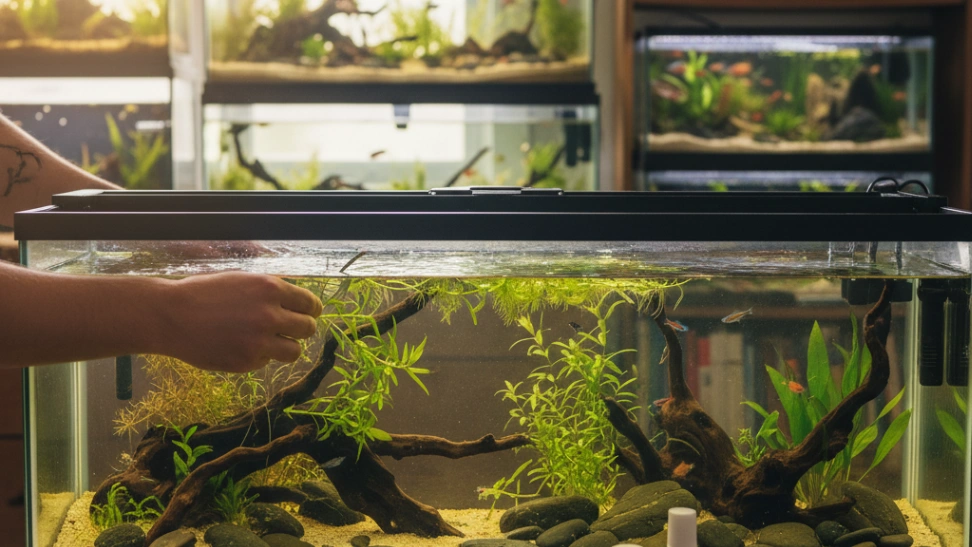
Best Beginner Aquarium Starter Kit 2026: 3 Picks Reviewed
The starter kit is the foundation of your first tank: the tank, hood, light, filter, and heater all in one box. Picking the right one is the difference between a stable tank you enjoy and a stressful project you abandon by month three.
HobbyStack may earn a commission from links on this page at no extra cost to you. Our picks are chosen on merit; the commission helps fund the research.
- Buy a starter kit, not loose parts. A good kit gets you a tank, hood, light, filter, and heater in one box for $80–230 — cheaper than buying them individually and pre-matched so nothing fights.
- 10 gallons is the practical floor; 20 gallons is forgiving. Smaller tanks are harder to keep stable, not easier — water chemistry swings faster with less volume. Go bigger if your space allows it.
- Our pick: the Aqueon 20-Gallon SmartClean Kit (~$160). Big enough to be forgiving, the SmartClean filter makes water changes a quarter as long, and Aqueon parts are stocked at every Petco for replacements.
- On a budget: the Aqueon 10-Gallon LED Starter Kit (~$80). The #1 Amazon best-seller for a reason — everything works, nothing breaks, dead simple.
- What the kit does NOT include and you should buy separately: API Freshwater Master Test Kit, a Python gravel siphon, and a bottle of Seachem Prime water conditioner. Together ~$60. Non-negotiable for keeping fish alive.
 Our pickAqueon 20-Gallon SmartClean Aquarium KitMost beginners$180Check price
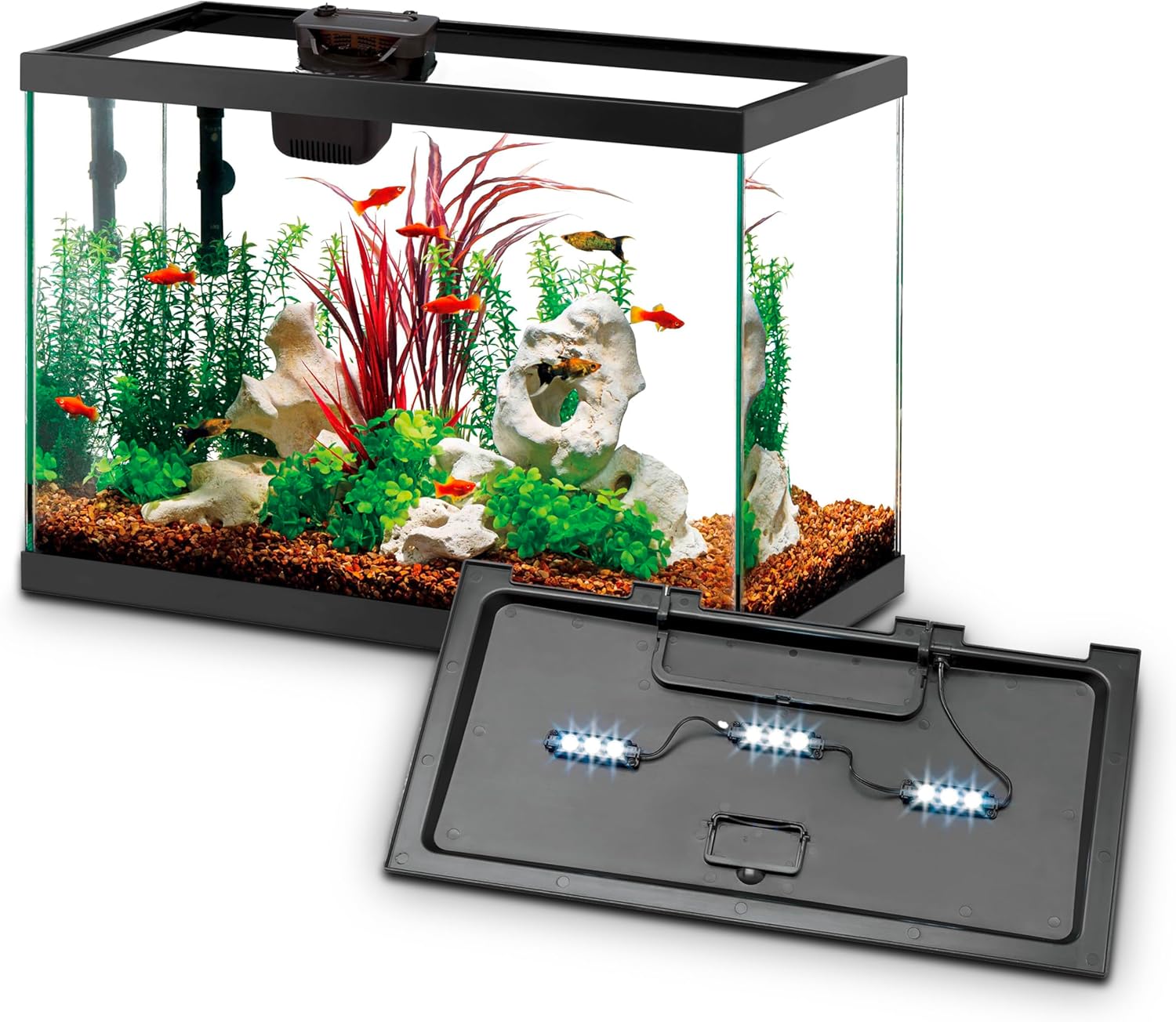 Aqueon 10-Gallon LED Aquarium Starter KitTrying it cheap$122Check price
 Fluval Flex 15 Gallon LED Aquarium KitGoing deep$270Check price
Why starter kits beat buying loose parts
The temptation when starting any hobby is to research each component independently and assemble "the best." For aquariums, this is the wrong move for your first tank. Filters need to be sized for the tank's water volume. Heaters need to be wattage-matched. Hoods need to match the tank's exact dimensions. Kits solve all of this — every piece is sized to work together, the parts have been tested as a system, and the price is meaningfully lower than buying each part separately at full retail.
You can absolutely build a better-than-kit setup later when you know which upgrades matter for your setup (planted? saltwater? big show fish? rare shrimp?). But your first tank is a learning environment. Optimize for "everything works on day one" — that's what kits do.
The single mistake to avoid: starter "kits" under $50 with a 1–3 gallon tank. The marketing suggests these are good for beginners because they're small and cheap. The reality is the opposite. Tiny tanks have tiny water volumes, which means the water chemistry swings dramatically with every feeding, every fish waste, every evaporation event. A 20-gallon tank is much more forgiving for a new fishkeeper than a 1-gallon one.
How we picked
We weighted the picks against what actually matters for someone setting up their first tank:
- Tank size: 10 gallons minimum, 20 gallons preferred. Smaller is harder, not easier.
- What's included: tank, hood/lid, LED light, heater, hang-on-back filter, conditioner. Everything you literally need to start cycling water.
- Filter quality: the kit's included filter matters most after the tank itself. A weak filter gets replaced fast; a good one lasts years.
- Replacement-part availability: when (not if) a heater or impeller goes, can you find the part at Petco, Petsmart, or on Amazon Prime next day? This is where house-brand kits from less-established vendors fail.
- What you'll still need to buy separately: a real test kit, a proper gravel vacuum, and water conditioner. The kit's "samples" of conditioner don't last past week one.
What we don't recommend: kits with tank sizes under 5 gallons, kits from vendors you've never heard of on Amazon with no replacement parts, "complete setup" kits that include fish (fish need an established/cycled tank; never start a tank and add fish the same day).
 Best for most beginners
Aqueon 20-Gallon SmartClean Aquarium Kit
20 gallons is genuinely the sweet spot for a first tank — large enough to be forgiving when you overfeed or skip a water change, small enough to fit on most desks or end tables. The SmartClean filtration system lets you do water changes without unplugging anything, which removes one of the most common reasons beginners skip water changes (and end up with sick fish). Aqueon parts are stocked at every Petco, Petsmart, and on Amazon Prime, so when anything breaks you're back in business same week.
What's good
- 20 gallons is much more forgiving than smaller tanks for new fishkeepers
- Filtration designed for easy water changes — practical and you'll actually do them
- Aqueon brand: parts stocked at every Petco/Petsmart and Amazon Prime
- Includes tank, hood, LED, heater, filter, water conditioner sample — true start-here-and-go
What's not
- Aesthetic is utilitarian — looks like a Petco display tank (which it is)
- 20 gallons + water + decor + stand = ~200 lbs. Make sure your stand is rated for it
- The SmartClean system is convenient but not better-filtering than a standard hang-on-back
 Best under $100
Aqueon 10-Gallon LED Aquarium Starter Kit
Amazon's #1 starter kit best-seller. The Aqueon 10-Gallon LED is the no-frills answer when budget is the constraint and you accept that 10 gallons means you need to be more careful about feeding and water changes than a 20 would require. Everything that needs to be in the box is in the box: tank, full-spectrum LED hood, preset 78°F heater, QuietFlow power filter, thermometer, food sample, and water conditioner sample. The only real downside vs. the 20-gallon is the tank size itself.
What's good
- Lowest barrier to entry that's still a real, working aquarium setup
- Best-selling starter kit on Amazon by a wide margin — proven
- Preset heater means you can't mis-set the temperature on day one
- Aqueon's QuietFlow filter is genuinely quiet
What's not
- 10 gallons is small — less forgiving of beginner mistakes than the 20
- Comes with food and conditioner samples only; you'll buy real bottles fast
- Hood is plastic and feels cheap (it's a $79 kit)
 Best-looking
Fluval Flex 15 Gallon LED Aquarium Kit
If the tank is going somewhere it'll be seen daily — a living room, an office — the Fluval Flex 15 is the kit that doesn't look like a Petco display. Curved-front glass, integrated 3-stage filtration hidden in the back compartment, programmable LED lighting with multiple color modes. Smaller than the Aqueon 20 (15 gal) but the build quality and aesthetic are a clear step up. Fluval is one of the most respected brands in the hobby, so parts and support are dependable.
What's good
- Curved-front design that actually looks like furniture, not equipment
- Hidden 3-stage filtration keeps the visible tank uncluttered
- Programmable LED lighting with multiple color modes
- Fluval brand reliability and parts availability
What's not
- 15 gallons is smaller than the Aqueon 20 (less forgiving of beginner mistakes)
- Hidden filter compartment means more disassembly when cleaning
- Higher price for similar function vs. the Aqueon 20
A starter kit does not actually contain everything you need to keep fish alive. Add these three to your order or you'll be on a panicked Petco run in week two: (1) API Freshwater Master Test Kit (~$36) — strips lie, drops don't. You need to know your ammonia, nitrite, nitrate, and pH. (2) Python No-Spill Clean and Fill gravel siphon (~$80) — connects to your sink, makes water changes a 15-minute job instead of 45 with buckets. (3) Seachem Prime water conditioner (~$12 for a bottle that lasts a year). The sample in the kit gives you week one only. Total: ~$130. Non-negotiable.
What to do BEFORE you add fish
This is the part every first-time fishkeeper underestimates and that kills most first tanks: you have to cycle the water before adding any fish. A new tank has zero beneficial bacteria. Fish produce ammonia in their waste. Ammonia is toxic. The beneficial bacteria that convert ammonia → nitrite → nitrate take 2–6 weeks to colonize a new tank.
If you add fish to an uncycled tank, ammonia builds up and kills them within days. This is called "new tank syndrome" and it's the #1 reason people quit the hobby in month one.
The fix is called a fishless cycle. Set up your kit. Fill it. Run the filter for 24 hours. Then dose ammonia (Dr. Tim's Ammonium Chloride, ~$10, sold for this purpose) and test your water every 2–3 days with the API Master Kit. When you can dose ammonia and it drops to zero within 24 hours AND nitrite drops to zero, your tank is cycled. NOW you can add fish.
This takes 2–6 weeks. Plan for it. The kit setup is the easy part; the cycle is the patience part. Skip it and you'll lose fish.
Before you buy
Measure your stand. A 20-gallon tank with water and decor is ~200 lbs. A typical IKEA bookshelf is not rated for that. Use a tank-rated stand or solid wood furniture.
Plan for the cycle. Order Dr. Tim's Ammonium Chloride at the same time as the kit. You'll cycle for 2–6 weeks before adding fish.
Don't buy fish at the same time as the tank. Tempting, fatal. Wait until the tank cycles.
Skip the goldfish. Despite the kid-fishbowl marketing, single goldfish need 30+ gallons. Start with neon tetras, white cloud minnows, or platy in a 20-gallon — beginner-forgiving species.
Get the kit + API Master + Python siphon all at once. Otherwise you will procrastinate on the test kit, skip water testing, and lose fish. Bundle the order.
Common questions about starter aquarium kits
Is a 10-gallon really enough or should I go bigger?
What fish should I start with?
How long until I can put fish in?
Why does my tank water look cloudy?
Do I really need the API test kit, or are strips fine?
Can I use tap water?
For most people, the Aqueon 20-Gallon SmartClean Aquarium Kit is the buy — the best balance of price, quality, and longevity. Want to spend less? The Aqueon 10-Gallon LED Aquarium Starter Kit gets you started for a fraction of the cost. Ready to go deeper? The Fluval Flex 15 Gallon LED Aquarium Kit is the upgrade.
Ready to actually do it?
The first aquarium keeping quest takes an evening, and it tells you whether the gear was worth it better than any review can.
Start Aquarium KeepingThe HobbyStack editorial team researches each guide against manufacturer specifications, published resources and practitioner sources. Every product is checked for availability and described against its current listing before publication, and prices are re-checked when guides are updated.
About our editorial process →More gear guides
All guides
Best Aquarium Filter for Beginners 2026: Sponge vs HOB vs Canister
A filter is the lungs of an aquarium: it keeps the water clear and, more importantly, houses the bacteria that keep your fish alive. The first decision is the type, and it's driven by your tank size: a sponge filter for small tanks, a hang-on-back for most beginner tanks, or a canister for big and planted ones. Here are three picks across that divide.

Best Aquarium Heater (2026): The One Component That Fails Dangerously
Every other piece of aquarium equipment fails by stopping. A heater can fail by staying on, and a stuck-on heater will cook a tank of fish in a day. That is why the interesting question is not which heater warms water — they all do — but which one fails safely and lets you check that it is telling the truth.

Best Aquarium Water Test Kit (2026): The 5-in-1 Strips Do Not Test Ammonia
The thing that kills fish in a new tank is invisible, has no smell, and is not on the strip most beginners buy. Ammonia is what a cycling tank produces first and what does the damage, and the popular 5-in-1 strips test five things that are not it. Knowing that before you buy is most of the value of this page.

Best Air Pump for Hydroponics (2026): Roots Drown Before They Starve
A plant in soil gets oxygen to its roots through air pockets between particles. A plant with its roots in a bucket of water has none of that, and roots without oxygen suffocate and rot within days. In deep water culture the air pump is not an accessory, it is the thing standing between your plants and root rot.

Best Grow Light for Hydroponics (2026): Coverage, Not Watts
Grow lights are sold on wattage, which is the one number that tells you almost nothing about whether plants will grow. Watts measure electricity consumed; what a plant responds to is how much usable light actually lands on its leaves. Two lights drawing the same power can differ enormously on that, and the specification that describes it is on the datasheet rather than the box.

Best Hydroponic Grow Kit for Beginners (2026): 3 Countertop Systems
A countertop hydroponic garden is the easiest way into growing without soil: you drop seed pods into a water reservoir, the built-in LED light and pump do the work, and you get fresh herbs and greens in a few weeks. The two things that matter most are the number of pods (how many plants) and whether you want to tend it yourself or let it automate. Here are three good ones, from a simple herb garden to a large app-controlled system.