Best Fishing Pliers (2026): Braid Destroys Ordinary Cutters
Braided line is woven from the same fibre used in body armour, and it does not cut so much as fray under a normal blade. A pair of pliers that handles mono perfectly well will chew braid into a fuzzy mess, and the fix is a specific material rather than a sharper edge.
HobbyStack may earn a commission from links on this page at no extra cost to you. Our picks are chosen on merit; the commission helps fund the research.
- Tungsten carbide cutters if you fish braid. Ordinary steel frays it.
- Saltwater eats plain steel. Aluminium, titanium bonded or a coated alloy.
- Rinse in fresh water after every saltwater trip, then oil the pivot.
- The lanyard is not decoration. Pliers go over the side.
- Long thin nose reaches a deep hook without your hand in the fish.
 Budget stainlessFreshwater and spares$9Check price
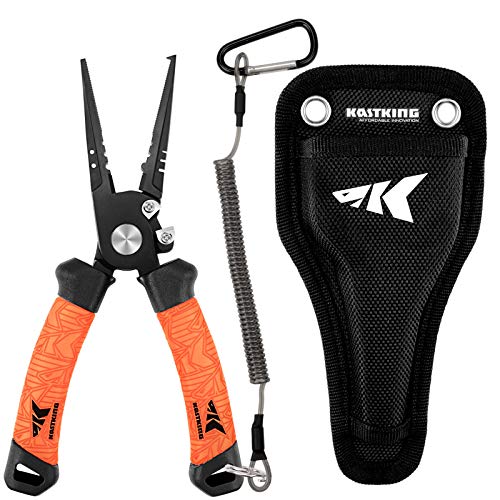 Our pickKastKing Speed Demon ProMost anglers$32Check price
 Cuda 7.5 inSaltwater$51Check price
Why braid needs a different cutter
Monofilament is a single extruded strand. It shears cleanly under almost any sharp edge, which is why cheap pliers feel fine right up until you change line.
Braided line is woven from many strands of ultra-high-molecular-weight polyethylene, the same family of fibre used in cut-resistant gloves and body armour. It is extremely strong for its diameter and it resists shearing. A normal steel edge pushes the strands aside rather than cutting them, and you end up sawing at a frayed tail you then cannot thread through a guide.
The answer is tungsten carbide, a material hard enough to shear the fibres rather than displace them. Carbide cutters are usually small inserts set into the jaw, and they cut braid, mono and fluorocarbon equally well.
Side-mounted cutters are worth looking for. Putting the cutter on the side of the jaw rather than at the pivot means you can cut without opening the pliers fully, which matters with one hand and a fish in the other.
They do dull eventually, and on better pliers the carbide inserts are replaceable. On cheap ones they are not, which is the real difference between a twenty-seven dollar pair and a nine dollar pair over a few seasons.
Fluorocarbon sits in between: harder and more brittle than mono, and it blunts ordinary cutters faster than people expect.
Corrosion, and the split ring nose
Saltwater destroys steel, and it does it faster than most people plan for. Salt crystallises in the pivot, the spring seizes, and the jaws lock solid.
The material choices, roughly in order:
- Plain stainless is fine for freshwater and will corrode in salt eventually, whatever the listing says.
- Coated stainless, like the polymer-coated 420 steel on the KastKing, resists salt considerably better while keeping the strength of steel.
- Aluminium alloy, as on the Cuda, does not rust at all in the way steel does. It is lighter and it is the usual choice for serious saltwater tools. Titanium bonding adds surface hardness on top.
The routine matters more than the material. Rinse in fresh water after every salt trip, dry them, and put a drop of oil in the pivot. Pliers die in tackle bags, not on boats.
Then the nose shape, which is a real fork in the road.
- A long thin nose reaches deep into a fish's mouth to retrieve a swallowed hook without putting your hand in there. Better for the fish and for your fingers.
- A split ring nose has a small hooked tip that opens split rings, which is what you need to change hooks on lures. If you fish lures, this saves genuine frustration.
The KastKing here has a split ring nose. The budget pair here has the long thin nose. Which one you want depends on whether you fish bait or lures.
 Best for freshwater and spares
Fishing Pliers Saltwater Freshwater Long Nose Hook Remover
Stainless scissors-style pliers with a long thin nose that reaches deep into a fish's mouth for a swallowed hook, which is better for the fish and for your fingers. Rubberised handles, a spring-loaded return with a lock, and both a nylon sheath and a stainless wire lanyard included. Cheap enough to keep a pair in every bag and the boat. Ordinary steel cutters, so they will fray braid, and they will corrode in salt eventually.
What's good
- Long thin nose reaches a deeply swallowed hook
- Sheath and stainless lanyard included
- Spring-loaded return with a lock for one-handed use
- Cheap enough to leave one in every bag
What's not
- Steel cutters fray braided line
- Plain stainless corrodes in saltwater
- No split ring nose for changing lure hooks
- Cutters are not replaceable
 Best for most anglers
KastKing Speed Demon Pro Fishing Pliers,7.5'' Split Ring Nose
Tungsten carbide cutters are the reason to buy these, and they go through braid, mono and fluorocarbon without frying. Mounting them on the side of the jaw means you can cut without opening the pliers fully, which matters with a fish in your other hand. The body is hard 420 stainless under a polymer coating that resists salt far better than bare steel, and the split ring nose opens rings so you can change lure hooks.
What's good
- Tungsten carbide cutters shear braid cleanly
- Side-mounted cutters work one-handed
- Polymer-coated 420 steel resists salt corrosion
- Split ring nose for changing lure hooks
What's not
- Split ring nose is less good in a fish's mouth
- Coating chips with hard use
- Three times the budget pair
- Heavier than aluminium pliers
 Best for saltwater
CUDA 7.5" Titanium Bonded Pliers Durable Fishing Braid
Aluminium alloy rather than steel, which is the point: aluminium does not rust the way steel does, and a titanium bonded surface adds hardness on top. Integrated tungsten carbide cutters slice braid, mono and fluorocarbon. Full-tang construction visible through the handle means there is no hidden weak join, and the scale-pattern grips hold when your hands are wet and slippery. Nylon sheath and lanyard included. Considerably dearer than the KastKing.
What's good
- Aluminium alloy does not rust like steel
- Titanium bonded surface adds hardness
- Tungsten carbide cutters for all line types
- Full-tang build with no hidden weak join
What's not
- Nearly double the KastKing
- Aluminium dents where steel would not
- No split ring nose
- Still needs rinsing after salt
Fishing pliers spend their lives being used one-handed, over water, with wet hands, while something is thrashing. They go over the side, and they sink. Every pair here comes with a lanyard and a sheath, and both are worth using from the first trip rather than after the first loss. A retractable zinger on a belt loop is the version most people settle on, because it puts the pliers back without you thinking about it.
Unhooking a fish properly
Wet your hands first if you are going to touch the fish at all. Dry hands strip the protective slime coat, which is what keeps infection off them.
Keep it in the water where you can. A fish out of water is holding its breath, and the clock matters more than a photograph does.
Back the hook out the way it went in. Grip the bend, not the shank, and reverse the path. Pulling straight out tears the tissue.
Deeply hooked and bleeding: cut the line. A hook left in place usually rusts out or is shed, and the fish very often survives. Digging for it usually kills it. This is the single most useful thing to know.
Crimp the barbs. Pliers do it in a second, they make unhooking dramatically faster and cleaner, and you lose far fewer fish than folklore suggests, because a barbless hook needs steady pressure rather than luck.
Mind your own hands. A hook through a finger while a fish is attached is a genuinely bad afternoon, and a long-nosed pair of pliers is what keeps your fingers out of the way. Learn the line-pull technique for removing a hook from skin before you need it.
Before you buy
Tungsten carbide cutters if you fish braid at all.
Split ring nose for lure fishing, long thin nose for bait.
Aluminium or coated steel for saltwater, plain stainless for fresh.
Check a sheath and lanyard are included.
Rinse, dry and oil the pivot after every salt trip.
Fishing plier questions
Why can my pliers not cut braided line?
What material is best for saltwater pliers?
Do I need a split ring nose?
What should I do if a fish is hooked deeply?
How to Read Water and Find Where the Fish Are
Getting to the point where you need these.
The KastKing Speed Demon Pro is the one to buy for most people: tungsten carbide cutters that actually deal with braid, mounted on the side so they work one-handed, and a coated steel body that survives salt. The nine dollar pair is genuinely worth owning as a spare and is fine for freshwater and mono. Step up to the Cuda if you fish salt regularly and want aluminium. And clip the lanyard on.
Ready to actually do it?
The first fishing quest takes an evening, and it tells you whether the gear was worth it better than any review can.
Start FishingThe HobbyStack editorial team researches each guide against manufacturer specifications, published resources and practitioner sources. Every product is checked for availability and described against its current listing before publication, and prices are re-checked when guides are updated.
About our editorial process →More gear guides
All guides
Best Beginner Fishing Rod and Reel Combo 2026: Spinning Setups That Just Work
For your first setup, a matched spinning rod-and-reel combo is the right call: it's pre-balanced, forgiving to cast, and gets you fishing without choosing parts you don't understand yet. Here are three combos that punch above their price, from a near-indestructible classic to a saltwater-ready upgrade.

Best Tackle Box for Beginners (2026): 3 Real Picks
A tackle box is where all your lures, hooks, and terminal tackle live, and how you store it shapes how easily you fish. The real question isn't which box is 'best' but how much tackle you carry and how you get to the water: a simple tray box is perfect if you fish from one spot, a backpack is better if you hike or bank-hop, and a modular system is the answer once your collection grows. The key thing to understand is the standard that runs through all of them, the 3700 utility box, which lets you scale storage without starting over. Here are three good options across the range, plus how to choose.

Best Beginner Gardening Pruners 2026: Fiskars vs Felco F-2 vs Felco F-8
Hand pruners are the most-used tool in any garden: deadheading, harvesting vegetables, shaping shrubs, cutting back perennials. The right pair makes clean cuts without crushing stems (which invites disease); the wrong pair bruises more than it cuts. Here are three options: a reliable budget shear, the Swiss-made professional standard, and Felco's ergonomic model for gardeners with hand fatigue.

Best Garden Hose (2026): Why Cheap Hoses Kink and Good Ones Do Not
A garden hose is a thing nobody thinks about until theirs kinks behind them for the fourth time in one watering. The difference between a hose that does that and one that does not is entirely material and construction, both of which are printed on the packaging and both of which most people ignore in favour of length and price.
Best Beginner Metal Detector 2026: Nokta Simplex vs Minelab Vanquish
A good beginner detector is one that can tell treasure from trash, which rules out the sub-$100 toys. Spend a bit more and you get discrimination, target ID, and waterproofing that actually find things. Here are three real beginner detectors, from a simple waterproof entry to a buy-it-once multi-frequency machine.

Best Metal Detecting Headphones (2026): You Are Listening for a Whisper
The loud clear signals are usually modern rubbish near the surface. The find worth digging is often a faint, broken whisper at the edge of hearing, and whether you notice it depends almost entirely on whether wind, traffic and your own footsteps are competing with it.