Best Fountain Pen Ink (2026): Almost Everything Is Safe, and a Few Things Are Not
The pleasant surprise about fountain pen ink is that a bottle costs less than a decent lunch and lasts a year or more, so this is a hobby where experimenting is genuinely cheap. The unpleasant surprise is that two categories of ink will wreck a pen permanently, and one of them is sold in the same shop aisle.
HobbyStack may earn a commission from links on this page at no extra cost to you. Our picks are chosen on merit; the commission helps fund the research.
- Only use ink sold for fountain pens. India ink and calligraphy ink contain shellac and will set solid inside a pen.
- A bottle lasts a very long time. This is a cheap thing to experiment with.
- Shading is one colour going light and dark. Sheen is a second colour on top where ink pools.
- Feathering and bleed-through are usually the paper, not the ink.
- Wet inks flow more and dry slower. Dry inks suit fine nibs and cheap paper.
 Sailor Four SeasonsA first bottle$12Check price
 Our pickPilot IroshizukuMost people$19Check price
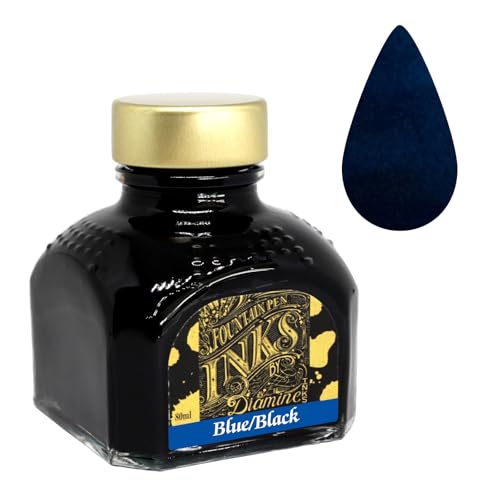 Diamine 80mlVolume and choice$19Check price
The inks that will destroy a pen
This is short, absolute, and the only genuinely dangerous thing in the hobby.
India ink and most calligraphy inks contain shellac or other binders. They are designed for dip pens and brushes, where the ink is used immediately and washed off. Inside a fountain pen — a closed system of narrow channels and a feed with capillary fissures a fraction of a millimetre wide — the binder dries and sets, and it does not redissolve in water. That is a pen destroyed, and on a vintage pen it can be unrecoverable.
Acrylic, drawing and "waterproof" inks are the same problem for the same reason.
Iron gall inks are the grey area. Traditional iron gall is acidic and corrosive to steel nibs and to some pen materials. Modern fountain-pen-safe iron gall inks exist and are formulated to be much milder, but they still want flushing more often and are not for a pen you leave sitting.
Pigmented inks — as opposed to dye-based — are permissible in fountain pens made for them but need regular flushing, because the pigment can settle.
Everything sold explicitly as fountain pen ink, including all three here, is fine.
Shading, sheen and shimmer
Three words that get used interchangeably and mean quite different things.
Shading is one colour appearing light and dark in the same line, depending on how much ink pooled. It is the most common and the most useful: it makes ordinary handwriting look considerably better, and it shows up best with a broad, wet nib on good paper.
Sheen is a different colour appearing on top of the ink where it pools thickly, usually a metallic glint at a low angle — a red-black ink flashing gold, or a blue flashing red. It needs a wet nib and non-absorbent paper, because the ink has to sit on the surface and dry slowly to separate.
Shimmer is actual glitter particles suspended in the ink. It looks spectacular and it is the one to be careful with: particles settle in the bottle, can clog a fine nib, and demand more frequent flushing. Not for a pen you leave for a month.
All three depend as much on nib width and paper as on the ink. The same bottle in a fine nib on cheap paper will show none of it, which is why people conclude an ink is boring when it is the setup.
 Best first bottle
Sailor Fountain Pen, Bottled Ink, Four Seasons, Dream
Sailor make ink the way they make pens, which is to say conservatively and very well, and the Four Seasons range is the accessible end of it. These are inks that behave: sensible flow, reliable drying, and no unpleasant surprises on cheap paper, which is exactly what you want in a first bottle before you know whether you prefer wet or dry, or what your paper does. The colours are muted and literary rather than loud — this is the Rikyucha, a brownish tea green — and that restraint is the appeal. It is the cheapest bottle here. What it is not is a showcase for sheen or dramatic shading, and the bottle is smaller than the Diamine, so the price per millilitre is less good than it looks.
What's good
- Very well-behaved flow and drying
- Forgiving on cheap paper
- Muted, considered colours
- Cheapest bottle here
What's not
- Smaller bottle than the Diamine
- Little sheen or dramatic shading
- Colour range is narrower than Diamine
- Price per ml is not the bargain it appears
 Best for most people
PILOT Iroshizuku Bottled Fountain Pen Ink
The ink most enthusiasts point a newcomer at, and the reason is consistency: Iroshizuku inks flow beautifully in almost any pen, shade well without being difficult, and dry at a sensible rate on ordinary paper. The colours are drawn from Japanese landscapes and named for them — this is Tsuki-Yo, moonlight, a deep teal that goes almost black in the thick strokes — and the range is genuinely lovely rather than merely large. 50ml in a heavy glass bottle with a sloped well that makes filling from the last third possible, which cheap bottles do not. Pilot have been making pens for over a century and it shows in how little the ink asks of you. It is a premium price for ink, and the bottle is smaller than Diamine's.
What's good
- Flows well in almost any pen
- Shades nicely without being fussy
- Heavy glass bottle designed for easy filling
- The range enthusiasts recommend first
What's not
- Premium price per millilitre
- 50ml against Diamine's 80ml
- Little dramatic sheen
- Colour names give no clue what they look like
 Best for volume and choice
Diamine 80ml Blue/Black fountain pen ink bottle
Eighty millilitres, which is well over half again the Iroshizuku bottle for about the same money, and that is most of the argument — this is the ink you buy when you have found a colour you write with daily and want to stop thinking about it. Diamine's range is enormous, running to hundreds of colours including sheening and shimmering ones, so if a specific shade exists someone has probably made it here. The inks are generally wetter than the Japanese options, which suits a dry pen or a fine nib and can be too much on absorbent paper. Quality across such a huge range is less uniform than Sailor or Pilot: most are excellent, a few are notably wet or slow drying, and the only way to know is to try.
What's good
- 80ml — far more ink for the money
- Enormous colour range including sheen and shimmer
- Generally wetter, which suits dry pens and fine nibs
- Widely available and easy to replace
What's not
- Consistency varies across such a big range
- Wetter inks feather on absorbent paper
- Plain bottle without a filling well
- Some colours dry slowly
India ink, most calligraphy ink, acrylic ink and drawing inks contain shellac or similar binders. They are meant for dip pens, where the ink is used and washed off immediately. Inside a fountain pen the binder sets in channels a fraction of a millimetre wide and does not redissolve in water — that is a pen ruined, and on a vintage pen often permanently. If the bottle does not say fountain pen ink, it is not.
Feathering, bleed and why it is usually the paper
People blame the ink and it is nearly always the paper.
Feathering is ink spreading sideways into the fibres, so a line looks furry. It happens when paper is absorbent and poorly sized — sizing is the coating that controls how much liquid soaks in. Cheap copier paper has little of it.
Bleed-through is ink going all the way through to the other side. Same cause, worse.
Ghosting is seeing the writing faintly from the back without ink actually penetrating, and that is just thin paper. Harmless.
The fix is paper, and it is cheap. Rhodia, Clairefontaine, Tomoe River and Midori are the names people repeat because they are heavily sized and hold ink on the surface, which also happens to be what makes sheen and shading appear.
If you must use bad paper — a work notebook, a form — use a finer nib and a drier ink, which puts less liquid down. That is the whole trick: a broad wet nib on office paper will feather regardless of how good the ink is.
Before you buy
Check the bottle says fountain pen ink. That is the only hard rule.
A bottle lasts a year or more, so experimenting is cheap.
Wetter inks for dry pens and fine nibs, drier inks for cheap paper.
Shading and sheen need good paper as much as good ink.
Avoid shimmer inks in fine nibs and in pens you leave sitting.
Fountain pen ink questions
Can I use any ink in a fountain pen?
What's the difference between shading and sheen?
Why is my ink feathering?
How long does a bottle of fountain pen ink last?
Pilot Iroshizuku is the bottle to start with: it flows well in almost any pen, shades without being difficult, and the bottle is designed so you can still fill from the last third. Sailor Four Seasons is the more restrained and slightly cheaper option, and equally well behaved. Diamine gives you far more ink and a far bigger colour range for the money, with slightly less consistency across it. And never put India ink in a fountain pen.
Ready to actually do it?
The first fountain pens quest takes an evening, and it tells you whether the gear was worth it better than any review can.
Start Fountain PensThe HobbyStack editorial team researches each guide against manufacturer specifications, published resources and practitioner sources. Every product is checked for availability and described against its current listing before publication, and prices are re-checked when guides are updated.
About our editorial process →More gear guides
All guides
Best Beginner Fountain Pen (2026): A Japanese Fine Is Not a European Fine
The most common first disappointment with a fountain pen is a line that comes out narrower than expected, and it is not a fault. Japanese nibs are ground finer than European ones at the same letter, so a Pilot Fine is roughly a Lamy Extra Fine. Knowing that before you order decides whether the pen feels right.

Best Fountain Pen Paper (2026): Feathering Is a Paper Problem, Not a Pen Problem
A new fountain pen that writes a furry, spreading line on office paper is not faulty. Copier paper is barely sized, so wet ink wicks along the fibres and spreads outward from the stroke. The same pen on properly sized paper lays a crisp line, and nothing about the pen changed.

Best Coin Collecting Books (2026): Learn to Grade Before You Learn Prices
A coin price guide is useless until you can grade. The same 1909 cent might be worth a few dollars or several thousand depending on condition, and every figure in every price book is quoted per grade. Learning to read the prices before you can judge the coin is how people overpay confidently.
Best Beginner Turntable (2026): 3 Picks That Won’t Wreck Your Records
The cute all-in-one suitcase players are exactly what you should not buy, their heavy tonearms and cheap needles quietly grind down the records you are paying for. A real beginner turntable protects your vinyl and sounds dramatically better. Here are three that do it right, from a true budget pick to an audiophile deck.

Best Phono Preamp (2026): A Cartridge Puts Out a Thousandth of Line Level
Plug a turntable straight into a normal input and you get something thin, quiet and strangely trebly. That is not a fault. A cartridge outputs a few thousandths of a volt against the one or two volts a line input expects, and records are deliberately cut with the bass reduced, so something has to put both back.
Best Record Cleaning Kit for Beginners (2026): 3 Real Picks
Clean records sound better and last longer, full stop: dust and grime in the grooves cause the crackle and pop people blame on vinyl itself, and they grind against your stylus over time. The question is how deep you want to go. A simple brush-and-fluid kit handles everyday dust; a wet-bath washer deep-cleans thrift finds and neglected records; a cleaning machine does it fastest and best. Here are three good options across the range, plus the one habit that matters more than any of them.