Best Speed Cubes for Beginners (2026)
The jump from a stiff hardware-store Rubik's Cube to a real magnetic speed cube is the single biggest upgrade in solving: it turns smoothly, corner-cuts instead of locking up, and the magnets snap each layer into place. Here are three, from a $10 cube that already does all that to a maglev flagship.
HobbyStack may earn a commission from links on this page at no extra cost to you. Our picks are chosen on merit; the commission helps fund the research.
- Any real speed cube beats a Rubik's-brand cube. Modern speed cubes turn smoothly, 'corner-cut' (complete a turn even when layers are slightly misaligned) instead of locking up, and come pre-lubed. This alone will drop your solve times.
- Our pick: the GAN 356 M (~$24). The classic first magnetic speed cube — fast, controllable, with tunable feel and strong magnets that click each layer home. What most cubers recommend to start.
- Budget: the Monster Go 3x3 M (~$10). GAN's beginner line: genuinely magnetic and smooth for the price, pre-lubed and ready to solve. The best cheap way to feel what a real cube does.
- Flagship feel: the GAN V100 Maglev (~$40). A magnetically levitated core makes it glide, and it is ultralight with deep tuning. More than a beginner needs, but the upgrade if speedsolving grabs you.
- Skip: the original Rubik's-brand cube (stiff, locks up, no magnets), and 'stickered' cubes (the stickers peel) — get a stickerless magnetic cube instead.
 Our pickGAN 356 M Magnetic Speed CubeBest for most beginners$28Check price
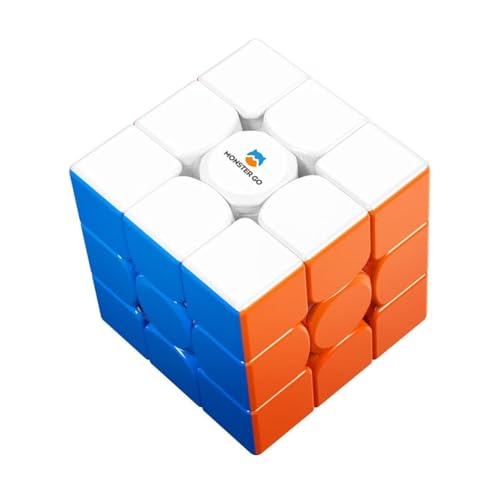 Monster Go 3x3 Magnetic Speed CubeBest cheap real cube$10Check price
 GAN V100 Maglev UV Speed CubeThe flagship to grow into$40Check price
What makes a speed cube fast
If your only reference is the classic Rubik's Cube from a toy aisle, a modern speed cube feels like a different object. A few features do the work:
- Magnets. Small magnets in each piece pull the layers into aligned positions, giving a satisfying click and helping you stop turns accurately without over-rotating. This is the single feature that most improves control, and every cube here has it.
- Corner-cutting. On a good cube you can start the next turn before the last one is perfectly lined up, and it self-corrects instead of jamming. A Rubik's-brand cube locks up; a speed cube flows. This is why times drop the moment you switch.
- Smoothness and lube. Speed cubes ship pre-lubricated and tensioned so they turn light and fast out of the box. Better cubes stay smooth longer and let you adjust the feel.
- Stickerless plastic. The colors are the plastic itself, not stickers that peel and wear. Every cube worth buying today is stickerless.
The good news for beginners: even a $10 cube now has magnets and corner-cutting. You do not need to spend much to get the core benefit — you spend more for smoother feel, adjustability, and flagship refinements like a maglev core.
 Best for most beginners
GAN 356 M Magnetic Speed Cube
The GAN 356 M is the cube nearly every cuber recommends as a first real speed cube, and it holds up. It is fast but controllable, the internal magnets are strong and precise so each layer clicks into place, and GAN's GES tuning system lets you soften or firm the turning as your hands improve. It ships pre-lubed and anti-scratch stickerless, and the honeycomb internal surface keeps it smooth over time. Crucially, it is a cube you will not outgrow — it carries plenty of people from their very first solves down into sub-30-second territory and beyond. The default first cube for good reason.
What's good
- Strong, precise magnets — layers click into place
- Adjustable tuning that grows with your skill
- Fast yet controllable; pre-lubed and stickerless
- A cube you keep well past the beginner stage
What's not
- Pricier than a pure budget cube
- More cube than a totally casual solver needs
 Best cheap real cube
Monster Go 3x3 Magnetic Speed Cube
Proof you do not have to spend much to feel the difference. Monster Go is GAN's budget line, and this 3x3 has 48 internal magnets and a modern mechanism that used to appear only on cubes costing twice as much — so it turns smoothly, corner-cuts, and clicks into alignment, all for around $10. It comes pre-lubed and tensioned, and there is even a companion app that solves the cube from photos if you get stuck. It is not as refined or tunable as the 356 M, but as a first real speed cube — or a cheap second one to leave at work — it genuinely delivers the core experience.
What's good
- Genuinely magnetic and smooth for about $10
- Pre-lubed and tensioned out of the box
- Corner-cuts and clicks into place like a real cube
- Great first cube or inexpensive spare
What's not
- Less refined and not as tunable as the 356 M
- You will likely want an upgrade if you get serious
 The flagship to grow into
GAN V100 Maglev UV Speed Cube
If speedcubing clicks and you want the flagship feel, the GAN V100 Maglev is the upgrade. Its magnetically levitated core replaces the usual spring with magnets, so the cube turns with an almost frictionless, buttery glide, and at 55mm and 64g it is compact and very light for fast, low-strain solving. A numerical tuning system offers dozens of handfeel settings so you can dial it in exactly. It is genuinely overkill for a total beginner — the gains over the 356 M are refinement you will only appreciate once you are quick — but it is the cube to want once you know speedsolving is your thing.
What's good
- Maglev core — an almost frictionless, gliding turn
- Ultralight 64g, compact 55mm for fast solving
- Deep numerical tuning to dial in the feel
- The flagship upgrade once you are hooked
What's not
- Overkill for a first cube — refinements a beginner won't use yet
- The priciest of the three
A good cube helps, but the real unlock is learning an actual solving method. The 'beginner's layer-by-layer' method — solve a cross, then the first two layers, then orient and permute the last layer — takes an afternoon to pick up from any free tutorial and gets almost anyone to a full solve. Most people reach a one-to-two-minute solve on method alone, long before hardware matters. Learn the method, then let a smooth magnetic cube take your times lower.
Before you buy
Get a stickerless magnetic cube. Stickerless means the colors are molded into the plastic, so nothing peels; magnetic means it clicks into alignment. Both are standard on any cube worth buying now.
Don't over-buy your first cube. A $10 to $25 magnetic cube is plenty to learn on and reach a fast solve. Flagships add refinement, not solutions — save the upgrade for when you know you are hooked.
Learn a method before chasing speed. The beginner's layer-by-layer method is the real first step. A free tutorial plus your new cube gets you to a full solve the same day.
A little lube goes a long way. Cubes ship pre-lubed, but a drop of cube-specific lube every few weeks keeps the feel smooth. Never use household oils — they degrade the plastic.
Tension to taste once you improve. Better cubes let you adjust how loose and fast they turn. Start with the factory setting; tune it only once you know whether you want faster or more controlled.
Common questions about speed cubes
What's the difference between a speed cube and a Rubik's Cube?
Do I need a magnetic cube as a beginner?
Is a $10 speed cube good enough to start?
How do I actually get faster?
Stickerless or stickered?
Is the flagship maglev cube worth it for a beginner?
Ready to actually do it?
The first speedcubing quest takes an evening, and it tells you whether the gear was worth it better than any review can.
Start SpeedcubingThe HobbyStack editorial team researches each guide against manufacturer specifications, published resources and practitioner sources. Every product is checked for availability and described against its current listing before publication, and prices are re-checked when guides are updated.
About our editorial process →More gear guides
All guides
Best Practice Locks for Lock Picking (2026): Learn on Real Locks
Locksport is the hobby of picking locks you own, and its learning curve is unusual: the skill is entirely in your fingertips, because you cannot see anything you are doing. That makes the choice of lock more important than the choice of picks. Start on something too hard and you learn nothing but frustration; start on the clear acrylic lock everyone buys first and you learn the wrong thing.

Best Beginner Chess Sets (2026): 3 Real Picks
A tournament-style set is the right first chess set: standard-size Staunton pieces, weighted so they don't tip, on a board with 2.25 inch squares. Skip the decorative themed sets for now. The one real decision is vinyl (cheap, portable, what clubs actually use) versus wood (nicer to own, costs more). Everything below is a set people genuinely buy and play on.
Best Chess Clock (2026): Delay, Increment and Why It Matters
A chess clock changes the game more than any other piece of equipment, because it turns thinking time into a resource you can run out of. The part beginners rarely have explained is that not all timed chess is the same: delay and increment are different rules that produce very different endgames, and the clock you buy determines which ones you can play.

Best Go Books (2026): Beginners Want Joseki and Need Life and Death
Every beginner reaches for a book of joseki, the memorised corner sequences, because they look like the secret. They are not. Strength at Go comes from reading life and death and recognising good shape, and a player who has memorised openings without those will play twenty moves of professional theory and then lose the group.

Best Go Sets for Beginners (2026)
A Go set is just a board, a bowl of black stones, and a bowl of white, but the details make a real difference when you are learning. Magnetic stones that do not slide, a full 19x19 grid, and a board that lies flat all make the game easier to focus on. Here are three complete sets, from a travel board to a bamboo one.

Best Pottery Tool Set (2026): Six of the Twelve Do Nearly Everything
Open a twelve-piece pottery set and six tools will do nearly all your work: the wire cutter, a wooden rib, a metal rib, a loop trimming tool, a sponge and a needle tool. The rest get picked up once, found to duplicate something, and left in the canister for years.