Best Headlamp for Camping (2026): The Lumen Number Is the First 30 Seconds
The lumen figure on a headlamp box is measured at the moment you switch it on with a fresh battery. Most lamps cannot hold it, and many are down to a third of it within the hour. What you actually care about is how bright it still is at 11pm when you are looking for the tent, which is a number almost nobody prints.
HobbyStack may earn a commission from links on this page at no extra cost to you. Our picks are chosen on merit; the commission helps fund the research.
- Peak lumens is a burst figure. Sustained output and burn time matter more.
- Red mode preserves night vision and does not blind everyone in the tent.
- 150 lumens is plenty around camp. You want the high setting for finding things in the dark.
- Cold kills alkaline batteries. Lithium AAAs or a pack kept inside your jacket.
- Lock mode is what stops the lamp draining itself in your pack.
 Petzl TikkaCamp and car$35Check price
 Our pickBlack Diamond Spot 400Most camping$48Check price
 Spot 400-R rechargeableRegular trips$58Check price
What the numbers on the box actually mean
Lumens is total light output, measured at the instant of switch-on with a full battery. It is a real number and it is also the least useful one, because a small lamp cannot dissipate the heat of running its LED at full power for long. Many drop substantially within minutes.
What you want to know is whether output is regulated. A regulated lamp holds a steady brightness until the battery is nearly done, then drops off. An unregulated one fades continuously from the first minute, which you barely notice because your eyes adapt, right up until it is not enough.
Burn time is quoted at a stated brightness, so it is only comparable if you check which one. A lamp claiming 200 hours is telling you about its lowest setting.
Beam pattern is the spec that changes how a lamp feels and is rarely a number. A flood beam lights a wide close area, which is what you want for cooking, reading, and finding things in a tent. A spot beam throws a narrow column much further, which you want on a trail. Good lamps do both, and how easily you switch between them matters daily.
Weight on your head is felt more than weight in a pack. The Tikka here is 94 grams with batteries, which is about the point where you stop noticing it.
Red light, batteries and the cold
Red mode is the feature people skip and then rely on. Your eyes take about twenty to thirty minutes to fully adapt to darkness, and one flash of white light resets it. Red light barely disturbs that adaptation, so you can read a map, find a bag or walk to the toilet and still see the stars afterwards.
It is also basic courtesy. Turning to face someone in a dark camp with 400 lumens on your forehead is genuinely unpleasant, and a good lamp starts in red so you cannot do it by accident.
Then batteries, which is the real choice on this page.
AAA lamps take three cells you can replace anywhere in the world at 2am. Carry spares and the lamp cannot die. The catch is that alkaline cells lose most of their capacity below freezing, so for winter or altitude you want lithium AAAs, which cost more and keep working far colder.
Rechargeable lamps have an internal lithium-ion pack, charge by USB, cost nothing to run, and are usually a little brighter because the pack delivers current more readily. The catch is that when it is empty you need power, which on a long trip means a power bank. Lithium-ion also loses capacity in the cold, though you can sleep with the lamp in your bag.
The honest answer for most camping is AAA with the option to upgrade, which is exactly what the Spot 400 offers.
Lock mode matters either way. A headlamp switched on inside a pack is flat by the time you need it, and every lamp here can be locked out.
 Best for camp and car
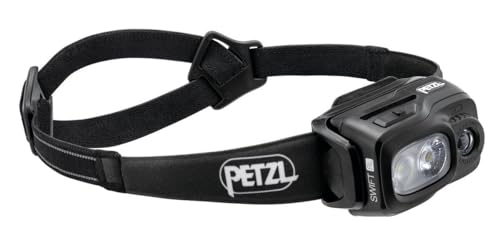
Petzl Tikka Headlamp - Black
Light, simple, and it does the things that matter rather than the things that sell. Three white levels run from maximum burn time up to 350 lumens, and there is continuous red for night vision plus a strobe. A charge indicator shows the battery state every time you switch on or off, which is more useful than it sounds. Only 94 grams, and the headband comes off to wash. The tilt is a plate rather than a hinge.
What's good
- 94 grams, light enough to forget
- Continuous red mode for night vision
- Charge indicator on every switch-on
- Washable headband made from recycled material
What's not
- 350 lumens, the dimmest here
- No waterproof rating quoted
- Plate tilt is less precise than a hinge
- AAA only, no rechargeable option
 Best for most camping
BLACK DIAMOND Spot 400 Headlamp
The default recommendation for good reasons: 400 lumens, a genuinely waterproof housing, red night vision, and both a spotlight and a softer proximity mode so it works for the trail and for cooking. It runs on three AAAs which you can replace anywhere, and it takes the BD 1500 lithium-ion pack later if you decide you would rather charge it. That upgrade path is why this rather than the rechargeable version for most people.
What's good
- 400 lumens with spot and proximity modes
- Waterproof housing for rain and snow
- AAA now, rechargeable pack later if you want
- Red night-vision mode
What's not
- Rechargeable pack and charger sold separately
- Button interface takes learning
- Heavier than the Tikka
- Alkaline AAAs fade badly in the cold
 Best for regular trips
BLACK DIAMOND Spot 400-R Headlamp
The same lamp with the battery decision made for you: a 1500 mAh lithium-ion pack built in, charged over USB, so there is nothing to buy and nothing to throw away. Rated IP67, meaning full submersion for half an hour rather than just rain resistance, which is the meaningful step up. Full power, dimming, strobe, red and a lock mode that stops it draining in your pack. If it runs flat somewhere remote, you need a power bank.
What's good
- Built-in 1500 mAh pack, nothing else to buy
- IP67 survives full submersion, not just rain
- Lock mode prevents pack drain
- No disposable batteries to carry or bin
What's not
- Flat means flat unless you carry a power bank
- Micro-USB rather than USB-C
- Lithium-ion loses capacity in real cold
- Dearest of the three
Around camp, 20 to 50 lumens is enough to cook, eat and find things, and running on low means the battery lasts several nights rather than one. The high setting is for the moments you actually need to throw light at something: a noise outside the tent, a trail junction, a dropped tent peg. People burn through batteries by leaving a lamp on maximum out of habit, then discover it flat on the night it matters.
Small things worth knowing
Store it with the batteries out, or at least locked. Alkaline cells left in a lamp for a year leak and corrode the contacts, which is how most headlamps actually die.
Wear it round your neck for camp chores. Both these lamps tilt far enough to point forward when worn that way, and it puts the light where your hands are without dazzling anyone you talk to.
Carry a spare set of AAAs even with a rechargeable lamp, if anyone else in the group is on AAAs. Batteries are the one bit of kit that is worth duplicating.
Learn the button in daylight. Most headlamps use one button with press, hold and double-press for different modes, and working out how to reach red mode while standing in the dark not wanting white light is a bad time to start.
Check the headband tension before the trip. Elastic goes slack with age and a lamp that slides down your forehead every ten minutes is genuinely maddening.
Hang it in the tent. A headlamp pointed up into a full water bottle or a stuff sack of clothes turns a spot beam into a soft ceiling light, which is far more pleasant to sit under than a beam.
Before you buy
Ignore peak lumens. Look for regulated output and honest burn times.
Red mode is not optional if you share a tent.
AAA for remote trips, rechargeable for regular weekends.
Lithium AAAs if you camp below freezing.
Check it has a lock mode.
Headlamp questions
How many lumens do I need for camping?
Why do headlamps have a red light?
Rechargeable or AAA batteries?
Do headlamps work in the cold?
The Black Diamond Spot 400 is the one to buy. It is bright enough, properly waterproof, has a real red mode, and takes AAAs you can replace anywhere while leaving the door open to a rechargeable pack later. Take the Petzl Tikka if light weight and simplicity matter more than maximum output. Choose the Spot 400-R if you camp often enough that disposable batteries have started to annoy you. Then run it on low.
Ready to actually do it?
The first camping quest takes an evening, and it tells you whether the gear was worth it better than any review can.
Start CampingThe HobbyStack editorial team researches each guide against manufacturer specifications, published resources and practitioner sources. Every product is checked for availability and described against its current listing before publication, and prices are re-checked when guides are updated.
About our editorial process →More gear guides
All guides
Best Beginner Camping Tent 2026: Coleman Sundome vs REI Wonderland vs Big Agnes Big House
The first tent makes or breaks whether you stick with camping. Buy a cheap pop-up and you'll quit by the second wet weekend. Buy a real tent for $100-450 and you'll camp for decades.

Best Sleeping Pad for Beginners (2026): R-Value Is the Number That Matters
People buy a warm sleeping bag, sleep badly, and blame the bag. Almost always it was the pad. You compress the insulation underneath you to nothing, so the only thing between your body and the ground is the pad, and cold ground pulls heat out of you far faster than cold air. The number that describes this is R-value, and it is the one specification worth understanding before you spend anything.

Best Air Compressor for Overlanding (2026): Airing Down Is Free, Airing Up Is Not
Dropping tyre pressure is the single most effective thing you can do off road and it costs nothing. Putting the air back before you rejoin a highway is the part that needs equipment, and it is where the cheap compressors fail — not dramatically, but by taking forty minutes per tyre and overheating halfway through.

Best Recovery Traction Boards (2026): Low Revs, and Never Stand Behind One
A traction board only works if the tyre bites it rather than polishing it. Spin a wheel on a nylon board and you melt the lugs flat in seconds, which is the single most common way people destroy a set on their first recovery. Low revs, and let the tyre walk up onto the board.

Best Beginner Hiking Backpack 2026: Osprey Daylite vs Talon vs Atmos
The right hiking backpack depends on one number: how long you plan to be out. Day hike → 20–30L. Overnight → 33–45L. Multi-day → 50–65L. Get the volume wrong and you're either cramming gear into too little space or hauling empty weight all day. Here are three Osprey packs, each sized for a different stage of hiking, that will outlast your beginner phase.

Best Beginner Hiking Boots 2026: Merrell Moab 3 vs Salomon X Ultra 4
Your first hiking boots need to do three things: not blister you, stay dry on wet trails, and grip technical terrain. The Merrell Moab 3 Waterproof checks all three for around $130. Here are three real boots: a non-waterproof breathable option, the waterproof all-rounder, and a stiffer upgrade for rocky terrain, each with a confirmed Amazon link.