Best Air Compressor for Overlanding (2026): Airing Down Is Free, Airing Up Is Not
Dropping tyre pressure is the single most effective thing you can do off road and it costs nothing. Putting the air back before you rejoin a highway is the part that needs equipment, and it is where the cheap compressors fail — not dramatically, but by taking forty minutes per tyre and overheating halfway through.
HobbyStack may earn a commission from links on this page at no extra cost to you. Our picks are chosen on merit; the commission helps fund the research.
- Most cigarette-lighter inflators explicitly do not support truck or LT tyres. Check before you buy.
- CFM is the number that matters. It decides how long you stand there.
- Duty cycle matters as much. A compressor that overheats after one tyre is not a four-tyre compressor.
- Alligator clips straight to the battery beat a 12V socket, which limits you to 10-15 amps.
- Air down for traction, air up before tarmac. Driving fast on soft tyres destroys them.
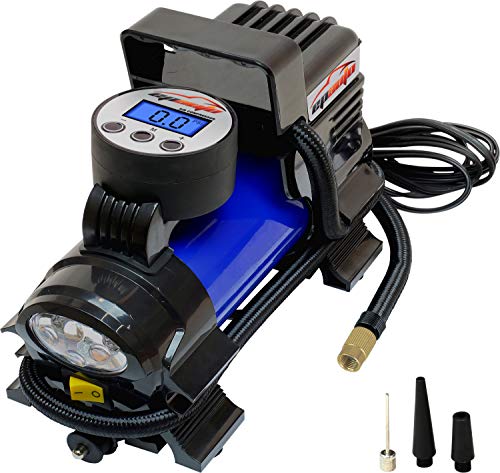 EPAuto 12V DC InflatorCars, not trucks$36Check price
 Our pickVIAIR 400P EFMost overlanders$240Check price
 ARB CKMTA12 TwinLockers and air tools$640Check price
Why airing down works
A tyre at road pressure has a small, hard contact patch. Let air out and the tyre deforms, and the contact patch gets longer — sometimes dramatically so.
That does three things at once. It spreads the vehicle's weight over more ground, so you float on sand rather than digging in. It lets the tread conform around rocks and roots instead of skating over them. And the softer sidewall absorbs impacts that would otherwise go through the suspension and into you.
Typical figures: mid-20s PSI for general dirt and gravel, mid-teens for rocks or mud, single figures to low teens for soft sand. Every vehicle and tyre differs, so treat those as starting points.
The cost is that a soft tyre is easy to roll off the rim in a hard turn, runs hot at speed, and steers vaguely. This is why airing back up is not optional: driving a highway on 15 PSI will overheat and destroy tyres, and it can do it quickly.
So the compressor is not a convenience item. It is the thing that lets you air down at all.
CFM, duty cycle, and how the cheap ones fail
Two numbers decide whether a compressor is any use, and only one is usually advertised.
CFM — cubic feet per minute of free airflow — is the rate it moves air. It is what decides whether reinflating four 33-inch tyres from 15 to 35 PSI takes ten minutes or the best part of an hour. A small cigarette-lighter unit might manage well under 1 CFM; a serious portable is around 2 to 3.
Duty cycle is how long it can run before it has to cool. This is the one that catches people. A compressor rated for a few minutes on and several off is fine for topping up a car tyre and is not a four-tyre-in-the-desert tool, because you will spend more time waiting for it to cool than running it.
Then power delivery. A 12V accessory socket is usually fused at 10 to 15 amps, which hard-caps what any compressor plugged into it can draw. Alligator clips direct to the battery remove that ceiling, which is why every serious portable uses them.
And PSI rating is mostly a red herring for tyres. Anything reaching 60 PSI covers every tyre you will run; 150 PSI matters for air tools and lockers.
 Best for cars, not trucks
EPAuto 12V DC Portable Air Compressor Pump
A 12V socket inflator that is genuinely good at what it is for, and it is important to be clear about what that is: the maker states outright it does not support truck tyres of any kind — not light truck, not heavy duty — and is rated for cars, sedans and midsize SUVs under a 3.5 litre engine. For an overlander that is a real limit, because the tyres involved are usually exactly the ones excluded. Within its range it is well made: auto shut-off at a set pressure, overheat protection, four units of display, an LED torch, and adapters for bicycles, balls and inflatables. It runs at 120 to 180W from the cigarette socket, which is the ceiling that defines it. Buy it for a road car or as a glovebox backup.
What's good
- Auto shut-off at your set pressure
- Overheat protection and a built-in LED torch
- Adapters for bikes, balls and inflatables
- Small enough to live in a glovebox
What's not
- Explicitly NOT for truck or LT tyres — the overlanding case
- 12V socket caps it at 10–15 amps
- Slow on anything large
- Short duty cycle, so it needs cooling breaks
 Best for most overlanders
VIAIR 400P EF Enhanced Flow
This is the class of tool the job actually needs. 2.59 CFM free flow and a 150 PSI maximum, powered by alligator clips through a 2-pin SAE connector with a 40-amp inline fuse, which sidesteps the accessory-socket ceiling entirely. VIAIR quote a 35-inch tyre in under five minutes, and it will do all four without sulking — the Enhanced Flow head is redesigned specifically for heat dissipation, which is the thing that limits cheaper units. It comes as a working kit rather than a bare pump: a 25-foot 5-in-1 inflator/deflator hose with an inline gauge, an 8-foot power lead, three tips and a dual-compartment bag. The I-Beam base is wide and low so it does not walk about on sand. Portable, so it moves between vehicles.
What's good
- 2.59 CFM — a 35" tyre in under five minutes
- Alligator clips bypass the 12V socket amp limit
- 25ft hose reaches all four tyres from one position
- Redesigned head dissipates heat, so it does four tyres
What's not
- Seven times the cheap inflator
- Bulky — it needs real storage space
- Clips mean opening the bonnet every time
- Loud, though quieter than previous VIAIR models
 Best if you run air lockers
ARB CKMTA12 '12V' On-Board Twin High Performance Air
A twin-motor compressor that mounts permanently in the vehicle rather than living in a bag, and that distinction is the whole decision. It exists primarily to run air lockers — pneumatically actuated locking differentials that need instant, repeatable air pressure on demand, which a portable pulled out and clipped up cannot provide mid-obstacle. Having done that, it also inflates tyres fast, runs air tools and drives an air horn. The motors are water-sealed and fully ball-bearing rather than bushed, with a linear brush pre-load system for long life and low heat, which is what a permanently installed unit needs. It requires proper installation and wiring, it costs two and a half times the VIAIR, and if you do not run lockers most of that is unused.
What's good
- Runs air lockers, which portables cannot do properly
- Twin motors — the fastest inflation here
- Water-sealed, all ball-bearing motors built to last
- Also drives air tools and an air horn
What's not
- Needs proper installation and wiring
- Two and a half times the VIAIR
- Lives in one vehicle — it does not travel
- Mostly wasted if you do not run air lockers
A tyre at trail pressure flexes constantly at speed, and that flexing generates heat the tyre cannot shed — which is how sidewalls fail. It is also far easier to roll a soft tyre off the rim in a hard turn. Air up at the last place you can before the highway, every time, even when it is dark and cold and you want to get home.
The rest of the tyre kit
A compressor is one of four cheap things that make up a working tyre setup, and the other three cost very little.
A deflator. Airing down four tyres by pressing a valve with a key takes an age and is inaccurate. A screw-on automatic deflator drops each tyre to a preset and stops, and a set does all four at once while you have coffee.
A decent gauge. Do not trust the one built into the compressor. A separate quality gauge is worth having, and worth checking against a second one, because every reading you make depends on it.
A tyre repair kit. Plug kits for punctures are cheap, effective on tread punctures, and every overlander should carry one and have practised with it. A sidewall tear is not repairable this way.
A valve core tool. Removing the core deflates a tyre in seconds rather than minutes, which matters when you are reseating a bead or in a hurry. It weighs nothing.
All four together cost a fraction of the compressor and turn it from a pump into a system.
Before you buy
Check the tyre size and type it supports. Many cheap inflators exclude LT and truck tyres.
Look for CFM, not just maximum PSI. CFM is the time you stand there.
Alligator clips beat a 12V socket, which caps current at 10-15 amps.
Check the duty cycle. Four tyres needs a compressor that can run for four tyres.
Only buy an on-board twin if you run air lockers.
Air compressor questions
Why do I need a compressor for overlanding?
What tyre pressure should I air down to?
What does CFM mean on an air compressor?
Can I use a cheap tyre inflator for off-roading?
The VIAIR 400P EF is the right compressor for most overlanders: enough flow to do a 35-inch tyre in under five minutes, alligator clips that bypass the accessory-socket ceiling, a head built to shed heat so it manages all four, and a 25-foot hose that reaches them from one spot. The EPAuto is a road-car tool and says so. Only buy the ARB twin if you run air lockers, because that is the job it exists for. Then add a deflator and a good gauge.
Ready to actually do it?
The first overlanding quest takes an evening, and it tells you whether the gear was worth it better than any review can.
Start OverlandingThe HobbyStack editorial team researches each guide against manufacturer specifications, published resources and practitioner sources. Every product is checked for availability and described against its current listing before publication, and prices are re-checked when guides are updated.
About our editorial process →More gear guides
All guides
Best Recovery Traction Boards (2026): Low Revs, and Never Stand Behind One
A traction board only works if the tyre bites it rather than polishing it. Spin a wheel on a nylon board and you melt the lugs flat in seconds, which is the single most common way people destroy a set on their first recovery. Low revs, and let the tyre walk up onto the board.

Best Beginner Camping Tent 2026: Coleman Sundome vs REI Wonderland vs Big Agnes Big House
The first tent makes or breaks whether you stick with camping. Buy a cheap pop-up and you'll quit by the second wet weekend. Buy a real tent for $100-450 and you'll camp for decades.

Best Headlamp for Camping (2026): The Lumen Number Is the First 30 Seconds
The lumen figure on a headlamp box is measured at the moment you switch it on with a fresh battery. Most lamps cannot hold it, and many are down to a third of it within the hour. What you actually care about is how bright it still is at 11pm when you are looking for the tent, which is a number almost nobody prints.

Best Sleeping Pad for Beginners (2026): R-Value Is the Number That Matters
People buy a warm sleeping bag, sleep badly, and blame the bag. Almost always it was the pad. You compress the insulation underneath you to nothing, so the only thing between your body and the ground is the pad, and cold ground pulls heat out of you far faster than cold air. The number that describes this is R-value, and it is the one specification worth understanding before you spend anything.

Best Beginner Fishing Rod and Reel Combo 2026: Spinning Setups That Just Work
For your first setup, a matched spinning rod-and-reel combo is the right call: it's pre-balanced, forgiving to cast, and gets you fishing without choosing parts you don't understand yet. Here are three combos that punch above their price, from a near-indestructible classic to a saltwater-ready upgrade.
Best Fishing Pliers (2026): Braid Destroys Ordinary Cutters
Braided line is woven from the same fibre used in body armour, and it does not cut so much as fray under a normal blade. A pair of pliers that handles mono perfectly well will chew braid into a fuzzy mess, and the fix is a specific material rather than a sharper edge.