Best Home Weather Station (2026): 3 Picks from Starter to Pro
A home weather station puts a sensor outside that measures your own backyard's temperature, humidity, wind, and rain, and sends it to a display, and often a phone app, indoors. The big decision is how much accuracy you want and whether you want it connected to WiFi. All three here are complete all-in-one stations, from an easy, affordable starter to a professional-grade unit that serious weather watchers keep for years.
HobbyStack may earn a commission from links on this page at no extra cost to you. Our picks are chosen on merit; the commission helps fund the research.
- Get an all-in-one station, not separate gadgets. A single outdoor array that measures temperature, humidity, wind, and rain together is simpler, tidier, and cheaper than buying each instrument on its own.
- Decide if you want WiFi. A WiFi station uploads your data to a phone app and to services like Weather Underground, so you can check your backyard weather from anywhere. A basic station just shows readings on an indoor display.
- Placement matters as much as the brand. Wind needs open air up high, the rain gauge needs clear sky, and the temperature sensor needs shade, or your readings will be off no matter how good the station is.
- Accuracy and update speed separate the tiers. Cheaper stations update every 15 to 30 seconds and drift a little; professional units update every few seconds with better-shielded sensors.
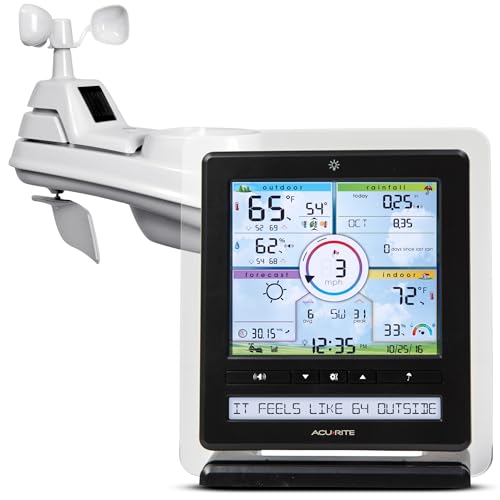 AcuRite Iris 5-in-1 Weather StationAn easy, affordable first station$99Check price
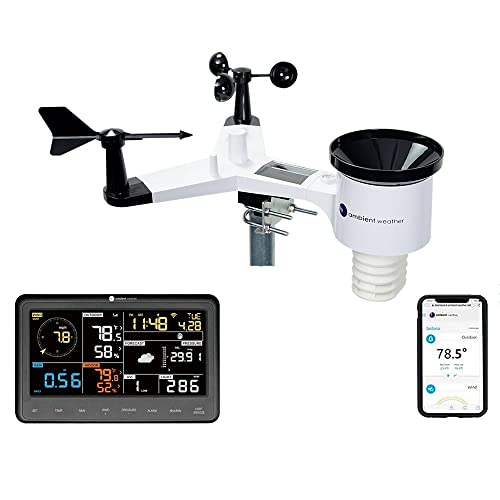 Our pickAmbient Weather WS-2902 WiFi Weather StationThe WiFi station most should buy$200Check price
 Davis Instruments Vantage Vue Weather StationProfessional accuracy to keep for years$425Check price
A home weather station is an outdoor sensor, usually a single array on a pole, that measures the weather where you actually live, plus an indoor display that shows it. The all-in-one design is what you want as a beginner: one sensor cluster handles temperature, humidity, wind speed and direction, and rainfall together, so setup is one mounting job rather than five. The next choice is connectivity. A basic station just shows readings on its indoor console, which is all some people want. A WiFi station also uploads your data to a phone app and to public networks like Weather Underground or the Ambient Weather Network, so you can watch your backyard weather from anywhere, get storm alerts, and even feed smart-home routines. If you enjoy the data, WiFi is the feature you will use most.
After connectivity, the tiers separate on accuracy, sensor quality, and how often the station updates. Entry stations refresh every 15 to 30 seconds and use decent but basic sensors; professional stations update every few seconds and use better-shielded, more accurate sensors that hold up for years in harsh weather. For most people an entry or mid station is plenty. Whatever you buy, remember that placement decides your accuracy as much as the hardware: the wind sensor wants open air well above the roofline, the rain gauge needs clear sky away from overhangs, and the temperature sensor must be shaded from direct sun or it will read too hot. A cheap station sited well beats an expensive one mounted badly.
 Best budget weather station
AcuRite Iris 5-in-1 Weather Station
The easiest and most affordable way into real backyard weather. The AcuRite Iris pairs a single 5-in-1 outdoor sensor, measuring temperature, humidity, wind speed, wind direction, and rainfall, with a color indoor display, and adds a barometer and a self-calibrating 12-hour forecast personalized to your location. It is genuinely simple to set up: mount the sensor, add batteries, and you are reading your own weather. It updates a little slower than the pricier stations and this version shows data on the display rather than your phone, but for someone who just wants accurate local conditions and a forecast without any fuss, it is a lot of station for the money. AcuRite also sells a WiFi version if you decide you want app access later.
What's good
- All-in-one 5-in-1 sensor, simple one-mount setup
- Color display with a self-calibrating local forecast
- Trusted, widely-used entry brand
- Affordable, with a WiFi upgrade version available
What's not
- This version shows data on the display, not an app
- Updates and sensor shielding are basic, not pro-grade
 Best for most people
Ambient Weather WS-2902 WiFi Weather Station
The weather station most enthusiasts should buy, because it adds the connectivity that makes the data fun to live with. The Ambient Weather WS-2902 uses an all-in-one Osprey sensor array (temperature, humidity, wind, and rain, plus UV and solar) and a bright color LCD console, and crucially it connects to WiFi, uploading your readings to a phone app and to public networks like Weather Underground and the Ambient Weather Network. That means you can check your backyard weather from anywhere, get alerts, share your station, and trigger smart-home routines with IFTTT. It is well-reviewed, accurate enough for keen hobbyists, and the go-to recommendation in weather-watching communities. It is a step up in price from the AcuRite, but the app access and sharing are what you will use every day.
What's good
- WiFi uploads to a phone app and Weather Underground
- All-in-one array adds UV and solar readings
- Smart-home ready with alerts and IFTTT
- The enthusiast community's default pick
What's not
- Costs about double the entry AcuRite
- Sensors are keen-hobbyist grade, not professional
 Best to grow into
Davis Instruments Vantage Vue Weather Station
The station for someone who wants professional accuracy and a unit that will outlast everything else in the yard. The Davis Vantage Vue uses genuinely higher-grade, better-shielded sensors than consumer stations, transmits wirelessly up to 1000 feet, and updates every 2.5 seconds rather than every 15 to 30, so fast-changing wind and gusts are captured properly. The sensor suite is solar-powered and the housing is potted and over-molded to survive years of sun, rain, and freezing weather, which is why Davis is the name serious amateur and professional weather watchers trust. It is the priciest here and more station than a casual user needs, and note the classic version pairs with a console rather than a phone app out of the box. But if you are serious about accurate data, it is a buy-once station.
What's good
- Professional-grade, better-shielded sensors
- Updates every 2.5 seconds, captures real gusts
- Rugged, solar-powered, built to last for years
- The brand serious weather watchers trust
What's not
- The priciest of the three by a wide margin
- The classic version uses a console; app access costs more
The most common mistake is mounting a good station badly. The wind sensor needs open air, ideally around 30 feet up and clear of the roofline, or buildings block and swirl the wind and make your readings meaningless. The rain gauge needs open sky above it, away from eaves and overhanging trees. And the temperature and humidity sensor must be shaded from direct sunlight, or it will read several degrees too warm on a sunny day. You do not need a weather tower to start, but get the sensor away from walls and out of the sun, and a cheap station will beat a pricey one mounted against a hot brick wall.
Which to buy: want accurate backyard weather and a forecast for the least fuss? The AcuRite Iris. Want WiFi, a phone app, and to share your station, which is most people? The Ambient Weather WS-2902. Want professional accuracy and a station built to last for years? The Davis Vantage Vue.
Before you buy
Mount the wind sensor high and in the open, the rain gauge under clear sky, and the temperature sensor in the shade.
If you want to see your weather on your phone, buy a WiFi model like the Ambient, or the WiFi version of the AcuRite.
Use fresh lithium batteries in the outdoor sensor for cold climates; regular alkalines fade fast in freezing temperatures.
Connecting to Weather Underground or the Ambient Weather Network is free and lets you compare your readings with neighbors.
It is easy to fall down the rabbit hole of buying a separate anemometer, barometer, hygrometer, and rain gauge, but for backyard weather you do not need to. An all-in-one station measures all of those in one sensor array, more tidily and usually more cheaply than buying each on its own. Standalone instruments are worth it later if you want a handheld wind meter for the field or one highly-accurate specialist sensor, but as your main setup, one good all-in-one station does the job.
Beginner weather station questions
What does a home weather station actually measure?
Do I need a WiFi one?
Which weather station should a beginner buy?
How accurate are they, and why does placement matter?
AcuRite vs Ambient vs Davis, what is the difference?
Can I share my data or see it online?
For most people the Ambient Weather WS-2902 is the pick: a complete all-in-one station with WiFi, a phone app, and free community sharing at a sensible price, which is what makes the data fun to live with. Want accurate backyard weather and a forecast for the least fuss? The AcuRite Iris 5-in-1 is the affordable starter. Want professional accuracy and a station that will outlast everything else in the yard? The Davis Vantage Vue is the buy-once choice. Whichever you get, mount the sensors well, because placement matters as much as the hardware.
Ready to actually do it?
The first meteorology quest takes an evening, and it tells you whether the gear was worth it better than any review can.
Start MeteorologyThe HobbyStack editorial team researches each guide against manufacturer specifications, published resources and practitioner sources. Every product is checked for availability and described against its current listing before publication, and prices are re-checked when guides are updated.
About our editorial process →More gear guides
All guides
Best Handheld Anemometer (2026): Where You Stand Changes the Reading
Wind speed is quoted at ten metres above open ground, because that is the standard. Standing in a garden holding a meter at chest height behind a fence, you will read a fraction of the real figure, and no instrument fixes that. Where and how you measure matters more than what you measure with.

Best Stereo Microscope for Entomology (2026): 3 Real Picks for Studying Insects
The moment you want to identify an insect, you need a stereo microscope, and it is worth being clear that this is the right type. A stereo (or dissecting) microscope gives a low-power, upright, 3D view of a whole specimen on the stage, which is how you examine a pinned beetle or a fly's wing. It is a different tool from the compound microscope from biology class, which magnifies far more but only sees thin slides. For entomology you want roughly 10X to 45X, good working distance, and enough light. Here are three good ones across the range.

Best Mushroom Grow Kit for Beginners (2026): Spray-and-Grow to Monotub
A mushroom grow kit is the easiest way into growing your own: the simplest ones are a block you open, mist daily, and harvest gourmet mushrooms from in a couple of weeks, with nothing to sterilize and no experience needed. Here are three good ones, from a foolproof spray-and-grow box to a full monotub setup you inoculate yourself.

Best Archaeology Trowel (2026): One Piece of Forged Steel, Four Inches Long
An archaeology trowel is a pointing trowel from a bricklayer, borrowed wholesale, and the profession is unusually specific about it. Four to five inches, one piece of forged high-carbon steel from tip to tang, and a blade that will be worn down to a stub over a career. Welded trowels snap at the neck, and everyone has seen it happen.

Best Pottery Tool Set (2026): Six of the Twelve Do Nearly Everything
Open a twelve-piece pottery set and six tools will do nearly all your work: the wire cutter, a wooden rib, a metal rib, a loop trimming tool, a sponge and a needle tool. The rest get picked up once, found to duplicate something, and left in the canister for years.

Long Blade Freediving Fins (2026): Stiffness Is Matched to Your Legs, Not Your Ambition
Long blades are not about speed. A long blade moves a large volume of water per kick, so you cover distance at a slow, unhurried cadence instead of a fast one, and on a breath-hold the thing you are conserving is oxygen. A stiff blade you cannot load properly burns more of it than a soft blade you can.