Best Leatherworking Starter Kit for Beginners (2026): 3 Picks Compared
Leatherworking needs a surprising number of small tools, and buying them one at a time is slow and expensive. An all-in-one starter kit gets you the core cutting, punching, and hand-stitching tools together, so you can make your first wallet or belt the week it arrives. Here are three good kits, from a cheap complete set to a big pro-grade box.
HobbyStack may earn a commission from links on this page at no extra cost to you. Our picks are chosen on merit; the commission helps fund the research.
- Buy an all-in-one kit. Hand-stitching leather needs many small tools, and a kit is far cheaper than buying them separately.
- The core tools are a cutting knife, stitching chisels or an awl, waxed thread and needles, an edge beveler, and a mallet.
- You still need to buy leather and a self-healing cutting mat separately. The kit is the tools, not the material.
- Hand-stitching (the saddle stitch) is the beginner path. You do not need a sewing machine to start.
 PLANTIONAL Leather Working Tools for BeginnersA complete kit for very little$29Check price
 Our pickNicpro 85-Piece Leather Tooling KitThe kit most beginners should buy$50Check price
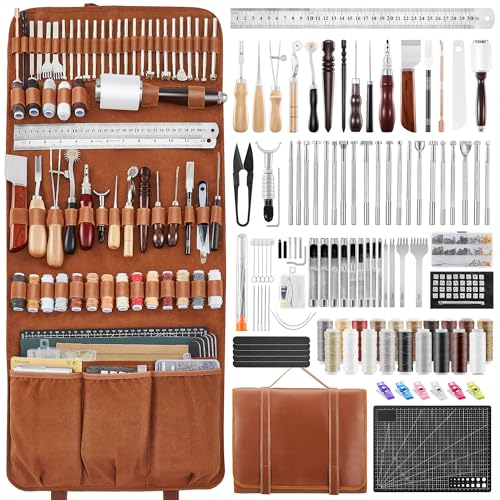 SAKERNEO Leather Working Tools Max KitA big kit you grow into$99Check price
Leatherworking is one of those hobbies where the tool list is longer than you expect: even a simple hand-stitched wallet needs a way to cut cleanly, mark and punch stitching holes, sew with waxed thread, and finish the edges. Buying each tool individually is slow and adds up fast, which is why an all-in-one starter kit is the smart entry. A good kit bundles the cutting, punching, stitching, and edge tools so you can actually complete a first project instead of waiting on a missing piece.
What separates a fine kit from a great one is the quality of the few tools you use most: the cutting knife, the stitching chisels (which punch evenly spaced holes for a neat saddle stitch), and the edge beveler and burnisher for a clean finish. Bigger kits add more punches, stamps, and hardware. Two things to remember: the kit is the tools, not the material, so you still buy leather and a self-healing cutting mat separately, and hand-stitching is the beginner path, so you do not need a machine.
 Best budget kit
PLANTIONAL Leather Working Tools for Beginners
A genuinely complete starter for pocket money. You get the core tools to cut, punch stitching holes, and hand-sew a first project, along with waxed thread and needles. Nothing here is heirloom quality, but it is enough to make a wallet, card holder, or simple strap and learn the saddle stitch, which is exactly what a first kit should do.
What's good
- Complete core toolset to finish a project
- Includes waxed thread and needles
- Very affordable
- Great for a first-ever project
What's not
- Entry-level tool quality
- Leather and cutting mat not included
 Best for most beginners
Nicpro 85-Piece Leather Tooling Kit
The kit that carries you well past your first project. Nicpro is a trusted craft-kit brand, and this 85-piece set gives you a fuller, better-organised spread of cutting, punching, stitching, and edge tools, plus a storage bag to keep them together. It is the no-overthinking pick: enough range and quality to keep making wallets, belts, and cases without hunting for a missing tool.
What's good
- Fuller, better-organised toolset
- Storage bag keeps everything together
- Trusted craft-kit brand
- Covers most beginner projects
What's not
- Costs more than a bare-bones kit
- Still add your own leather and mat
 Best to grow into
SAKERNEO Leather Working Tools Max Kit
The buy-once kit. This is a large, pro-grade set that adds more punches, stamps, edge tools, and even cutting mats, all in a proper carrying case, so you are equipped for tooled belts, bags, and detailed work, not just simple wallets. More than a first project needs, but if you already know leatherwork is your thing, having the full toolset up front saves piecemeal buying later.
What's good
- Large pro-grade toolset
- Includes cutting mats and a case
- Handles detailed and tooled work
- A kit you will not outgrow soon
What's not
- Premium price for a beginner
- More tools than a first project needs
A starter kit gets you the tools, but you still need leather to work and a self-healing cutting mat to work on. Pick up a piece of veg-tan or a leather scrap pack and a cutting mat alongside the kit, so your first project is not held up. A cutting mat also protects your table and your knife edge.
Which to buy: just want a complete kit to try a first wallet cheaply? The PLANTIONAL set does it all. Want a fuller, better-organised kit that keeps up as you improve? The Nicpro 85-piece is the easy pick. Already sure you love it and want the full toolset for tooled, detailed work? The SAKERNEO Max kit.
Before you buy
Buy leather and a self-healing cutting mat alongside the kit. The kit is tools only.
Start with a simple project (a card holder or wallet) to learn cutting, punching, and the saddle stitch.
Learn the saddle stitch by hand first. It is stronger than machine stitching and needs no machine.
Stitching chisels that punch evenly spaced holes make neat stitching far easier than an awl alone at first.
Leatherworking kit questions
What tools does a beginner leatherworker need?
Do I need a sewing machine for leatherwork?
What else do I need besides the kit?
What is the saddle stitch?
What leather should a beginner start with?
Are big multi-piece kits worth it?
For most beginners the Nicpro 85-piece kit is the pick: a fuller, well-organised toolset that keeps up as you improve. Just want to try a first wallet cheaply? The PLANTIONAL kit is complete and inexpensive. Already sure you love it and want the full range for tooled work? The SAKERNEO Max kit. Whatever you choose, remember to buy leather and a cutting mat too.
Ready to actually do it?
The first leatherworking quest takes an evening, and it tells you whether the gear was worth it better than any review can.
Start LeatherworkingThe HobbyStack editorial team researches each guide against manufacturer specifications, published resources and practitioner sources. Every product is checked for availability and described against its current listing before publication, and prices are re-checked when guides are updated.
About our editorial process →More gear guides
All guides
Best Beginner Weaving Loom (2026): 3 Rigid-Heddle Looms to Start On
For learning to weave, the loom to start on is a rigid-heddle loom. It is simple, affordable, and quick to set up compared to a big floor loom, and you can weave real scarves, towels, and cloth on it within a day. The main choices are size, brand, and whether it folds. All three picks here are proper rigid-heddle looms from the two names weavers trust, from a complete starter kit to a folding loom you grow into.
Best Beginner Sewing Machine 2026: Brother vs Janome vs Singer
The first sewing machine is the difference between sewing as a satisfying hobby and sewing as the thing you tried for a month. Here's how to pick a beginner machine that actually works, plus the brands and models to skip.

Best Fabric Marking Tools (2026): Marks That Come Out Again
Every marking tool is a trade between two failure modes: a mark that disappears before you have sewn it, and a mark that will not come out afterwards. There is no tool that avoids both on every fabric, which is why experienced sewers own several and always test on a scrap first. The one that ruins a garment is usually the one nobody tested.

Best Fabric Shears for Beginners (2026): 3 Real Picks
There is one rule that matters more than which shears you buy: they never touch paper. Paper dulls a fabric blade fast, and a dull blade stops cutting cloth and starts pushing it, so your line wanders and the edge frays. That single habit separates shears that stay sharp for years from a pair that feels cheap within a month, and it is why sewers guard their fabric scissors and label them. Beyond that, the choices are simple: length, weight, and whether the handle suits your hand. Here are three good pairs and who each is actually for.

Best Seam Ripper (2026): The Tool That Saves the Garment
Unpicking is not a sign of failure; it is most of sewing. Every fitted garment involves stitching something, trying it, and taking it apart again, and the tool that does that badly will put a hole in fabric you have already cut and cannot replace. A seam ripper is two pounds of insurance on a project worth considerably more.

Best Sewing Machine Needles (2026): The Cheapest Fix for Bad Stitching
Skipped stitches, puckering, snapping thread and a machine that suddenly sounds wrong are almost always the needle, and almost never the machine. Needles are consumable — they blunt, bend a fraction and develop burrs long before they look damaged — and most people sewing badly are sewing with a needle that should have been binned months ago.