Best Remote Shutter Release (2026): Check the Mount Before Anything Else
At macro magnifications, pressing the shutter button is enough to blur the shot. Depth of field is measured in millimetres and any vibration you introduce is magnified along with the subject, which is why a remote release is not a convenience here the way it is in normal photography. The catch is that these are not universal, and the compatibility list is the whole purchase.
HobbyStack may earn a commission from links on this page at no extra cost to you. Our picks are chosen on merit; the commission helps fund the research.
- Check the compatibility list for your exact body. These are not universal and adapters are model-specific.
- At macro magnification, touching the camera is enough to blur the frame.
- An intervalometer is the feature worth paying for — focus stacking, timelapse, long exposures.
- Bulb mode needs a release that can hold the shutter open. Most cameras cannot alone.
- A 2-second self-timer is the free version, and enough for a lot of work.
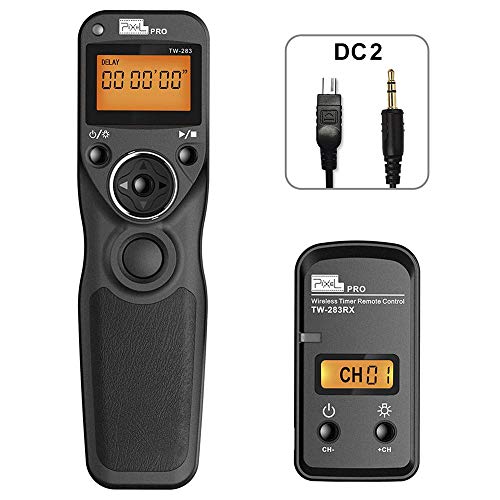 Our pickPixel TW-283 WirelessMost people$40Check price
 Vello FreeWave MicroMinimal kit$73Check price
 Nikon MC-36AAbsolute reliability$165Check price
Compatibility is the whole decision
Remote releases connect through a proprietary port, and manufacturers change it between model generations for no reason a photographer benefits from.
Nikon alone uses several: the DC2 connector on enthusiast bodies, the ten-pin on professional ones, and different arrangements again on parts of the Z line. Canon splits between the E3 sub-mini jack and the N3 connector. Sony has its own multi-terminal.
Which is why the Pixel listing here reads like a catalogue — it lists the bodies it fits and then, unusually and helpfully, lists bodies it explicitly does not: the D3400, Z5II, Z50II, Z50, Z30, Zf and Zfc.
Read that list for your exact body before buying anything. Not the series, the model. A remote that fits a Z6 and a Z7 may well not fit a Z50, and the two look similar in a shop.
Bluetooth and app control is the alternative on newer bodies, using the manufacturer's own app. It avoids the connector problem and adds latency, another battery, and a phone you have to keep unlocked — which is why hardware releases persist.
And if in doubt, the 2-second self-timer is built into every camera ever made and costs nothing.
What an intervalometer buys you
A plain release fires the shutter. An intervalometer schedules it, and that is where the real capability is.
Focus stacking is the macro application. Depth of field at 1:1 magnification can be under a millimetre, so a single frame has almost nothing sharp in it. The technique is to take many frames at slightly different focus distances and combine them, and doing that by hand introduces vibration on every shot. A release that fires a set number of frames on a schedule lets you move focus and let it settle.
Long exposures beyond 30 seconds need bulb mode, where the shutter stays open as long as the release holds it. Most cameras top out at 30 seconds on their own dial, so anything longer is a release-only capability. The Pixel here times bulb exposures up to 99 hours, 59 minutes and 59 seconds.
Timelapse is the same mechanism pointed at intervals rather than duration.
Delay avoids the vibration of your own hand entirely.
The Pixel supports autofocus, single, continuous, bulb, delay from 1 to 59 seconds, and 1 to 99 shots with repeat scheduling — which is a full intervalometer at a price where many releases are just a button.
 Best for most people
Wireless Remote Shutter Compatible
A wireless release with a complete intervalometer at the price most brands charge for a plain button, which is what makes it the pick. It does autofocus, single and continuous shooting, bulb, delay from 1 to 59 seconds, and scheduled shooting with timer, interval and repeat — up to 99 hours 59 minutes 59 seconds and 1 to 99 shots — so focus stacking, timelapse and long exposures are all covered by one device. Range is over 80 metres with 30 selectable channels to avoid interference from other remotes at the same location. The compatibility list is long and, unusually, it also states what does not fit: D3400, Z5II, Z50II, Z50, Z30, Zf and Zfc. Check your exact body against both lists.
What's good
- Full intervalometer at a plain-remote price
- Bulb timing to 99h59m59s and 1-99 shots
- 80m+ range with 30 channels against interference
- Listing states incompatible bodies as well as compatible
What's not
- Nikon mount only — check your exact model
- Explicitly not compatible with several Z bodies
- Two units to keep charged and not lose
- Menu takes some learning
 Best minimal kit
Vello FreeWave Micro Wireless Remote Shutter Release
A very compact wireless release, and size is genuinely the argument — a macro kit in the field is already a camera, a lens, a tripod, a diffuser and probably a flash, and a remote small enough to live in a pocket is a remote you have with you. The FreeWave Micro is a fraction of the bulk of a full intervalometer unit and does the core job reliably: trigger the shutter without touching the camera. Vello have a solid reputation for build. What you give up against the Pixel is the scheduling: no full intervalometer, so focus stacking sequences and timelapse need doing another way. It is twice the price for a smaller, simpler device, which is a real trade rather than an upgrade.
What's good
- Very small — genuinely pocketable in a field kit
- Reliable triggering with a solid build
- Less to fumble with cold hands
- Simple enough to need no manual
What's not
- No full intervalometer or scheduling
- Twice the Pixel for fewer features
- Model-specific, so check your body
- Small enough to lose
 Best for reliability
Nikon MC-36A Multi-Function Remote Shutter Release Cord
Nikon's own wired multi-function release, and wired is the point rather than a limitation. A cable cannot lose a radio link, cannot be interfered with by someone else's remote at the same location, and does not need its own battery — so for a sequence that has to work, unattended, for hours, there is nothing to go wrong. It carries the same class of functions as a good third-party intervalometer: shutter lock for bulb, interval timing and long-exposure scheduling. Being first-party, compatibility with the bodies it lists is certain rather than probable. Two honest caveats: it is over four times the Pixel for broadly the same capability, and a cable running from your camera is one more thing to snag on a tripod leg in the dark.
What's good
- Wired — no radio link to drop or be interfered with
- No battery of its own to go flat mid-sequence
- First-party, so compatibility is certain
- Shutter lock, interval and long-exposure timing
What's not
- Over four times the Pixel for similar capability
- A cable to snag on tripod legs
- Ten-pin bodies only — not the DC2 range
- Wired means you stay near the camera
Manufacturers change the release connector between generations within the same line. Nikon uses DC2 on enthusiast bodies, ten-pin on professional ones and different arrangements again across parts of the Z range — the Pixel listing here fits a long list and explicitly does not fit the D3400, Z5II, Z50II, Z50, Z30, Zf or Zfc. Look up your specific body before ordering, because "fits Nikon" means nothing.
The rest of not shaking the camera
A remote release removes one source of vibration. At macro magnification there are several more, and they all matter.
Mirror slap on a DSLR is the mirror flipping up immediately before the exposure, and it rings through the camera. Mirror lock-up or exposure delay mode raises it first and waits, and it is the single biggest improvement on a DSLR at high magnification. Mirrorless cameras avoid it entirely.
Shutter shock is the mechanical shutter itself. Electronic first curtain or a fully electronic shutter removes it, and most modern bodies offer one.
The tripod matters more than the head. A light tripod with a heavy macro rig on it will ring at every touch. Weighting the centre column helps; a shorter, wider stance helps more.
Wind is the enemy outdoors, and it moves the subject rather than the camera, so no amount of camera stability fixes it. A windbreak, or waiting, is the only answer.
Flash freezes everything. A short flash duration outruns vibration entirely, which is why so much serious macro is flash-lit rather than tripod-stabilised.
Before you buy
Look up your exact camera model against the compatibility list.
An intervalometer is what you actually want for focus stacking.
Bulb capability if you shoot exposures over 30 seconds.
Try the 2-second self-timer first. It is free and often enough.
Turn on mirror lock-up or electronic first curtain as well.
Remote release questions
Do I need a remote release for macro photography?
Will any remote release fit my camera?
What is an intervalometer for?
What else causes blur at macro magnification?
The Pixel TW-283 is the buy: a complete intervalometer — bulb timing, intervals, repeat scheduling — at the price most brands charge for a plain button, which covers focus stacking and long exposures rather than just avoiding a finger press. The Vello is smaller and simpler for twice as much, which suits a minimal field kit. The Nikon MC-36A is wired, so nothing can drop out mid-sequence, at over four times the price. Before any of that, check your exact model against the list.
Ready to actually do it?
The first macro photography quest takes an evening, and it tells you whether the gear was worth it better than any review can.
Start Macro PhotographyThe HobbyStack editorial team researches each guide against manufacturer specifications, published resources and practitioner sources. Every product is checked for availability and described against its current listing before publication, and prices are re-checked when guides are updated.
About our editorial process →More gear guides
All guides
Best Beginner Mirrorless Camera 2026: Canon EOS R50 vs Sony ZV-E10 II
The best beginner mirrorless camera teaches you photography, not menus. It needs reliable autofocus, a grip that makes sense, and enough image quality to reward good technique. The Canon EOS R50 with its kit lens is the right camera for most people who are just starting out. Here's why, and who should buy something different.

Best Camera Bag for Beginners (2026): How You Get At Your Kit
Most people buy a camera bag on capacity and regret it on access. The question that decides whether a bag gets used is how you reach the camera: if getting the body out means putting the bag on the ground and unpacking it, you will leave the camera in the bag and stop taking pictures. Everything else — padding, weather cover, laptop sleeve — is secondary to that.

Best Camera Tripod for Beginners (2026): 3 Real Picks
A tripod unlocks the shots you cannot get handheld: long exposures, low light, sharp landscapes, self-portraits, and steady video. The good news is a beginner does not need a $600 one. Any stable tripod that holds your camera perfectly still does the core job; what more money buys is less weight, faster setup, and a sturdier hold as your gear grows. Here are three across the range, plus what actually matters when you choose.

Best First Camera Lens for Beginners (2026): 3 Nifty Fifties by Mount
The kit zoom that came with your camera is fine, but a cheap, fast prime lens is the upgrade that suddenly makes your photos look better. The classic first buy is a 'nifty fifty': a 50mm f/1.8 lens that is sharp, tiny, brilliant in low light, and cheaper than almost anything else you can put on your camera. The one catch is that lenses are not universal, so you have to match the lens to your camera's mount. Here are three good first primes in ascending price, plus how to find the right one for your camera brand.
Best SD Card for Photography 2026: SanDisk Extreme PRO vs Ultra vs Sony TOUGH
A memory card is the one piece of gear that, if it fails, costs you the photos themselves: so it's worth getting right, even though it's the cheapest thing in the bag. The good news: the choice comes down to speed class, and most photographers need far less than the marketing implies. A fast V30 UHS-I card handles burst stills and 4K; UHS-II is a video upgrade most cameras can't even use. Here's the honest breakdown.

Best Audio Interface for Beginners (2026): 3 Picks to Record Clean Audio
An audio interface is the box that turns your microphone or guitar into clean, professional-sounding audio your computer can record. It plugs in over USB and does two jobs a laptop cannot: it powers proper microphones and converts the sound with far less noise and latency than your built-in socket. For most beginners the honest truth is that the differences between the good ones are small, so you are really choosing how many inputs you need and how much you want to spend. Here are three that will not let you down, from a simple one-mic setup to a step-up with warmer, more characterful sound.