Best Aquarium Water Test Kit (2026): The 5-in-1 Strips Do Not Test Ammonia
The thing that kills fish in a new tank is invisible, has no smell, and is not on the strip most beginners buy. Ammonia is what a cycling tank produces first and what does the damage, and the popular 5-in-1 strips test five things that are not it. Knowing that before you buy is most of the value of this page.
HobbyStack may earn a commission from links on this page at no extra cost to you. Our picks are chosen on merit; the commission helps fund the research.
- The 5-in-1 strips test pH, hardness, nitrite and nitrate. Not ammonia.
- Ammonia is the one that kills during cycling. Any tank under three months old needs it.
- Liquid kits are slower and considerably more accurate than strips.
- Shake the ammonia and nitrate reagents hard. Not shaking is the top source of false readings.
- Reef tanks need a different set of tests entirely: alkalinity, calcium, magnesium.
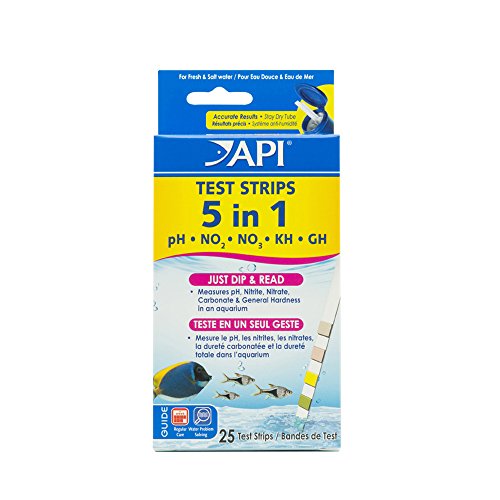 API 5-in-1 StripsQuick weekly checks$13Check price
 Our pickAPI Freshwater MasterEvery freshwater tank$36Check price
 Salifert Master ReefReef tanks$87Check price
The nitrogen cycle, because that is what you are testing for
Fish produce waste, and uneaten food rots. Both release ammonia, which is highly toxic and burns gills at a fraction of a part per million.
In an established tank, bacteria living in the filter convert that ammonia into nitrite. Nitrite is also toxic. A second population of bacteria converts nitrite into nitrate, which fish tolerate at reasonably high levels and which you remove with water changes.
That chain is the nitrogen cycle, and in a brand new tank none of those bacteria exist yet. It takes several weeks for them to establish, and during that window ammonia and then nitrite spike to lethal levels while the water still looks completely clear.
This is what kills most first fish, and it has a name: new tank syndrome. The fish die and the owner blames the shop.
The only way to see any of it is a test kit. So the parameters that actually matter, in order of importance:
- Ammonia — should be 0. Anything above 0.25 ppm is an emergency
- Nitrite — should be 0. Also an emergency
- Nitrate — under about 40 ppm, lowered with water changes
- pH — stability matters far more than the exact number
A tank is cycled when it processes ammonia to zero and nitrite to zero within 24 hours, and nitrate is climbing.
Strips versus liquid, honestly
Test strips are a dipstick with reagent pads. Dip, wait, compare to a chart. They take fifteen seconds and they are genuinely useful for a quick weekly check on a tank you already know is stable.
The problems are real though. Pads degrade once the tube is opened, humidity ruins them, the colours are close together at the low end where precision matters most, and readings drift if you leave the strip too long.
The bigger issue on this page is coverage. The 5-in-1 strips test pH, carbonate hardness, general hardness, nitrite and nitrate. There is no ammonia pad. So during the exact period when ammonia is the thing endangering your fish, the popular strip cannot see it. API sell separate ammonia strips, and plenty of people never realise they need them.
Liquid kits use reagents in a test tube against a printed colour card. They take five minutes, they are fiddly, and they are much more accurate, particularly in the low ranges that decide whether a fish lives.
The API Freshwater Master covers pH, high range pH, ammonia, nitrite and nitrate, which is the full cycling picture, and it stretches to around 800 tests. Per test it is far cheaper than strips.
Use both. Strips for the fast weekly glance, liquid whenever a number looks wrong or a fish looks unhappy.
 Best for quick weekly checks
API 5-in-1 Test Strips Freshwater and Saltwater Aquarium Test
Dip, wait, compare. Fifteen seconds against five minutes for a liquid kit, which is the difference between checking weekly and meaning to. It covers pH, carbonate and general hardness, nitrite and nitrate in both fresh and saltwater. The gap is the important one though: there is no ammonia pad, so this cannot watch a cycling tank. Pads also degrade once the tube is open, so replace them rather than trusting an old batch.
What's good
- Fifteen seconds, so you actually do it weekly
- Covers hardness, which the liquid master kit does not
- Works in fresh and saltwater
- Cheap enough to keep two tubes
What's not
- No ammonia test — the one that matters most
- Colour blocks are close together at low readings
- Pads degrade once opened and in humidity
- Dearer per test than the liquid kit
 Best for every freshwater tank
API Freshwater Master Test Kit 800-Test Freshwater Aquarium
The kit almost every experienced freshwater keeper owns, and the one to buy before you buy fish. Seven reagent bottles, four glass tubes and a colour card cover pH, high range pH, ammonia, nitrite and nitrate, which is exactly the set you need to watch a tank cycle and to diagnose a sick one. Around 800 tests in the box, so the cost per test is very low. Freshwater only, and it takes five minutes.
What's good
- Covers the full cycling picture including ammonia
- Around 800 tests, so pennies per reading
- Far more accurate than strips at low readings
- Glass tubes and a colour card, nothing to expire quickly
What's not
- Five minutes per full round of tests
- Freshwater only, no use on a reef tank
- Colour matching is subjective in poor light
- No hardness tests, unlike the strips
 Best for reef tanks
Salifert Master Reef Testing Combo Kit - Saltwater Aquariums
A saltwater kit, not a better freshwater one, and worth understanding before you buy. Corals care about a different set of numbers, so this covers calcium, alkalinity, magnesium, phosphate, nitrate and pH: six Salifert kits in one box. Alkalinity and calcium in particular need watching closely, because coral skeletons consume both and a swing in either shows up as bleaching. Overkill and mostly irrelevant for a freshwater community tank.
What's good
- Covers the parameters corals actually consume
- Salifert is the reference brand for reef testing
- Six kits together costs less than buying separately
- Titration tests are precise where it matters
What's not
- Saltwater only — wrong kit for a freshwater tank
- No ammonia test in the combo
- Considerably dearer
- Titration takes practice to read consistently
The commonest cause of a wrong reading on the API kit is not shaking the second nitrate bottle hard enough. The reagent settles into a solid layer at the bottom, and the instructions ask for 30 seconds of vigorous shaking, which almost nobody does. Bang it on a hard surface first, then shake properly. An unshaken bottle 2 reads nitrate far lower than reality, and people conclude their tank is fine when it is not.
Testing so the numbers mean something
Test at the same time of day. pH swings across a day in a planted tank as plants take up and release carbon dioxide. A reading at 8am and one at 8pm are not comparable, and the difference alarms people unnecessarily.
Rinse the tubes with tank water, not tap water and never with soap. Residue throws the next reading and soap is a disaster.
Read against white in daylight. The colour card is printed for natural light. Under a warm bulb, ammonia at 0.25 and 0 look the same, which is exactly the distinction you need.
Write it down. A single reading tells you almost nothing. A column of readings tells you whether the tank is cycling, stalled, or drifting. A notes app is fine.
Test before and after a water change when something is wrong, so you know whether the change helped.
Check your tap water too. Some supplies come out with nitrate already in them, and chloramine reads as ammonia on the API test, which sends people chasing a problem their dechlorinator has already neutralised.
Replace liquid kits every few years. The reagents do expire, and a kit that has sat in a warm cupboard for five years will lie to you confidently.
Before you buy
Confirm the kit tests ammonia if the tank is under three months old.
Liquid for accuracy, strips for speed. Most people benefit from both.
Freshwater and reef need different kits. Check before ordering.
Buy it before the fish, not after something goes wrong.
Check the expiry, and replace liquid reagents every few years.
Aquarium testing questions
Do API 5-in-1 test strips measure ammonia?
Are test strips accurate enough?
What readings should I be aiming for?
Why does my ammonia reading seem wrong?
Buy the API Freshwater Master Test Kit, and buy it before the fish. It covers ammonia, which is the parameter that actually kills, and at around 800 tests it works out cheaper per reading than strips. Add the 5-in-1 strips for fast weekly checks once the tank is settled, since a test you do in fifteen seconds is a test you will actually do. Go to Salifert only if you are keeping corals.
Ready to actually do it?
The first aquarium keeping quest takes an evening, and it tells you whether the gear was worth it better than any review can.
Start Aquarium KeepingThe HobbyStack editorial team researches each guide against manufacturer specifications, published resources and practitioner sources. Every product is checked for availability and described against its current listing before publication, and prices are re-checked when guides are updated.
About our editorial process →More gear guides
All guides
Best Aquarium Filter for Beginners 2026: Sponge vs HOB vs Canister
A filter is the lungs of an aquarium: it keeps the water clear and, more importantly, houses the bacteria that keep your fish alive. The first decision is the type, and it's driven by your tank size: a sponge filter for small tanks, a hang-on-back for most beginner tanks, or a canister for big and planted ones. Here are three picks across that divide.

Best Aquarium Heater (2026): The One Component That Fails Dangerously
Every other piece of aquarium equipment fails by stopping. A heater can fail by staying on, and a stuck-on heater will cook a tank of fish in a day. That is why the interesting question is not which heater warms water — they all do — but which one fails safely and lets you check that it is telling the truth.

Best Beginner Aquarium Starter Kit 2026: 3 Picks Reviewed
The starter kit is the foundation of your first tank: the tank, hood, light, filter, and heater all in one box. Picking the right one is the difference between a stable tank you enjoy and a stressful project you abandon by month three.

Best Air Pump for Hydroponics (2026): Roots Drown Before They Starve
A plant in soil gets oxygen to its roots through air pockets between particles. A plant with its roots in a bucket of water has none of that, and roots without oxygen suffocate and rot within days. In deep water culture the air pump is not an accessory, it is the thing standing between your plants and root rot.

Best Grow Light for Hydroponics (2026): Coverage, Not Watts
Grow lights are sold on wattage, which is the one number that tells you almost nothing about whether plants will grow. Watts measure electricity consumed; what a plant responds to is how much usable light actually lands on its leaves. Two lights drawing the same power can differ enormously on that, and the specification that describes it is on the datasheet rather than the box.

Best Hydroponic Grow Kit for Beginners (2026): 3 Countertop Systems
A countertop hydroponic garden is the easiest way into growing without soil: you drop seed pods into a water reservoir, the built-in LED light and pump do the work, and you get fresh herbs and greens in a few weeks. The two things that matter most are the number of pods (how many plants) and whether you want to tend it yourself or let it automate. Here are three good ones, from a simple herb garden to a large app-controlled system.