Best Automata Kit (2026): A Cam Is a Shape That Stores a Movement
An automaton is a machine that turns one simple input, usually a crank, into a specific sequence of movement. The clever part is almost always a cam: a shape cut so that as it rotates, a follower riding on its edge rises and falls in exactly the pattern you designed. The movement is stored in the shape.
HobbyStack may earn a commission from links on this page at no extra cost to you. Our picks are chosen on merit; the commission helps fund the research.
- Cams convert rotation into a chosen up-and-down pattern. The shape is the program.
- Laser-cut plywood kits teach the mechanisms with no workshop at all.
- Dry-fit everything before any glue. Most of these kits need none.
- Sand the char and burrs off every part or the gears will bind.
- Wax the gear teeth. Friction is what stops these models running.


The four mechanisms worth understanding
Almost every automaton is built from a small number of motion converters, and once you can name them you start seeing them everywhere.
The cam. An irregular disc on a rotating shaft, with a follower resting on its edge. As the cam turns, the follower rises and falls according to the cam's profile. The shape determines the motion, which means you can store a slow rise and a sudden drop, or a pause, simply by how you cut the edge. This is the heart of most figure automata.
The crank. Converts rotation into back-and-forth linear motion, or the reverse. A bent axle driving a connecting rod.
The linkage. Rigid bars pinned together so that moving one moves the others in a fixed relationship. Linkages are how a single input becomes a walking leg or a flapping wing.
The gear train. Changes speed and direction. Two gears meshing turn opposite ways; different tooth counts trade speed for torque. A worm gear turns rotation through ninety degrees and will not drive backwards, which is useful when you want something to hold position.
Laser-cut plywood kits are an unusually good way to learn all four, because the mechanism is exposed rather than hidden in a case. You can watch the cam lift the follower and the gear train step down the speed, which is a very different kind of understanding from reading about it.
They are also a bridge. People who build a few kits and want to design their own move to cutting their own cams from plywood or MDF, and the kit has already taught them what a cam profile does.
Building one without breaking it
These kits are precision-cut plywood sheets, and the assembly has a few steps that are not in most instructions.
Sand every part before fitting it. Laser cutting leaves two problems: a thin burnt char layer, and small burrs where the part joined the sheet. Both add friction, and friction is what stops these models running. A light pass with fine paper on each piece, especially on gear teeth and axle holes, makes the difference between a model that spins freely and one that stalls.
Punch parts out carefully. Twist rather than pull, and cut any stubborn tab with a craft knife instead of forcing it. Thin plywood splits along the grain.
Dry-fit before glue, and check whether you need glue at all. Most UGEARS and ROKR kits are designed as friction-fit and specify no adhesive, because a glued joint in the wrong place locks a mechanism that is supposed to move. Where glue is called for, use it sparingly — wood glue swells plywood and a swollen axle hole seizes.
Wax the moving surfaces. Most kits include a small block of wax or candle stub for exactly this. Rub it on gear teeth and axles. It is not optional on a model powered by a rubber band or a light spring, because the drive has very little force to spare.
Test each sub-assembly as you go. Turn it by hand and confirm it moves freely before building the next stage onto it. Finding a bound gear at step forty is a disassembly job.
Keep the sheets and the diagram. Spare parts are often on the sheet, and a part number you can still read saves a lot of guessing.
Expect four to ten hours depending on the kit, spread over evenings.
 Best for a first kit
UGEARS Old Clock Tower 3D Wooden Puzzles for Adults - Wooden Model Kits
A small geared mechanism that is the right size to find out whether this appeals before committing an evening a night for a week. It has a working gear train and a visible mechanism, so it teaches the same principles as a larger kit in a fraction of the build time, and UGEARS cutting tolerances are good enough that parts fit without forcing. Small enough that there is less to admire when finished, and less to go wrong.
What's good
- Short build, so low commitment
- Working gear train with a visible mechanism
- UGEARS tolerances mean parts fit cleanly
- Cheapest way to learn whether you enjoy it
What's not
- Less impressive finished than a larger kit
- Fewer mechanisms to learn from
- Small parts are fiddly for large hands
- Still needs sanding and waxing
 Best for most builders
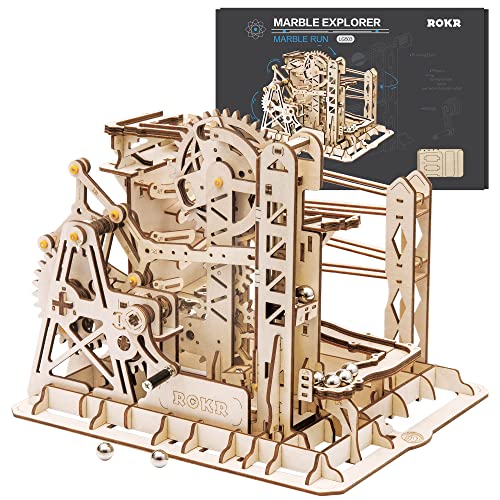
ROKR 3D Assembly Wooden Puzzle Brain Teaser Game Mechanical Gears Set Model Kit Marble Run Set Unique Craft Kits Christmas/Birthday/Valentine's Gift for Adults & Kids Age 14+(LG503-Lift Coaster)
A mechanical gear model built around the gear train itself, which makes it the most instructive of the three: the whole point of the design is that you can see tooth counts trading speed for torque and watch direction reverse at each mesh. ROKR kits are friction-fit and need no glue, so a mistake is recoverable. A long enough build to be a project across several evenings without becoming a commitment you resent.
What's good
- Built around the gear train, so it teaches directly
- Friction-fit, so mistakes are recoverable
- Long enough to be a proper project
- Mechanism stays visible when finished
What's not
- Over twice the small UGEARS kit
- Instructions are diagram-only and terse
- Needs patient sanding of every gear tooth
- Rubber band drive has little force to spare
 Best for something to show
UGEARS Book of Secrets 3D Wooden Puzzles for Adults - Mechanical 3D Puzzle
A mechanism built into a book-shaped case with a puzzle lock, which is a different proposition from the open-frame kits: the appeal is a finished object that sits on a shelf and does something surprising when someone works out how to open it. The mechanism is more involved and the build is correspondingly longer. The trade is that enclosing it hides much of the movement, so you learn a little less about what is actually happening inside.
What's good
- A finished object worth displaying
- More involved mechanism than the smaller kits
- Puzzle lock makes it interactive
- Substantial build across many evenings
What's not
- Enclosure hides much of the mechanism
- Teaches less than an open-frame kit
- Longest and most demanding build here
- Dearest by a clear margin
The commonest complaint about these kits is that the finished model is stiff or stalls, and it is almost always friction rather than a fault. Laser cutting leaves a burnt char layer and small burrs on every part. Give each piece a light pass with fine paper, paying attention to gear teeth and axle holes, and rub the included wax on every moving surface. A rubber-band drive has very little force to spare.
Going from kits to designing your own
Build two or three kits first. They teach cams, cranks, linkages and gear trains faster than reading does, because you can turn the handle and watch the relationship.
Then cut your own cams. A disc of plywood or MDF with a profile you draw yourself, on a shaft, with a follower resting on it. This is the whole of automata design in one component, and a hand-cut cam with a coping saw works perfectly well.
Draw the motion you want first, as a graph of height against rotation, then wrap that graph around a circle. That is literally how a cam profile is generated, and doing it once makes the idea permanent.
Keep the drive simple. A hand crank is the traditional input and it sidesteps every problem a motor introduces. Most of the charm of an automaton is in someone turning the handle themselves.
Mind the friction budget. A hand-cranked mechanism has a lot of force available; a spring or rubber band has almost none. Design accordingly.
Look at Cabaret Mechanical Theatre's work. The modern automata tradition is well documented and the mechanisms are deliberately explained rather than hidden.
Expect the first original design to fail. Something will bind, and finding out where is the actual skill.
Before you buy
Start small. A short build tells you whether you enjoy the process.
Open-frame kits teach more than enclosed ones.
Check whether glue is required. Most are friction-fit.
Plan to sand every part and wax every moving surface.
Keep the part sheets and the diagram for spares.
Automata kit questions
What is a cam and why does it matter?
Do these kits need glue?
Why is my finished model stiff?
How long does a kit take to build?
Best Rotary Tool and Flex Shaft
What you reach for when you start cutting your own cams.
The ROKR gear model is the one to build: it is designed around the gear train itself, so watching it work teaches you what tooth counts and meshes actually do, and friction-fit assembly means mistakes are recoverable. Start with the small UGEARS clock tower if you want to test the water in an evening. The Book of Secrets is the one to display. Sand everything and use the wax.
Ready to actually do it?
The first automata quest takes an evening, and it tells you whether the gear was worth it better than any review can.
Start AutomataThe HobbyStack editorial team researches each guide using practitioner communities, published resources, and direct input from active hobbyists. Every guide is reviewed for accuracy before publication and updated when practices change.
About our editorial process →More gear guides
All guides
Best Beginner MIG Welder for Metal Sculpture (2026): 3 Real Picks
A MIG welder is the tool that turns a pile of steel into a single joined form, and MIG is the right process to start with because it is by far the easiest arc to learn: pull the trigger, wire feeds automatically, and a bead lays down. Most beginner sculpture is thin mild steel that a 110-volt machine handles from a normal outlet. The real choice is how far you plan to take it. Here are three good ones, all in stock, plus the gear beginners forget.

Best Soap Carving Tools (2026): Loop Tools Cut, Knives Only Slice
A knife slices soap, which is fine for the first rough shape and useless for a curve. To hollow a concave surface you need a loop or ribbon tool that shaves a thin controlled ribbon away, and that single tool change is what separates a carved bar from a whittled one.

Best Coin Collecting Books (2026): Learn to Grade Before You Learn Prices
A coin price guide is useless until you can grade. The same 1909 cent might be worth a few dollars or several thousand depending on condition, and every figure in every price book is quoted per grade. Learning to read the prices before you can judge the coin is how people overpay confidently.

Best Candle Pouring Pitcher (2026): The Spout Is the Whole Tool
Everything else in candle making tolerates improvisation. The pour does not. You are moving hot liquid wax into a narrow-mouthed jar around a centred wick, and a pot without a proper spout dribbles down the outside, floods the wick and leaves you cleaning wax off a worktop instead of making candles.

Best Dog Agility Jumps (2026): Height Comes From the Dog, Not the Box
Jump height is set by the dog, measured at the withers, and every competitive class in every organisation works that way. Guessing it is not a minor error: a dog repeatedly jumping above its class height takes impact through shoulders and spine that it has no way of telling you about.
Best Dip Pen Nibs (2026): New Nibs Are Coated and Will Not Take Ink
A brand new nib dipped in ink will often refuse to write, and almost every beginner concludes they have bought a dud. Nibs ship with a thin oil or lacquer coating to stop them rusting in the packet, and ink beads off it. Until you remove that coating, nothing is going to work.