Best Chef's Knife for Beginners 2026: Victorinox vs Wüsthof vs Shun
A chef's knife is the most important tool in any kitchen, and the best news for beginners is that the cheap one is genuinely excellent. The Victorinox Fibrox is what culinary schools and professional kitchens use, for around $50. So the real question isn't which knife cuts best, a sharp one of any of these does, but whether you want to spend up for a German or Japanese knife's feel. Here's the honest breakdown.
HobbyStack may earn a commission from links on this page at no extra cost to you. Our picks are chosen on merit; the commission helps fund the research.
- For almost everyone, the Victorinox Fibrox 8-inch (~$47) is the pick — the same sharp, tough, comfortable knife that diners, hospital kitchens, and test kitchens reach for. It out-cuts knives costing four times more, survives abuse and the dishwasher, and its slightly soft steel forgives the technique mistakes every beginner makes. Buy this and stop thinking about knives.
- Want an heirloom that holds its edge longer? The Wüsthof Classic 8-inch (~$170) is the German pick — heavier, forged, with harder steel that stays sharp longer and a full bolster finger guard. The buy-once-for-life knife, if you want one.
- Prefer a sharper, lighter blade? The Shun Classic 8-inch (~$161) is the Japanese pick — harder steel taken to a finer, keener edge, lighter in the hand, beautiful. The trade is it's more delicate (that hard edge can chip) and asks for more careful technique.
- The real decision isn't budget — it's whether you need more than the Victorinox (you probably don't). If you do step up, it's a style choice: German (Wüsthof — heavier, durable, forgiving) vs Japanese (Shun — lighter, sharper, more delicate). Both cut beautifully; neither makes you a better cook than a sharp Victorinox does.
- Skip: a knife-block set (you use one knife for 90% of tasks — buy one good chef's knife, not twelve mediocre ones); any knife you'll be afraid to use hard; and the belief that a pricier knife cuts better. A sharp cheap knife beats a dull expensive one every time — which is why the real upgrade is a honing steel and learning to sharpen.

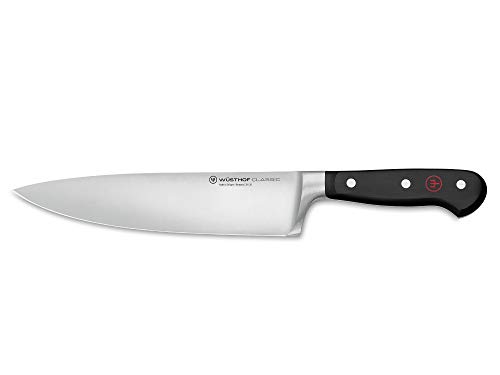

You don't need an expensive knife — but if you want one, German or Japanese?
The most important truth about chef's knives: the cheap one is genuinely excellent. The Victorinox Fibrox is what culinary schools issue, what diners and hospital kitchens run on, and what test kitchens repeatedly rank at or near the top — for around $47. It's sharp out of the box, light, comfortable for hours of prep, and tough enough to survive the mistakes beginners make. For the overwhelming majority of home cooks, it isn't a stepping stone — it's the destination.
So when does spending more make sense? Only when you want a nicer object, not a better cut — and then the choice is a fork in the road:
German knives (like the Wüsthof Classic) are heavier, forged from a single bar of tougher steel, usually with a full bolster — the metal collar at the heel that acts as a finger guard. They feel substantial, power through dense vegetables and the occasional bone, hold an edge longer than the Victorinox, and forgive rough treatment. They're the heirloom-grade workhorse.
Japanese knives (like the Shun Classic) take a harder steel to a finer, sharper edge, on a lighter, thinner blade. They're a joy for precise, delicate work and glide through food. The trade-offs are real: that hard, keen edge is more prone to chipping if you twist it or hit bone, and it asks for more careful technique and more attentive sharpening.
Here's the part nobody selling you a $200 knife will say: a sharp Victorinox cuts better than a dull Wüsthof or Shun. The single biggest upgrade to your cutting isn't a pricier knife — it's keeping whatever knife you own sharp. Buy the Victorinox, add a honing steel, learn to sharpen, and only then decide whether you want to spend up for the feel.
 Best for almost everyone
Victorinox Fibrox Pro 8-Inch Chef's Knife
The knife the pros actually use. The Victorinox Fibrox is the chef's knife culinary schools issue and professional kitchens run on, and it earns it: razor-sharp out of the box, light and comfortable through a long prep session, and built around a tough, slightly soft steel that flexes instead of chipping when a beginner twists it or clips a bone. The textured Fibrox handle stays grippy when wet, it shrugs off the dishwasher (though hand-washing any knife is kinder), and at around $47 it's cheap enough to treat as a tool rather than a treasure. It out-performs knives several times its price in blind tests — buy it, keep it sharp, and you may never need another.
What's good
- The sharp, tough knife pros and test kitchens choose
- Soft-enough steel forgives beginner technique
- Light and comfortable for long prep sessions
- A quarter the price of premium knives — and cuts as well
What's not
- Stamped, not forged — less heft and 'presence'
- Softer steel needs honing more often than premium
- Plain looks; no heirloom feel
 The German heirloom
Wusthof Classic 8-Inch Chef's Knife
The buy-once-for-life German knife. The Wüsthof Classic is forged from a single bar of steel, noticeably heavier and more substantial than the Victorinox, with harder steel (around 58 HRC) that holds its edge longer between sharpenings and a full bolster that doubles as a finger guard. It powers through dense squash, root vegetables, and the occasional bone with authority, and it's tough enough to forgive a beginner while feeling like a serious tool. You're not buying sharper cuts than a freshly-honed Victorinox gives — you're buying heft, edge retention, and an heirloom you'll hand down. If you want one knife to keep for thirty years, this is it.
What's good
- Forged, substantial, beautifully balanced
- Harder steel holds its edge longer
- Full bolster finger guard; powers through dense food
- Heirloom-grade — a keep-for-life knife
What's not
- Heavier — some cooks find it tiring
- The full bolster makes full-edge sharpening harder
- Several times the Victorinox for no better cut when both are sharp
 The Japanese pick
Shun Classic 8" Chef's Knife
The sharpest, most refined blade here. The Shun Classic is a Japanese knife: harder steel taken to a finer, keener edge, on a lighter, thinner blade with a beautiful Damascus-clad finish. It glides through food and excels at precise, delicate work — once you've used a properly sharp Japanese knife, the difference in finesse is obvious. The trade-offs are equally real: the hard edge is more prone to chipping if you twist it, hit bone, or cut on the wrong board, and it rewards careful technique and regular, attentive sharpening. For an enthusiast who'll treat it well, it's a joy; for a rough-and-ready beginner, it's more knife than the job needs.
What's good
- Harder steel, finer edge — exceptionally sharp
- Light and thin — superb for precise, delicate work
- Beautifully made, with a Damascus-clad blade
- The enthusiast's knife
What's not
- Hard edge can chip if twisted or used on bone
- Asks for careful technique and regular sharpening
- More knife than most beginners need
If you buy one thing alongside your knife, make it the means to keep it sharp — it matters more than which knife you choose. A blade dulls with use, and a dull knife is both worse to cut with and more dangerous (it slips instead of biting). Get a honing steel (~$15) and give the edge a few passes before each session to keep it true, and learn to actually sharpen — a whetstone or a pull-through — every month or so. Hand-wash and dry your knife rather than leaving it in the sink or dishwasher, store it on a magnetic strip or in a block (not loose in a drawer), and always cut on wood or plastic — never glass, stone, or the countertop, which wreck any edge. Do this and a ~$${round(B)} Victorinox will out-cut a neglected $200 knife forever.
How to choose between the three
Pick the Victorinox if you want the most knife for the least money — which is almost everyone. It's the sharp, forgiving, pro-grade workhorse that wins blind tests and runs professional kitchens. Buy it, add a honing steel, and you're done.
Pick the Wüsthof if you want a substantial, forged German knife to keep for life — heavier in the hand, longer between sharpenings, with the heft and finger guard that make it feel like a serious tool.
Pick the Shun if you want the sharpest, lightest, most refined blade and you'll treat it with care — a Japanese knife that rewards good technique and regular sharpening with exceptional finesse.
If you're unsure, get the Victorinox. The honest truth of chef's knives is that the cheap one is the right answer for most people; everything above it is about how the knife feels to own, not how well it cuts.
Before you buy
Buy one chef's knife, not a block set. An 8-inch chef's knife handles ~90% of kitchen tasks; a set is mostly knives you won't use, plus markup. Add a paring knife and a serrated bread knife later if you need them.
8 inches is the sweet spot. Long enough to be efficient, short enough to control. Go 6-inch only if your hands are small or counters tight; 10-inch is for big hands and big jobs.
Hold it before choosing between premium knives. German vs Japanese is mostly about feel — heavy and substantial vs light and nimble. If you can, handle both; the right one is the one that feels good in your hand.
Budget for sharpening. A honing steel and a way to sharpen matter more to your cuts than the knife's price. Factor them in from day one.
Don't fear the cheap knife. The Victorinox isn't a compromise — it's the knife that wins blind tests and runs professional kitchens. Spending more buys feel and longevity, not better cutting.
Common questions about chef's knives
What's the best chef's knife for a beginner?
Are expensive chef's knives worth it?
German vs Japanese chef's knife — which should I get?
What size chef's knife should I buy?
Do I need a whole knife set?
How do I keep my chef's knife sharp?
For almost everyone, the Victorinox Fibrox Pro 8-Inch Chef's Knife is the buy — the sharp, tough, forgiving knife pros and test kitchens choose, for around $47. It is not a compromise. Want a substantial German knife to keep for life? The Wusthof Classic 8-Inch Chef's Knife. Want the sharpest, lightest Japanese blade and you'll baby it? The Shun Classic 8" Chef's Knife. But keep whichever you choose sharp — that, far more than price, is what makes a knife cut.
Ready to actually do it?
The first cooking quest takes an evening, and it tells you whether the gear was worth it better than any review can.
Start CookingThe HobbyStack editorial team researches each guide using practitioner communities, published resources, and direct input from active hobbyists. Every guide is reviewed for accuracy before publication and updated when practices change.
About our editorial process →More gear guides
All guides
Best Dutch Oven 2026: Lodge vs Le Creuset vs Staub (Is the Expensive One Worth It?)
A Dutch oven is the most versatile heavy pot you'll own: braises, stews, soups, and bakery-quality bread. The first thing to know is the one nobody selling you a $400 pot leads with: enameled cast iron cooks nearly the same whatever the badge. So the real question isn't which cooks best, it's what the extra money buys, and whether that's worth it to you.

Best Skillet for Beginners (2026): 3 Real Picks
A skillet is the one pan you'll reach for most, so it's worth getting right, and the honest truth is the best skillet depends on what you cook. Cast iron is cheap, lasts forever, and sears beautifully but is heavy and needs care; nonstick makes eggs and delicate food effortless but wears out; carbon steel is the restaurant choice, searing like cast iron but lighter and more responsive. Rather than budget-to-best of one thing, these are three genuinely different pans for three ways of cooking. Here they are, plus how to pick the one that fits your kitchen.
Best Baking Sheet for Beginners (2026): Why Half-Sheet Aluminium Wins
A baking sheet is the most-used pan in most kitchens and the one people spend least time choosing. The cheap ones warp with a bang the first time they hit a hot oven, and a warped sheet cooks unevenly forever after. The fix is not expensive: a heavy half sheet in bare aluminium with a rolled rim, which is what professional kitchens have used for decades.

Best Beginner Stand Mixer 2026: KitchenAid Artisan vs Classic vs Pro 600
Stand mixers are a one-time purchase that lasts decades. Pick the right KitchenAid (it's almost always going to be a KitchenAid) and you'll never need to think about it again. Pick wrong and you'll end up reselling and rebuying within 5 years.

Best Kitchen Scale for Baking 2026: Escali vs Ozeri vs OXO
A kitchen scale is the single most important tool in baking: weight is exact where measuring cups aren't, and switching to grams is the fastest way to make your recipes finally come out the same every time. The good news: accuracy is basically a solved problem, so the real choice isn't which scale weighs best (they're all spot-on) but which features you want. Here's the honest breakdown.
Best Mixing Bowls for Baking (2026): Stainless, Glass or Plastic
Mixing bowls are the piece of kit people own by accident — whatever came with the house, in whatever sizes. It mostly does not matter, with one real exception: plastic bowls will stop egg whites whipping, and almost nobody is told why. Beyond that it is about weight, nesting, and owning three rather than one.