Best Screwdriver Set for Keyboards (2026): Stripped Screws Are the Real Risk
The screws in a keyboard case are small, soft and often threaded into aluminium. A bit that does not fit properly rounds the head on the first turn, and a stripped screw in a closed case is a genuinely difficult problem to solve. That is the whole argument for buying a decent precision set rather than using the driver that came in a drawer.
HobbyStack may earn a commission from links on this page at no extra cost to you. Our picks are chosen on merit; the commission helps fund the research.
- Bit fit prevents stripped screws. A slightly wrong size rounds a soft screw head on the first turn.
- A spinning cap on the handle lets you push down with your palm and turn with your fingers — that downward force is what stops slipping.
- Most keyboards use Phillips PH00, PH0 or PH1, and some use hex or Torx. A set covers them all.
- Magnetic bits stop dropped screws vanishing inside a case.
- Hardened steel bits keep their shape. Soft bits deform and then start stripping screws themselves.
 ORIA 61-in-1 Precision SetOne build$15Check price
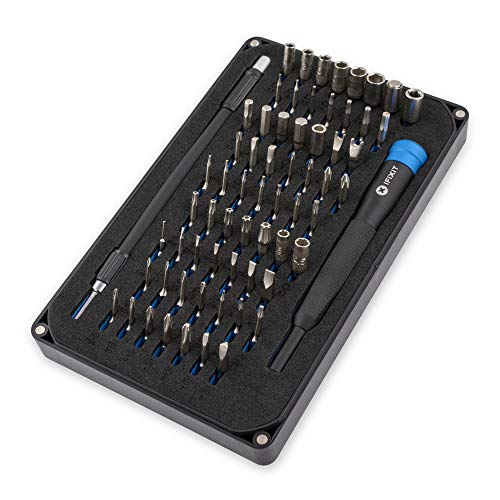 Our pickiFixit Mako Driver KitMost people$40Check price
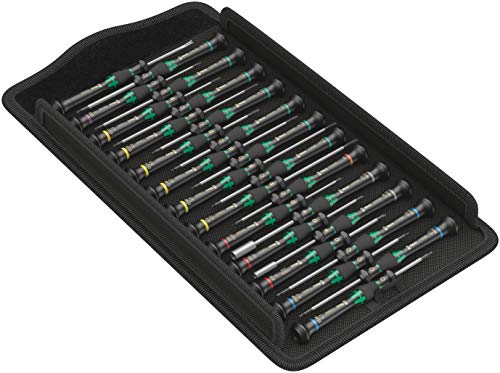 Wera Kraftform MicroWorking on things often$101Check price
Why screws strip, and how to not do it
A Phillips screw is designed to cam out — the bit rises out of the head under load — which was originally a feature to prevent over-tightening. In a soft, small screw it is also exactly how heads get rounded.
Three things prevent it.
The right size bit. PH0 in a PH00 screw feels like it fits and is not. It sits high, contacts only the top of the cross, and rounds it out. If a bit rocks at all in the head, it is the wrong one.
Downward force. Most of the effort should be pushing into the screw, not turning it. Roughly seventy percent down, thirty percent rotation is the usual guidance, and it is why a handle you can push through matters.
Bit hardness. A soft bit deforms slightly under load, which makes the fit worse, which makes it strip the next screw. Cheap sets fail this way after a few uses and start damaging screws they used to turn fine.
What a spinning cap is for
Every decent precision driver has a cap at the end of the handle that rotates freely. It is not decoration.
You rest your palm or index finger on the cap and press down, while your other fingers spin the knurled handle. That separates the two forces: constant downward pressure from your palm, rotation from your fingers.
With a fixed handle you have to grip and twist at the same time, which means the downward force fluctuates every time you re-grip — and every fluctuation is a chance for the bit to cam out and round the head.
It is a small mechanical detail that makes a large difference on soft screws, and it is one of the clearest ways to tell a real precision driver from a toy.
 Enough for one build
ORIA 61 in 1 Precision Screwdriver Set with 57 Bits
A large bit set at a price that makes it hard to argue with, and for assembling one keyboard it will do the job. The coverage is genuinely broad — Phillips, flathead, Torx, hex and the security bits you occasionally meet — and the bits are magnetic, which matters more than it sounds when a screw disappears into a closed case. The handle has a spinning cap. Where it shows its price is bit hardness: these deform faster than hardened bits under load, and a deformed bit fits worse, which is how a cheap set starts stripping screws it used to turn cleanly. Fine for a build or two. If you expect to open things regularly, buy once and buy better.
What's good
- Very broad bit coverage for the price
- Magnetic bits — fewer lost screws
- Spinning cap on the handle
- Fine for one or two builds
What's not
- Softer bits deform with use
- Deformed bits start stripping screws
- Case is flimsy
- Not for regular work
 Best for most people
iFixit Mako Driver Kit
The set that people who open electronics for a living tend to own, and the reason is bit quality rather than bit count. The bits are properly hardened, so they hold their shape under load instead of deforming and quietly getting worse at fitting — which is the failure mode that makes cheap sets start damaging screws. Sixty-four bits covers essentially anything a keyboard, a laptop or a console will present. The driver has a good spinning cap and a comfortable knurled grip, and the case actually keeps bits in place rather than scattering them. It is three times the budget set. If you expect to build more than one board or open anything else, that is straightforwardly worth it.
What's good
- Hardened bits keep their fit
- Covers keyboards, laptops, consoles
- Excellent handle and spinning cap
- Case holds bits properly
What's not
- Three times the budget set
- More bits than a keyboard needs
- No fixed drivers for heavy torque
- Overkill for a single build
 Best for frequent work
Wera Kraftform Micro Screwdriver Set
Fixed drivers rather than a bit-and-handle system, and that is the meaningful difference: with a bit driver there is always a small amount of play where the bit meets the socket, and a one-piece driver has none. On very small, very soft screws that missing play translates into a more positive fit and less chance of camming out. The steel and the tip machining are excellent, and the handles are among the most comfortable made. The costs are real: it is many times the price, fixed drivers cover far fewer sizes than a bit set, and it will not have the Torx or security bits a bit kit gives you. Buy it if you work on small electronics constantly and want the best fit available.
What's good
- No bit play — the most positive fit
- Outstanding steel and tip machining
- Very comfortable handles
- Effectively permanent
What's not
- Many times the price
- Covers far fewer sizes than a bit set
- No security or Torx coverage
- Wrong buy for one keyboard
Aim for roughly seventy percent downward force and thirty percent rotation. Most stripped screws come from turning hard while pressing lightly, which lets the bit ride up out of the head. Rest your palm on the spinning cap, press, and let your fingers do the turning — the cap exists precisely so you can do both at once.
If a screw is already stripped
It happens. A few things that work, roughly in order of how much you should try them.
A rubber band. Lay a wide flat elastic band over the screw head and press the driver through it. The rubber fills the rounded recess and can give just enough grip. Costs nothing, works surprisingly often.
A larger flathead. Sometimes a flat bit will catch across the remains of the cross where a Phillips no longer can.
Screw extractor bits. Small reverse-threaded bits that bite into the head as you turn anti-clockwise. Effective, and worth owning if you build regularly.
What not to do is keep turning with the bit that stripped it. Every additional attempt removes more metal and makes every later method less likely to work.
Before you buy
Check the set covers PH00, PH0 and PH1 — that is most keyboard screws.
Hardened bits matter more than bit count.
Make sure the handle has a freely spinning cap.
Magnetic bits save a lot of time fishing screws out of cases.
If a bit rocks in the head, stop and find the right size.
Screwdriver questions
What screwdriver size do mechanical keyboards use?
Why do keyboard screws strip so easily?
What is the spinning cap on a precision screwdriver for?
How do I remove a screw that is already stripped?
Buy hardened bits and a handle with a spinning cap, and the stripped-screw problem largely disappears. The iFixit Mako is the right set for most people — properly hardened bits, coverage for anything you will open, and a case that keeps them in order. The ORIA set is fine if you are building one board and want to spend as little as possible. The Wera drivers are for people who open small electronics constantly. And push harder than you turn.
Ready to actually do it?
The first mechanical keyboards quest takes an evening, and it tells you whether the gear was worth it better than any review can.
Start Mechanical KeyboardsThe HobbyStack editorial team researches each guide against manufacturer specifications, published resources and practitioner sources. Every product is checked for availability and described against its current listing before publication, and prices are re-checked when guides are updated.
About our editorial process →More gear guides
All guides
Best Beginner Mechanical Keyboard 2026: Redragon vs GMMK Pro vs Keychron Q1 Pro
Mechanical keyboards are one of the deepest hobbies on the internet: infinitely customizable, surprisingly affordable to start, genuinely improves the typing experience. Hot-swap is the must-have feature. Here are the three boards worth buying as a beginner.

Best Mechanical Keyboard Kit (2026): Finished, Hot-Swap or Barebone
The word "kit" hides a big difference. One of these arrives finished and ready to type on, one arrives as a board with sockets and no switches or keycaps at all, and the gap between them is about eighty pounds of parts you have not bought yet. Working out which one you want is most of the decision.

Best Beginner Fountain Pen (2026): A Japanese Fine Is Not a European Fine
The most common first disappointment with a fountain pen is a line that comes out narrower than expected, and it is not a fault. Japanese nibs are ground finer than European ones at the same letter, so a Pilot Fine is roughly a Lamy Extra Fine. Knowing that before you order decides whether the pen feels right.

Best Fountain Pen Ink (2026): Almost Everything Is Safe, and a Few Things Are Not
The pleasant surprise about fountain pen ink is that a bottle costs less than a decent lunch and lasts a year or more, so this is a hobby where experimenting is genuinely cheap. The unpleasant surprise is that two categories of ink will wreck a pen permanently, and one of them is sold in the same shop aisle.

Best Fountain Pen Paper (2026): Feathering Is a Paper Problem, Not a Pen Problem
A new fountain pen that writes a furry, spreading line on office paper is not faulty. Copier paper is barely sized, so wet ink wicks along the fibres and spreads outward from the stroke. The same pen on properly sized paper lays a crisp line, and nothing about the pen changed.

Best Coin Collecting Books (2026): Learn to Grade Before You Learn Prices
A coin price guide is useless until you can grade. The same 1909 cent might be worth a few dollars or several thousand depending on condition, and every figure in every price book is quoted per grade. Learning to read the prices before you can judge the coin is how people overpay confidently.