Best DJ Headphones (2026): Loud Rooms, One Ear, and a Cable That Survives
DJ headphones are not judged the way listening headphones are. You are cueing a track against a loud room, usually with one ear on and one off, often with the headphones half-hanging off your head, and the pair that wins is the one that isolates well and does not break at the cable. Sound quality matters less than either of those.
HobbyStack may earn a commission from links on this page at no extra cost to you. Our picks are chosen on merit; the commission helps fund the research.
- Isolation beats fidelity. If you cannot hear the cue over the room, nothing else matters.
- Closed-back, always. Open-back headphones leak and let the room in.
- A detachable cable is the difference between a repair and a replacement. Cables fail first.
- Single-sided cables suit one-ear monitoring, which is how most DJs actually cue.
- Do not mix on DJ headphones. They are shaped for cueing, not for judging a mix.
 Sony MDR-7506Doing everything$100Check price
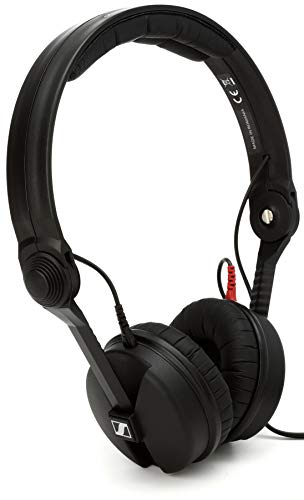 Our pickSennheiser HD 25Actual DJing$130Check price
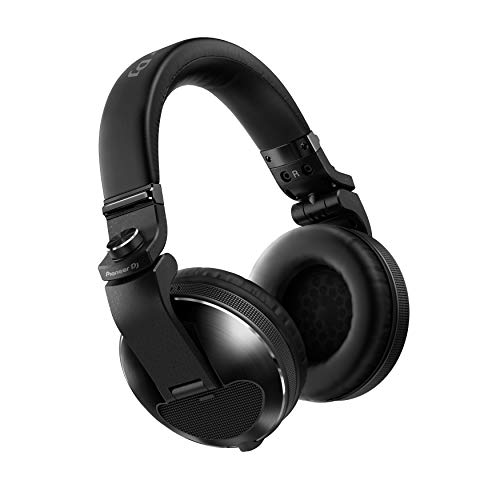 Pioneer DJ HDJ-X10Loud booths and touring$449Check price
Isolation is the actual specification
Everything else about a DJ headphone is downstream of one question: can you hear the track you are cueing over the room you are standing in?
A club runs loud enough that a headphone which merely sounds nice becomes useless. You end up cranking the cue volume to compete, which is both how DJs damage their hearing and how they still fail to beatmatch reliably.
So: closed-back, which physically seals against the room. Open-back headphones sound wonderful at home and are the wrong tool entirely here, because they let the room in and leak your cue out.
Clamping force is part of isolation too, and it is a real trade. A tight clamp seals better and gets uncomfortable after two hours; a loose one is comfortable and lets the room in.
On-ear versus over-ear is the other half. Over-ear seals more completely and gets hot. On-ear is cooler and easier to flip one cup, which is how most people cue, and it is why the HD 25 has survived as a standard for decades despite being small and unglamorous.
The cable is what actually breaks
Ask anyone who has replaced headphones about how they died, and it is almost never the drivers. It is the cable, at the point where it enters the cup or the plug, from being yanked, trodden on, wound tightly and pulled sideways a thousand times.
So a detachable cable is not a convenience feature. It is the difference between a fifteen-pound repair and buying new headphones.
This is the one real weakness of the Sony: its 9.8-foot cable is not detachable, so when it fails — and it will — you are soldering or replacing. Plenty of people do resolder them, and the headphones are cheap enough that some just buy another pair, but it is worth knowing before you choose.
Single-sided cables, where the wire enters only one cup, are the DJ preference. With a cable on one side only there is nothing dangling on the ear you have flipped off, and nothing to catch on a mixer when you swing a cup up.
Also check replacement pads. Earpads flake and compress within a couple of years, and a pair you can re-pad lasts twice as long.
 Best all-rounder
Sony MDR-7506 Professional Headphones Level 2 190839079527
A studio monitoring headphone that ended up in every broadcast van, edit suite and DJ booth in the world, mostly by being reliable and honest. Closed-back with 40mm neodymium drivers, a fairly flat response that tells you what is actually in the recording, and enough isolation to work in a busy room. They fold flat into the supplied case, which matters more than it sounds when they live in a bag. The catch is the cable: 9.8 feet, coiled, gold-plated plug, and permanently attached, which is precisely the part that fails. Buy these if you also record or edit, because they do that job well too. Buy something else if they are purely for the booth.
What's good
- Honest, flat response — good for editing too
- Closed-back with solid isolation
- Folds into the supplied case
- Replacement pads are cheap and everywhere
What's not
- Cable is not detachable, and cable is what fails
- Coiled cable is heavy and catches on gear
- Not single-sided, so it dangles when you flip a cup
- Clamps loosely compared to a dedicated DJ pair
 Best for actual DJing
Sennheiser Pro Audio Professional HD 25 On-Ear DJ Headphones
The headphone that has been the booth standard for decades, and it is worth understanding why, because it is not sound quality. It is on-ear, very light, clamps hard, handles extremely high volume without distorting, and has a detachable single-sided cable — so nothing dangles on the ear you have flipped, and when the cable dies you replace the cable. The split headband lets you wear one cup on your ear and the other on top of your head, which is a DJ-specific solution to a DJ-specific problem. Every part is available separately, which is the real story: people keep these running for fifteen years. Honest limits: on-ear pressure gets tiring, and they are not the most pleasant thing to simply listen to music on.
What's good
- Detachable single-sided cable — the failure point is fixable
- Handles very high volume without distorting
- Split headband suits one-ear cueing
- Every part sold separately, so they last for years
What's not
- On-ear clamp gets tiring over hours
- Not a pleasant casual listening headphone
- Small pads mean less isolation than an over-ear
- Plain, almost austere build
 Best for loud booths
Pioneer DJ HDJ-X10 Flagship Over-Ear DJ Headphones
Pioneer's flagship, and the case for it is specific: 50mm drivers, high sound insulation aimed at the loudest rooms, and MIL-STD-810 shock testing, which is a durability standard rather than a marketing line. Over-ear, so it seals more completely than the HD 25 and stays comfortable across a long set where an on-ear clamp would have you taking them off. The cable detaches. If you play real rooms on real systems regularly, the isolation is the thing you are buying and it does make cueing easier at volume. If you are learning at home or playing small rooms, you are paying three times the HD 25 for isolation you do not need and detail that gets lost in a booth anyway.
What's good
- 50mm drivers with strong isolation for loud rooms
- MIL-STD-810 shock tested
- Over-ear comfort across a long set
- Detachable cable
What's not
- Three times the HD 25 for a real but narrow gain
- Over-ear gets hot under lights
- Bulky to carry compared to the HD 25
- Overkill for home practice or small rooms
Poor isolation makes you turn the cue up to compete with the room, and headphone volume at that level does permanent damage fast — the more so because you are already in a loud environment. Good isolation lets you cue quieter. Wear proper musicians' earplugs in loud rooms too: they lower the volume without muffling the detail, so you can still hear what you are doing.
Cueing headphones are not mixing headphones
A headphone shaped for a booth is deliberately not neutral, and that is the right choice for the job — but it makes them the wrong tool for a different one.
Cueing means finding a beat, matching a tempo and hearing the low end clearly against a loud room. That rewards emphasised bass, strong isolation and high volume handling.
Mixing and mastering means judging whether a track is balanced, which requires a flat response and hearing the room the way a listener would. Bass-forward headphones will have you cutting low end that was never too loud.
So if you also produce, keep them separate: DJ headphones for the booth, something flat for the studio, and check your mixes on a cheap speaker and in a car as well. The Sony sits closest to both jobs, which is a large part of why it is still everywhere.
Before you buy
Closed-back only. Open-back is the wrong tool.
Detachable cable if you can. It is the part that fails.
Check replacement pads exist. They flake within a couple of years.
Single-sided cable if you cue with one ear, which most people do.
Do not judge your mixes on them.
DJ headphone questions
What makes DJ headphones different from normal headphones?
Can I use studio headphones for DJing?
Why does a detachable cable matter?
Should I mix on my DJ headphones?
The Sennheiser HD 25 is the pick for anyone actually DJing, and has been for decades — light, loud, single-sided detachable cable, and every part replaceable, so a pair lasts years rather than seasons. The Sony MDR-7506 is the better buy if you also edit or record and want one pair for both, provided you accept a fixed cable. The Pioneer earns its price only in genuinely loud rooms. Whatever you choose: closed-back, and cue quietly.
Ready to actually do it?
The first djing quest takes an evening, and it tells you whether the gear was worth it better than any review can.
Start DJingThe HobbyStack editorial team researches each guide against manufacturer specifications, published resources and practitioner sources. Every product is checked for availability and described against its current listing before publication, and prices are re-checked when guides are updated.
About our editorial process →More gear guides
All guides
Best DJ Controller for Beginners (2026): Mix Out of the Box
A DJ controller is an all-in-one setup, two decks, a mixer, and a sound card in one unit, that plugs into your laptop and lets you actually mix out of the box with the included software. For a beginner the key thing is that it works with pro software (rekordbox or Serato) so your skills carry over to club gear. Here are three good ones, from a learning-focused controller to a 4-channel step up.

Best Powered Speakers for DJing (2026): 3 Picks for Beginners
Powered speakers (also called active speakers) are the simplest way to actually hear your mixes out loud: the amplifier is built into the cabinet, so you just plug your controller in and go, with no separate amp to buy or match. For a beginner DJ the things that matter are whether it is active, the size (12 or 15 inch), and the wattage, and the honest truth is you want two of them for proper stereo sound. Here are three good ones, from an affordable Mackie to a QSC that is a genuine industry standard.

Best Hot Glue Gun for Cosplay (2026): High Temperature Melts EVA Foam
Most buying guides assume the most powerful option is the best one. Cosplay inverts that. EVA foam, the material most armour is built from, deforms and melts at the temperature an industrial glue gun runs at, so the 220 watt professional gun is the wrong tool for the job people most often buy it for.

Best Rotary Tool for Beginners (2026): 3 Dremel Kits for Crafts and Cosplay
A rotary tool is the little handheld workhorse that sands, grinds, cuts, engraves, and polishes almost any material, which is why it is a staple for cosplay, model-making, jewelry, and general crafting. For a first one the honest advice is simple: buy a real Dremel. The cheap copies wobble, overheat, and lose power under load, while a genuine Dremel is smooth, holds its speed, and takes the huge range of accessories you will actually want. The three here climb Dremel's own lineup, from a capable entry kit to the flagship.

Best Voice Recorder for Actors (2026): Hearing Yourself Is the Whole Point
Actors improve fastest by hearing themselves, because the performance you feel giving is not the performance that arrives. A recorder makes that gap visible — the rushed line, the dropped ending, the habit you did not know you had. What surprises most people is that the room you record in matters more to the result than the device you record with.

Best Beginner Drum Kits: Electronic vs Acoustic and What to Buy First
For most beginners the real decision is not which kit: it is electronic or acoustic, and that usually comes down to how much noise your home can take. Here are the three kits worth buying, how we chose them, and what to expect once you start playing.